
5 Deadly Hiker Hazards and How to Respond
Understanding Fear of Wildlife and How to Stay Safe
It’s not your fault you’re afraid of snakes. Really: A 2001 Gallup poll found that a whopping 56 percent of Americans are nervous around the slithery critters, topping other common fears like public speaking, heights, and the dark. As far as science can tell, that fear is inborn—a holdover from the ancient past, when antivenom and hospitals were nonexistent and a bite from a venomous species was more likely to be fatal than not.
But like many of our fears, our nervousness around snakes and other wildlife doesn’t necessarily match up with reality. Wild animal attacks on humans are rare: According to a 2019 paper from Utah State University, about 47,000 people in the United States seek medical attention because of a bite from a wild animal every year, with just 8 of those dying as a result. (To put that into context, more than 400 people die each year after running into an animal in their cars, so you’re less likely to be injured by a critter on the trail than on your commute.)
Whether it’s snakes, bears, or something else, you don’t need to let your fear of a spicy encounter with wildlife affect your peace of mind on the trail. A little knowledge goes a long way: We profiled 5 of the most hazardous animals that hikers can expect to encounter in the U.S., and break down how often attacks happen, why, and what you can do to coexist peacefully.
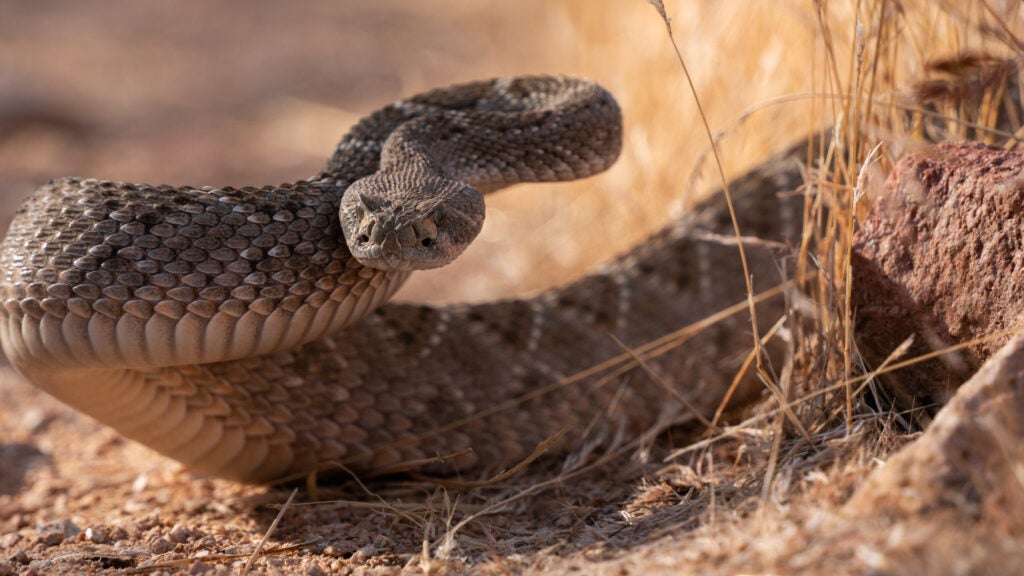
Rattlesnakes
Rattlers are a common sight on trails around the U.S., especially in the arid southwest, where hikers may encounter them basking in open areas or taking shelter under rocks. But for how widespread they are, bites are very rare: According to the Natural History Museum of Los Angeles County, they and the other three groups of venomous snakes in the U.S.—cottonmouths, copperheads, and coral snakes—collectively bite 7,000 to 8,000 people every year—0.0025 percent of the U.S. population. Only about 5 of those people die, meaning that your chances of death by snakebite are roughly a quarter of your chances of death by lightning.
What to Do If You See (or Hear) a Rattlesnake
First off: don’t touch it. That may sound like a no-brainer, but a majority of snakebites—two-thirds, according to one study from researchers in West Virginia—are “illegitimate,” meaning the person in question provoked or tried to handle the snake. If you hear a rattle, freeze in place immediately to give yourself time to figure out where it’s coming from. Give the snake a wide berth—at least 6 feet, preferably more. Don’t wave your trekking poles at the snake or try to drive it away, as those actions are likely to agitate it more.
Rattlesnakes often (though not always) warn off perceived threats with their eponymous rattle, so leave your earphones out if you’re on a trail where you might encounter them. And look where you’re walking: Step on, not over, rocks, logs, and other obstacles to avoid the chance of accidentally treading on one.
Case Study: Pacific Crest Trail, California
In June 2023, a hiker suffered a bite from a rattlesnake on the PCT near Tehachapi, California while hiking with three other people. The other hikers managed to call for help. Rescuers dispatched by the Kern County Fire Department reached the group on off-road vehicles and gave the bitten hiker first aid until a helicopter was able to airlift them to a hospital, where they made a full recovery.
Bears
Literally and figuratively, bears are larger than life. They’re the biggest predators that most hikers will ever encounter, and because of the attention their attacks on people garner, they have a reputation to match. Numbers-wise, though, they’re even less likely to kill you than a rattlesnake: Grizzlies kill an average of 2 to 3 people per year in North America, while black bears kill fewer than one. Most grizzly attacks are defensive and involve mothers with cubs, while black bears are more likely to be behind predatory attacks. Preventing surprise encounters by making noise, hiking in a group, and keeping dogs on leash can reduce the possibility of a run-in.
What to Do if You See a Bear
Stay calm; form a group with your hiking partners, speak to the bear in a calm, firm voice, and give the bear a chance to leave. If you have bear spray (you should), get it out and get it ready. If the bear charges, deploy your bear spray in a short burst when it’s roughly 50 feet away; your aim is to make a cloud of spray that the animal will have to go through before it reaches you.
If the bear makes contact, what you do next depends entirely on what kind of bear it is. If it’s a black bear, it’s likely trying to make a meal out of you. Try to escape to a car or building—forget about getting up a tree, you can’t climb as well as a black bear—and if that’s not possible, fight back. If it’s a grizzly, the attack is most likely defensive. Lay on your stomach with your hands clasped behind your neck, spread your legs to make it harder to flip you over, and wait for the bear to leave.
Case Study: Anchorage, Alaska
In July 2025, a hiker called 911 and reported that she had been mauled by a brown bear in the Stuckagain Heights area near Anchorage and couldn’t hike out on her own. Firefighters, police officers, and personnel from the Bureau of Land Management and state fish and game agency located the hiker with a drone and evacuated her via helicopter with what they described as non-life-threatening injuries.
Later that week, a brown bear sow mauled another hiker in the same area after his off-leash dog encountered her and her cub. That hiker managed to stop the attack by spraying the bear, then spraying it again after it returned. In comments to the media after the attacks, wildlife officials noted that the encounters happened near a stream where bears congregate to feed on salmon.
Bison
They may look placid, but these kissing cousins of domestic cattle weigh up to a ton, run fast enough to break residential speed limits, and can hit like a truck. They also have a low tolerance for tourists’ foolishness, causing more injuries in Yellowstone National Park than any other animal. The park recorded 25 visitor injuries from bison between 2000 and 2015, though—luckily—no deaths.
What to Do if You See a Bison
Say it with us: Don’t pet the fluffy cows. With some grace for people who encounter bison on twisty, turny trails with low visibility, most bison attacks on hikers are a result of poor decision-making. Stay at least 25 yards away from bison at all times. (Don’t know how far that is? Use the rule of thumb: Stick your hand out at arms length, close one eye, and try to cover the animal with your thumb. If you can see any part of it sticking out, back up.) Bison blocking the trail? Wait, find another route, or give it a wide, wide berth. If a bison charges, your best bet is to run and seek cover behind a solid object.
Case Study: Antelope Island State Park, Utah
In 2019, Kyler Bourgeous was running on Antelope Island near Salt Lake City when he surprised a bison from the park’s resident herd. The animal charged him, leaving him with puncture wounds to his armpit and hip and a fractured rib. In an interview with the CBC, Bourgeous said he had just crested a hill at the time of the encounter, and had not noticed the bison until he was “way too close.”
A few months after the incident, Bourgeous went back to Antelope Island with a date, Kayleigh Davis. Their plan was for Davis, who was training for a half-marathon, to run a trail in the park and then meet up for the sunset. In a cruel coincidence, Davis also got attacked by a bison, sustaining a broken ankle and a deep cut to her calf.
Cougars
Puma, cougar, mountain lion, catamount: Call them what you want, but this large feline’s ability to move silently through the forest and penchant for ambushing its prey inspires a level of fear in hikers that far outstrips its actual danger. In the past 135 years, cougars have only been responsible for 130 attacks and 28 fatalities on people in North America. Most of those unlucky people have been lone children or adults, though a small minority were pairs or trios spread out enough that the cat likely didn’t see them as part of a group.
What to Do if You See a Cougar
Spotting a cougar is very rare. Like most of their relatives, mountain lions generally don’t like to face off with their prey, and mostly avoid people. Prevention is important: If you’re in an area with mountain lion activity, travel in a group, especially if you’re trail running or biking, which may provoke the cat’s chase instinct.
In the exceptional event you encounter a cougar, don’t run or bend over, both of which may trigger an attack. Instead, make yourself as big as possible by raising your arms, lifting up children, and opening your jacket. Face the cat and speak firmly and loudly—your goal is to convince it you’re not prey. In the extremely unlikely event of an attack, fight back with rocks, sticks, bear spray, or your fists and feet.
Case Study: Georgetown, California
In March 2024, brothers Taylen and Wyatt Brooks were shed hunting when they encountered a cougar. While the two made themselves as large as possible and shouted, the cougar attacked them, pouncing on Wyatt first. The pair fought back, and the cougar turned on Taylen, grabbing him by the throat. Wyatt first attempted unsuccessfully to get the cougar off of his brother, then ran to his truck to look for cell service to call 911. When officers arrived, they found the cougar guarding Taylen, who was deceased; wildlife officials later trapped and euthanized the animal. The incident was California’s first fatal mountain lion attack in 20 years.
Alligators
In the mid-20th century, gators were so rare in Florida that they were listed as endangered. Since then, the species has undergone a remarkable recovery: Today, there are an estimated 1.3 million alligators across all 67 of Florida’s counties, and they’re a common sight everywhere from the depths of the Everglades to roadside ditches. Your odds of getting chomped are still low, though: Between 1948 and 2024, 487 people suffered unprovoked bites from gators, of which just 27 died.
What to Do if You See a Gator
The power is in your hands here: Your odds of having a run-in with an alligator are much higher in the water than they are on land, and one study from University of Florida and Kentucky’s Centre College found that 96 percent of incidents were preceded by people taking unnecessary risks like walking dogs near bodies of water or swimming in lakes or rivers where not allowed.
But what if you do find an alligator on or by the trail you’re hiking? First off, keep your distance—at least 30 feet. If the gator hisses at you, it thinks you’re too close. If one does run at you, book it: While alligators are quick, they have poor endurance on land and will almost always give up the chase once you’ve vacated their space. Use extra caution around bodies of water at dawn, dusk, and during the night, when gators tend to be more active. In the extremely rare event that one attacks, fight back, targeting the eyes and nose, until it lets go.
Case Study: Everglades National Park, Florida
In 2020, an 18-year-old college student was hiking in the Everglades with her professor and 14 other students. While wading along a flooded trail near the Pahayokee Overlook, a female alligator grabbed the student by her lower right leg. NPS spokesperson Allyson Gantt told press that the student had sustained two small “low-pain” puncture wounds. Gantt noted that the trail is popular with hikers and that alligator attacks there are extremely rare, and reminded visitors that the park recommends against swimming.

Posting Komentar untuk "5 Deadly Hiker Hazards and How to Respond"
Posting Komentar