
AI Dominates Earnings Season: The Only Game in Town
The AI Revolution Is Reshaping the Economy
As we approach the midpoint of the second-quarter earnings season, one truth is becoming increasingly clear: artificial intelligence (AI) is no longer just a buzzword. It’s the driving force behind some of the most significant growth stories in modern business. From cloud computing to healthcare, retail, and law enforcement, AI is transforming industries at an unprecedented pace. This rapid expansion has created what many are calling a 'technochasm'—a growing divide between those who are leveraging AI and those who are not.
This wealth gap is expanding rapidly, with tech companies that embrace AI seeing exponential growth while others struggle to keep up. If you’re not investing in AI, you're essentially betting against the future of economic growth. The stakes have never been higher, and the message is clear: AI isn’t just part of the story—it’s the story.
Alphabet's AI Engine Powers Explosive Growth
Alphabet, the parent company of Google, delivered a standout performance in its latest earnings report. Revenue far exceeded expectations, and profits surged. But what truly set this quarter apart was how AI has become the core driver of growth across all of Alphabet’s major business units.
Google Cloud saw a 32% year-over-year increase in revenue, fueled entirely by demand for AI compute. Meanwhile, search and YouTube ad revenues posted their strongest growth rates in several quarters. This is because AI is making these platforms more efficient, leading to higher revenue per user, per click, and per second.
Alphabet’s AI video platform, Veo3, has already generated over 70 million videos in just two months. Its Gemini AI product now has over 450 million monthly active users, with daily requests increasing by 50% from the previous quarter. These numbers reflect the exponential usage of AI technologies.
In response to this demand, Alphabet raised its capital expenditure guidance by another $10 billion. The company simply can’t build AI infrastructure fast enough to meet current needs, signaling confidence in the long-term potential of AI.
Microsoft’s AI Ecosystem Sets New Records
Microsoft also delivered impressive results during the earnings season. Azure, its cloud business, experienced 39% year-over-year growth—the best performance since early 2024. And this growth is almost entirely driven by AI.
Microsoft Fabric, the company’s AI data platform, saw a 55% increase in revenue. With over 25,000 customers, it has become the fastest-growing database product in Microsoft’s history. That’s a powerful indicator of the shift happening in the tech industry.
Microsoft’s Copilot, its flagship AI assistant suite, now has over 100 million monthly active users. In fact, more than 800 million people use a Microsoft AI product at least once a month. This isn’t just about new products—it’s about a fundamental platform shift, and Microsoft is leading the charge.
Meta’s AI Strategy Delivers Triple Returns
Meta’s AI strategy is delivering triple returns through engagement, ad dollars, and hardware adoption. Time spent on Facebook grew by 5%, and Instagram saw even better numbers, with engagement up 6%. These gains are directly tied to AI-powered content ranking improvements.
Meta’s AI ad engine boosted conversion rates by 3% on Facebook and 5% on Instagram—significant numbers in the digital advertising world. Additionally, Meta AI, the company’s consumer-facing chatbot, now has over 1 billion monthly active users.
Meanwhile, sales of the Ray-Ban Meta smart glasses have tripled over the past year, with demand outpacing supply. This signals a strong trend in the consumer AI market.
AI’s Impact Across Industries
AI isn’t just changing how people interact with apps—it’s reshaping entire industries. For example, Intuitive Surgical, a maker of surgical robots, reported 14% growth in AI-powered robot installations and 21% revenue growth. Hospitals are adopting AI faster than medical schools can update their curricula.
Lemonade, an AI-driven insurance disruptor, saw 24% customer growth and 35% revenue growth, proving that AI is winning even in heavily regulated sectors. Aurora, an autonomous trucking startup, completed over 20,000 miles of driverless travel between Dallas and Houston and is expanding to Arizona.
Behind the scenes, companies building AI infrastructure—including chipmakers, cooling solutions providers, and networking firms—are reporting some of their strongest quarters ever.
AI Software Spending Surges
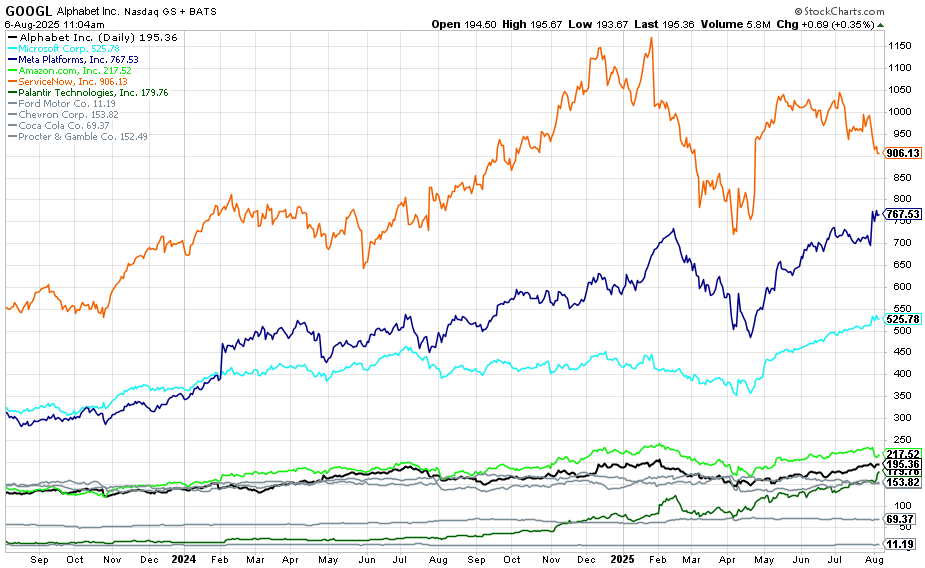
While infrastructure is crucial, the software side of AI is equally transformative. Enterprise software companies like ServiceNow and Palantir are seeing explosive growth as businesses adopt AI to enhance productivity.
ServiceNow’s revenue grew over 20%, driven by high demand for AI software. The number of AI deals surged by 50%, and the company landed its largest AI contract yet—a $20 million deal for its Now Assist platform.
Palantir reported nearly 50% revenue growth in Q2, surpassing $1 billion in quarterly revenue for the first time. The company closed 157 deals worth over $1 million, with 42 of them exceeding $10 million. This demonstrates the growing demand for AI solutions across industries.
Amazon’s Physical AI Transformation
While much of the AI conversation focuses on software, the physical transformation is just as powerful. Amazon is a prime example of how AI is redefining legacy business models.
The company’s e-commerce revenue rose 11%, and retail margins hit fresh highs. Net sales reached $167.7 billion, up 13% year-over-year. Operating income hit $19.2 billion, with an operating margin of 11.4%.
This success is driven by robots. Amazon recently deployed 1 million robots in its warehouses, optimizing throughput, slashing costs, and turning warehouses into highly efficient cash generators.
The Future of AI Is Here
Earnings season has made one thing abundantly clear: all the growth in today’s economy is happening within the AI ecosystem. Everything else is just noise.
AI is boosting productivity, supercharging revenues, and widening profit margins. It’s creating new markets, changing how work is done, and reshaping decision-making across every industry.
We are in the middle of the most profound platform shift in human economic history. If you want to capture this growth and secure your financial future, there’s only one move to make: go all-in on AI.
And now’s the time to act. AI’s next phase is moving from theory to reality, with new developments expected to reshape the physical world. This will mark a “Day Zero” moment for investors, potentially unleashing a $20 trillion economic wave.
The opportunity is here, and the time to act is now.

Posting Komentar untuk "AI Dominates Earnings Season: The Only Game in Town"
Posting Komentar