
ASML vs. AMAT: Which Semiconductor Giant Offers More Value?
Key Players in the Semiconductor Equipment Industry
ASML Holding and Applied Materials (AMAT) are two of the most prominent companies in the semiconductor equipment industry. Both play essential roles in the chipmaking process, but they specialize in different areas. ASML is a global leader in lithography systems, particularly in high-end extreme ultraviolet (EUV) technology, which is critical for manufacturing advanced chips used in AI accelerators, high-performance computing, and smartphones. On the other hand, AMAT has a dominant position in deposition, etching, and process control, providing tools that support multiple stages of the semiconductor production process.
As the semiconductor industry continues to expand due to trends in artificial intelligence (AI), automotive, and cloud computing, investors may be considering which of these two giants offers a better investment opportunity at this time.
ASML: Strong Technology with Near-Term Challenges
ASML Holding is often seen as the most crucial player in the global semiconductor value chain because of its monopoly in EUV lithography. This cutting-edge technology is vital for producing the smallest and most advanced chips. Top customers such as Taiwan Semiconductor Manufacturing, Samsung, and Intel are investing heavily in advanced node development, which keeps demand for EUV systems strong.
Financially, ASML has performed well. In the second quarter of 2025, it reported a 23% revenue increase and a 47% rise in earnings per share. However, management’s recent comments on future growth have raised concerns. Previously, the company had expected continued demand growth in 2026, driven by AI-related chip production. However, during the second-quarter earnings call, ASML stated that it could not confirm growth in 2026, citing customer hesitation and market uncertainty.
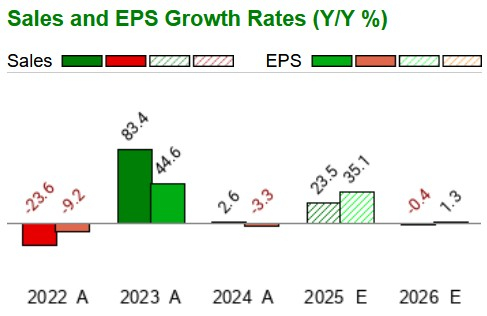
This hesitation may delay orders and revenue recognition into 2026. Additionally, ongoing U.S.-China tariff discussions, including the Section 232 tariff review, are affecting customer capital spending timelines. Analysts are also skeptical about ASML’s 2026 prospects, as reflected in the Zacks Consensus Estimate.
Moreover, ASML issued disappointing guidance for the third quarter, forecasting revenues between €7.4 billion and €7.9 billion. This represents a year-over-year growth of 14.6% at the midpoint, significantly lower than the 46% growth in the first quarter and 23.2% in the second quarter. The gross margin is also expected to decline, from 53.7% in the second quarter to 50-52% in the third quarter, primarily due to margin-dilutive High NA system revenues and fewer upgrade orders.
AMAT: Diversified Portfolio and Solid Performance
Applied Materials benefits from a more diversified product portfolio within semiconductor manufacturing equipment. Unlike ASML, which focuses on lithography, Applied Materials provides tools used across deposition, etch, and metrology processes. This diversification allows the company to better navigate industry fluctuations and capture market share across logic, memory, and packaging markets.
The long-term growth prospects for AMAT remain compelling, especially with the increasing demand for AI-driven semiconductor technology. AI chip demand is driving new investments in semiconductors, and Applied Materials is well-positioned to benefit from this trend. Its expertise in gate-all-around (GAA) transistors, high-bandwidth memory (HBM), and advanced packaging makes it a key supplier for AI chipmakers.
In fiscal 2024, Applied Materials’ revenues from advanced semiconductor nodes exceeded $2.5 billion. Management expects this figure to double in fiscal 2025, driven by growing customer adoption of GAA and backside power delivery solutions.
These factors are fueling both top-line and bottom-line growth for the company. In the second quarter of fiscal 2025, its non-GAAP EPS increased by 14.4%, while revenues rose by 6.8%. The company’s guidance for the third quarter indicates a 6.2% year-over-year revenue growth and a 10.8% increase in non-GAAP EPS.
Analysts are optimistic about AMAT’s near-term performance, as reflected in the Zacks Consensus Estimate for fiscal 2025 and 2026, which shows steady growth momentum.
ASML vs. AMAT: Price Performance and Valuation
Year-to-date, shares of ASML Holding have declined by 0.5%, while Applied Materials has risen by 10.2%. On the valuation front, ASML trades at a forward earnings multiple of 24.33, compared to AMAT’s 18.14X. While both companies are high-quality, AMAT appears more reasonably priced, especially given its stronger near-term momentum.
Conclusion: AMAT Offers Better Value Now
Although both companies are essential to the future of semiconductor manufacturing, Applied Materials stands out as the better investment option at this time. It offers stronger near-term earnings stability, broader product exposure, and a more attractive valuation. ASML remains a long-term winner due to its unmatched lithography technology, but its higher valuation and short-term challenges make it less appealing than AMAT.
Additionally, AMAT carries a Zacks Rank #2 (Buy), making it a clear choice over ASML, which currently has a Zacks Rank #4 (Sell).

Posting Komentar untuk "ASML vs. AMAT: Which Semiconductor Giant Offers More Value?"
Posting Komentar