
Can Coca-Cola's Coffee Move Boost Global Sales?
Coca-Cola's Coffee Ambitions: A Work in Progress
The Coca-Cola Company has long aimed to make a significant impact in the global coffee market. Its acquisition of Costa was intended to open up new opportunities, including store-based retail, ready-to-drink (RTD) formats, and at-home coffee experiences. While the Costa brand has shown strength in physical locations, particularly in the U.K., its expansion into RTD and vending solutions has not met the company’s expectations.
Management has acknowledged that the initial investment hypothesis hasn’t fully materialized, with much of Costa’s growth still concentrated in traditional retail settings rather than diversified platforms. Despite this, Coca-Cola remains committed to the coffee opportunity. The category is large, fragmented, and continues to grow globally, prompting the company to reassess its strategy.
Coca-Cola is focusing on learning from past experiences and exploring new avenues for expansion. Although Costa hasn't performed as expected, it remains a profitable and strategically important brand. The company has prioritized affordability, store refreshment, and speed of service to stabilize Costa’s performance while working on longer-term transformation initiatives.
Looking ahead, Coca-Cola is likely to take a more measured and insight-driven approach to coffee. With existing $30-billion brands and a strong innovation pipeline, the success of Costa’s transformation will depend on its ability to tap into global consumption trends and leverage Coca-Cola’s system capabilities. While the coffee venture hasn’t significantly boosted global sales, it remains a strategic growth lever with untapped potential if execution aligns with evolving consumer behavior.
Competitors in the Coffee Market
Other major players in the beverage industry are also expanding their presence in the coffee market. PepsiCo Inc. (PEP) and Keurig Dr Pepper Inc. (KDP) have been actively building their positions, each leveraging unique brand partnerships and distribution strengths to tap into the high-growth category.
PepsiCo’s coffee presence remains limited, with no direct updates in its second-quarter 2025 remarks regarding new coffee-specific products or partnerships. While PEP continues to see strong growth in segments like zero-sugar sodas, functional hydration, and prebiotic beverages like poppi, coffee is not yet a core focus. However, with an emphasis on expanding in fast-growing beverage categories and improving channel presence, PepsiCo could explore selective coffee innovations or partnerships in the future.
Keurig Dr Pepper’s coffee business showed sequential improvement in the second quarter of 2025, driven by better pod pricing and resilient volume trends. Although brewer shipments remained pressured due to tight retailer inventory, point-of-sale consumption was stable. The company is expanding into premium and cold segments, with Lavazza dessert-inspired K-Cups and La Colombe RTD coffee gaining traction. Despite near-term challenges related to cost and tariff headwinds, KDP remains focused on long-term growth through innovation and next-gen systems.
Financial Outlook for Coca-Cola
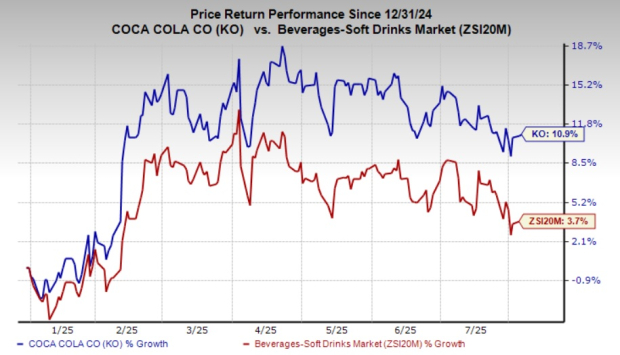
KO shares have risen 10.9% year to date compared to the industry’s growth of 3.7%. From a valuation standpoint, Coca-Cola trades at a forward price-to-earnings ratio of 22.11X, significantly higher than the industry’s 17.39X.
The Zacks Consensus Estimate for KO’s 2025 and 2026 earnings implies year-over-year growth of 3.1% and 8.3%, respectively. Earnings estimates for 2025 have remained unchanged over the past 30 days.
Coca-Cola currently carries a Zacks Rank #3 (Hold). Investors looking for strong buy opportunities can refer to the complete list of today’s Zacks #1 Rank (Strong Buy) stocks.

Posting Komentar untuk "Can Coca-Cola's Coffee Move Boost Global Sales?"
Posting Komentar