
Can We Outdo Trumpian or Neoliberal Trade Policy? Yes.
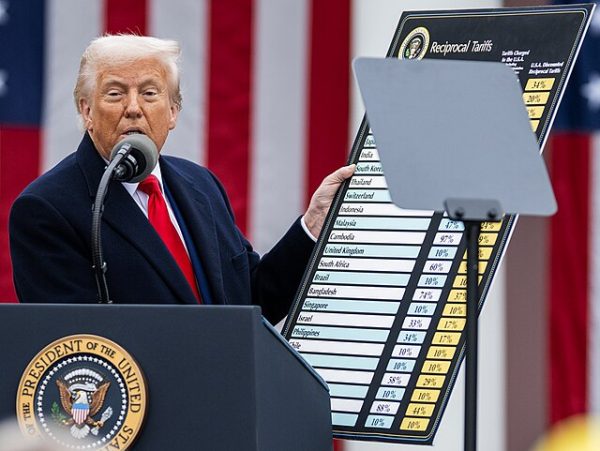
The Impact of Trump's Trade Policies on the U.S. and Global Economy
U.S. President Donald Trump significantly altered the international trading system by moving away from the concept of “free trade” and reintroducing protectionist measures. This shift has led to considerable uncertainty in both the U.S. and global economies, disrupting the traditional left-right divide on international trade. However, as economist Arthur MacEwan explains, there are alternative approaches to organizing international trade that could be more beneficial for workers and society as a whole.
MacEwan, a professor emeritus of economics at the University of Massachusetts Boston, argues that neoliberal regimes and Trumpian tariffs are not the only options for shaping international trade policy. He advocates for a progressive approach that prioritizes worker protection and economic fairness over job preservation or nationalistic policies.
The Limitations of Tariffs
One of the key points MacEwan makes is that tariffs are unlikely to bring back manufacturing jobs or significantly boost U.S. manufacturing output. While the U.S. has faced competition from countries like China, the decline in manufacturing employment cannot be solely attributed to foreign imports. Between 2000 and 2024, manufacturing output increased by only 2.4%, while overall GDP rose by 65%. Meanwhile, the number of manufacturing workers dropped by 26%, largely due to automation and changes in production methods.
Tariffs may seem like a way to protect domestic industries, but they also raise the cost of imported materials, which can hurt U.S. manufacturers. Additionally, tariffs act as a regressive tax, disproportionately affecting low-income individuals who spend a larger share of their income on goods and services. This means that while tariffs might help some industries, they often come at the expense of consumers.
The Traditional Left-Right Divide on Trade
The debate over trade policy has traditionally been framed as a conflict between free trade (often associated with neoliberalism) and protectionism (linked to nationalist policies). However, MacEwan suggests that this divide is not as clear-cut as it appears. Neoliberal trade agreements have often included provisions that favor large corporations, such as extended patent protections and dispute resolution mechanisms that benefit businesses over workers.
On the other hand, many on the left have supported protectionist policies to shield domestic industries from foreign competition. Yet, MacEwan emphasizes that the real issue is not just about protecting jobs, but about protecting workers and their power. A progressive trade policy should focus on supporting workers through strong labor rights, fair wages, and access to education and healthcare.
Alternatives to Free Trade and Protectionism
MacEwan outlines several elements of a progressive trade policy. These include:
- Recognizing the benefits of international commerce, such as access to diverse goods, services, and cultural exchanges.
- Protecting workers rather than specific jobs, ensuring that those displaced by trade or automation have access to support systems like healthcare, education, and retraining.
- Implementing domestic policies that promote fair wages, stronger unions, and social safety nets to support workers during transitions.
- Considering limited use of tariffs in cases where there are ethical concerns, such as products made under exploitative conditions or with environmental harm.
However, he also notes that the justification for such measures must be balanced against the potential costs to consumers and the broader economy.
Labor Shortages in Manufacturing
A recent report highlighted a shortage of manufacturing jobs in the U.S., raising questions about whether the sector is recovering. MacEwan suggests that these claims should be taken with caution. Employers often cite a lack of available workers, but this may reflect low wages, poor working conditions, or a lack of investment in workforce development.
While traditional economic theory suggests that higher wages would attract more workers, employers have instead focused on keeping wages low through automation, union-busting tactics, and offshoring. This has contributed to stagnant wage growth for manufacturing workers, despite rising overall household incomes.
Lessons for the Left
From Trump’s approach to trade, the left can draw several important lessons. First, the focus should be on protecting workers’ rights and power rather than simply preserving jobs. Second, international trade policy must be closely linked to domestic economic strategies, including fair wages, strong labor protections, and accessible education and healthcare.
Ultimately, MacEwan argues that both Trump’s protectionist policies and neoliberal free trade agreements have failed to address the underlying issues of inequality and power imbalances in the economy. A truly progressive trade policy must look beyond these extremes and work toward a more equitable and sustainable model of international commerce.

Posting Komentar untuk "Can We Outdo Trumpian or Neoliberal Trade Policy? Yes."
Posting Komentar