
Cosmic Collisions Create Heavyweight White Dwarfs
A Unique Stellar Remnant Challenges Conventional Understanding
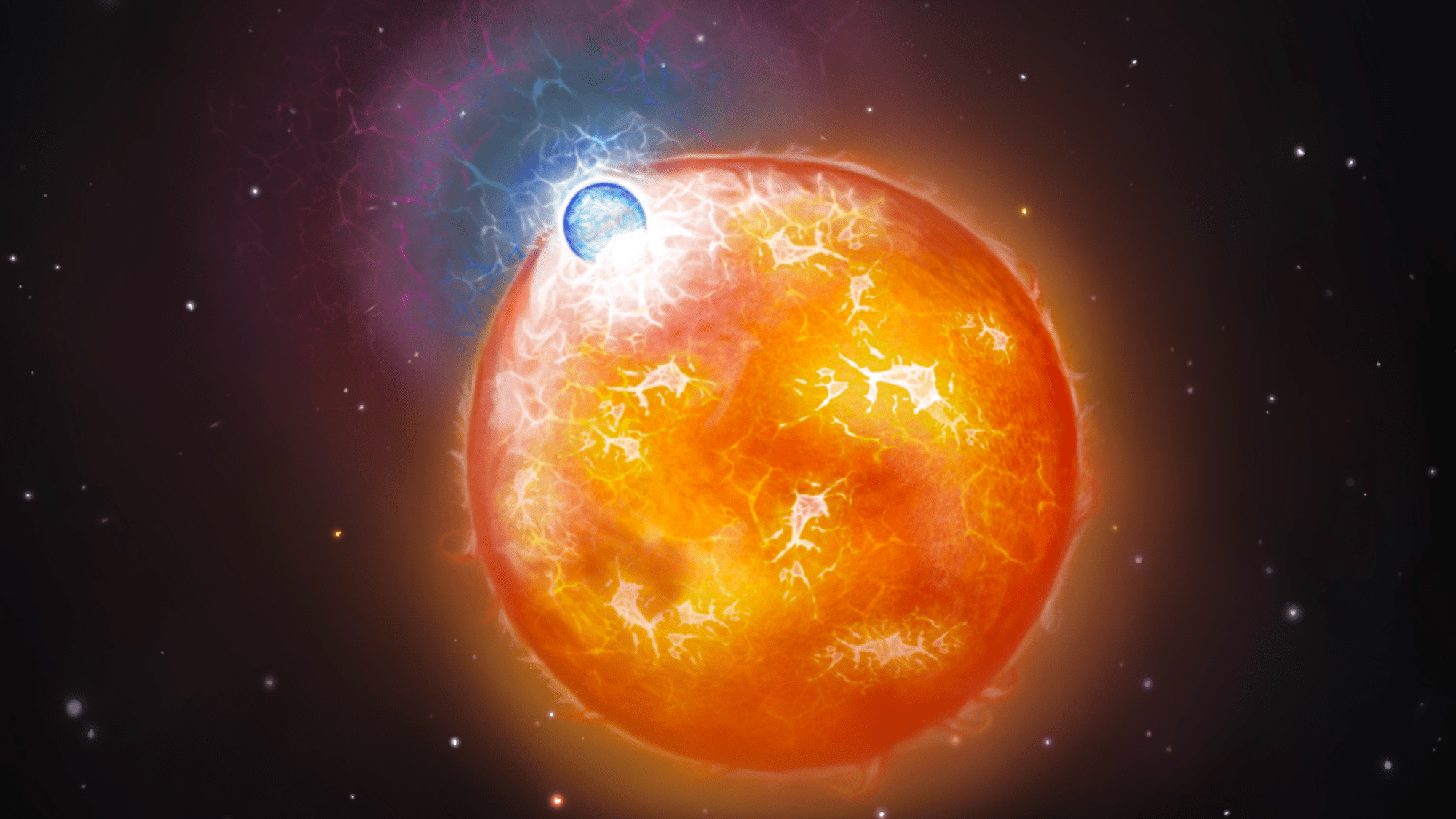
A massive, smoldering stellar remnant located in Earth’s cosmic neighborhood is pushing the boundaries of what we consider a “white dwarf.” This unusual object has captured the attention of astronomers at the University of Warwick, who believe they have uncovered its mysterious origin. After analyzing data from the Hubble Space Telescope, the team suggests that this white dwarf did not form from a single star's demise but rather from the collision of two celestial fusion reactors. Their findings are detailed in a paper published on August 6 in Nature Astronomy.
White dwarfs are among the most common remnants in the universe. These dense, Earth-sized objects are formed when stars exhaust their nuclear fuel and shed their outer layers, leaving behind a core composed primarily of carbon and oxygen. They are typically surrounded by layers of hydrogen and helium. Despite their small size, white dwarfs are incredibly dense, with masses often around half that of the Sun. However, some white dwarfs defy this norm, possessing significantly higher masses.
One such example is WD 0525+526, a white dwarf located 130 light-years away from Earth. It is 20 percent larger than the Sun, making it an "ultra-massive" white dwarf. While it is possible that WD 0525+526 formed from a single massive star, ultraviolet data collected by the Hubble telescope suggests a different story.
"In optical light (the kind of light we see with our eyes), WD 0525+526 looks like a heavy but otherwise ordinary white dwarf," explained Snehalata Sahu, a research fellow at the University of Warwick and the study's first author. "However, through ultraviolet observations obtained with Hubble, we were able to detect faint carbon signatures that were not visible to optical telescopes."
This discovery is significant because typical white dwarfs have their core elements hidden beneath thick layers of hydrogen and helium. But when two stars collide, these layers can be stripped away, revealing a white dwarf with a much thinner hydrogen-helium layer. This allows for the detection of carbon on the surface.
WD 0525+526 is even more peculiar. Not only is its hydrogen-helium layer unusually thin, but it also contains roughly 100,000 times less carbon on its surface compared to similar cosmic mergers.
"The low carbon level, together with the star’s high temperature (nearly four times hotter than the Sun), tells us WD 0525+526 is much earlier in its post-merger evolution than those previously found," said Antoine Bédard, a co-first author of the study and astrophysicist.
Understanding these unique characteristics can provide valuable insights into the fate of binary star systems. These systems often play a crucial role in supernova explosions. However, detecting binary star white dwarfs remains challenging due to their distinctive ultraviolet emissions. Earth's atmosphere blocks much of this light, making space telescopes like Hubble essential for such discoveries.
"[The study] tells us there may be many more merger remnants like this masquerading as common pure-hydrogen atmosphere white dwarfs," said Sahu, emphasizing the importance of ongoing space telescope projects.
"Only ultraviolet observations would be able to reveal them to us," Sahu added. This highlights the critical role that advanced observational techniques play in expanding our understanding of the universe and the complex processes that shape it.

Posting Komentar untuk "Cosmic Collisions Create Heavyweight White Dwarfs"
Posting Komentar