
GR-3 Humanoid Robot Makes Debut with Emotional Awareness and Realistic Movement
A New Era of Human-Robot Interaction
In a world where machines are often seen as cold and unfeeling, Fourier has introduced a groundbreaking innovation that challenges this perception. The company’s latest creation, the GR-3, is more than just a robot—it’s a “Care-bot” designed to listen, respond, and connect with humans in meaningful ways.
Unveiled on August 6, the GR-3 represents a significant leap forward in the field of robotics and artificial intelligence. As the first full-size addition to Fourier’s GRx humanoid robot lineup, it reimagines how humans and robots can interact, emphasizing empathy, emotion, and connection as core values.
A Design Philosophy Rooted in Love
The design philosophy behind the GR-3 is simple yet powerful: “Love, above all functionality.” This guiding principle ensures that the robot is not only functional but also emotionally engaging. Unlike traditional robots built purely for utility, the Care-bot focuses on human-centered service, where emotional interaction is just as important as mechanical precision.
The GR-3 is designed to build emotional rapport in real-world environments, including public spaces, homes, hospitals, and eldercare facilities. Whether offering comfort to a child, acting as a responsive companion to an older adult, or assisting with mobility and health monitoring, the GR-3 introduces a new dimension to what machines can do and feel.
A Robot That Feels Familiar
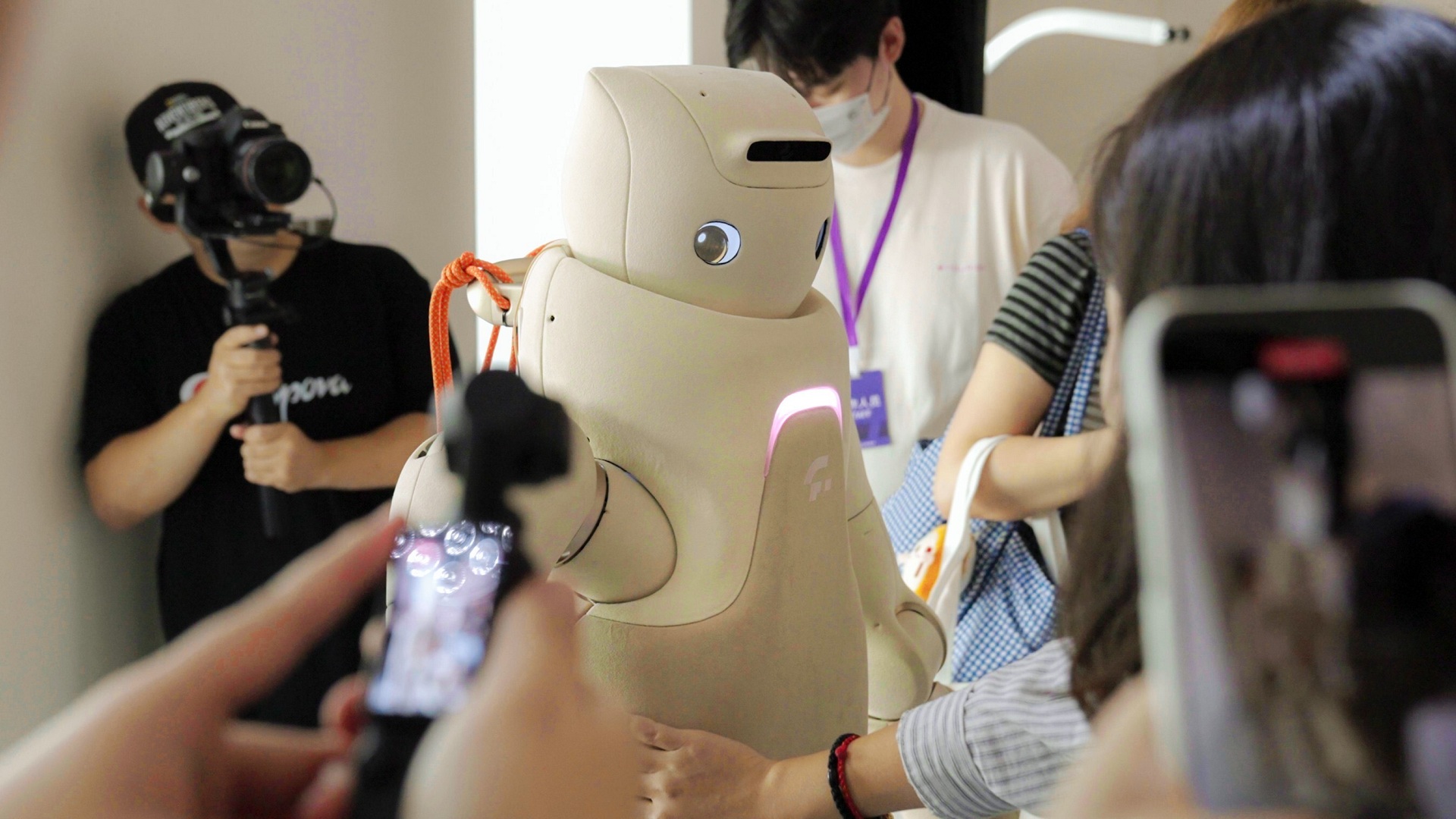
To achieve this level of connection, the GR-3 features a soft-touch shell, warm neutral tones, and premium automotive upholstery. These design choices make the robot feel familiar rather than foreign, helping to ease the transition between human and machine interactions.
Standing at 165 cm tall and weighing 71 kg, the GR-3 boasts 55 degrees of freedom, allowing for balanced and natural movement. Its animated facial interface and fluid gait work together to create a sense of personality and presence, moving beyond the typical robotic detachment.
At the heart of the GR-3’s emotional intelligence is Fourier’s Full-Perception Multimodal Interaction System. This advanced system fuses sight, sound, and touch into a single, real-time emotional engine. It can localize voices using a four-microphone array, make eye contact while you’re speaking, and recognize your face through structured-light cameras.
But the GR-3 doesn’t stop there. With 31 pressure sensors across its body, it can detect touch and trigger lifelike responses such as blinking, eye tracking, or subtle emotional gestures. This means the robot doesn’t just hear and see you—it reacts like it actually gets you.
Empathy in Every Circuit
What truly sets the GR-3 apart is its dual-path response architecture. This hybrid system allows the robot to handle both reflexive, rule-based responses and complex, contextual conversations. “Fast thinking” manages immediate reactions, while “slow thinking” draws on a large language model to engage in deeper, more nuanced interactions.
This approach enables the GR-3 to interpret emotion, recognize intent, and respond with awareness—bridging the gap between perception and connection. The robot adapts not only to tasks but also to tone, body language, and emotional cues, making every interaction more natural and meaningful.
Ready for the Real World
The GR-3 is also built to thrive in real-world environments. It features a hot-swappable battery system, intelligent power management for continuous operation, and locomotion modes that allow it to squat, bend, and even adopt expressive gaits like “bouncy walk” or “fatigue mode” based on the environment.
Fourier isn’t positioning the GR-3 as just a product; it’s laying the groundwork for a platform. Its modular structure, developer-friendly APIs, and support for third-party algorithms make it customizable for researchers, caregivers, and service industries alike.
A Step Toward Human-Robot Integration
The GR-3 marks a new phase in Fourier’s pursuit of human-robot integration. Every aspect of its design—from hardware architecture to software framework—was shaped by a key question: Can a robot be genuinely accepted in human environments?
With the GR-3, Fourier is betting the answer is yes—and that the future of robotics might just be a little more human.

Posting Komentar untuk "GR-3 Humanoid Robot Makes Debut with Emotional Awareness and Realistic Movement"
Posting Komentar