
How Utah Shapes Apple's New Chip-Making Bet
Apple’s Expansion of U.S. Manufacturing Investments
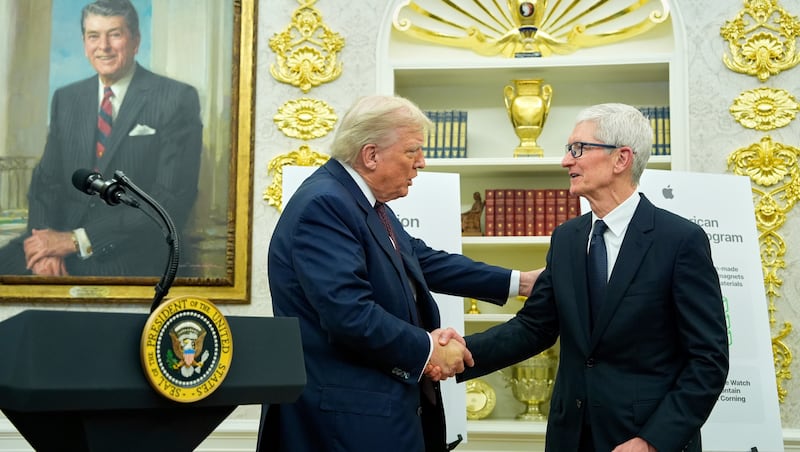
Apple CEO Tim Cook joined President Donald Trump in a significant announcement regarding the company's plans to increase its investments in domestic manufacturing. The move represents a major step forward for the tech giant, with an additional $100 billion added to previous commitments. This brings the total investment under Apple’s American Manufacturing Program to $600 billion over the next four years.
The program includes substantial support for advanced manufacturing in Utah, as confirmed by an Apple spokeswoman. During the event, Trump highlighted that Apple will be investing in semiconductor manufacturing within the state, while Cook emphasized the launch of new partnerships with nearly a dozen U.S. companies.
“Today, we’re proud to increase our investments across the United States to $600 billion over four years and launch our new American Manufacturing Program,” Cook stated during the Oval Office announcement. “This includes new and expanded work with 10 companies across America. They produce components that are used in Apple products sold all over the world, and we’re grateful to the president for his support.”
Apple has also deepened its collaboration with Texas Instruments, expanding their partnership to enhance future product development and strengthen U.S. capacity for transforming wafers into chips. The company is committing $500 million to Texas Instruments to support additional tool installations at its facility in Lehi, Utah, and a new facility in Sherman, Texas.
“Apple engineers work closely with suppliers across the United States to create silicon chips that are on the leading edge of innovation,” said Sabih Khan, Apple’s chief operating officer, in a press statement. “We’re committed to supporting U.S. suppliers involved in every key stage of the chip-making process — from the earliest stages of research and development, to final fabrication and packaging. We want America to lead in this critical industry, and we’re expanding our efforts to grow a silicon manufacturing ecosystem that will benefit innovators across America.”
The Utah and Texas facilities are home to TI’s most advanced process technologies for making critical semiconductors used in Apple products, including iPhone units shipped globally. White House spokesperson Taylor Rogers praised the announcement, stating that President Trump’s America First economic agenda has secured trillions of dollars in investments that support American jobs and bolster American businesses.
Strategic Goals and Industry Challenges
Trump has made boosting the manufacturing sector a top priority in his second term. He has emphasized the importance of tariff changes to incentivize U.S. companies to bring back or establish domestic facilities. However, the majority of Apple’s products, including most models of its popular iPhone, are still manufactured in China.
The U.S. and China continue negotiations for a permanent trade deal, with an Aug. 12 deadline looming. Earlier this year, U.S. trade levies on Chinese goods briefly surged to 145% amid rising tensions between the two countries.
While Trump has expressed confidence in the U.S. ability to manufacture iPhones domestically, industry analysts have been skeptical. Wedbush’s Dan Ives estimated that a U.S.-made iPhone would need to be priced at $3,500 and that Apple would require $30 billion over three years to shift 10% of its supply chain to the U.S.
In recent developments, Trump announced a reduction in the blanket tariff rate on countries without trade agreements with the U.S., setting it between 15% and 20%. This follows a trade deal with the European Union, where the U.S. import levy was set at 15%.
Ahead of the Apple investment announcement, Trump increased the tariff rate on India to 50%, citing concerns over the country’s purchases of Russian petroleum. The decision was outlined in an executive order, highlighting the administration’s focus on protecting national interests through trade policies.

Posting Komentar untuk "How Utah Shapes Apple's New Chip-Making Bet"
Posting Komentar