
Lifestyle Changes Alter Gene Regulation in Asian Skeletal Muscle
Understanding the Role of Lifestyle in Gene Regulation
A groundbreaking study conducted by researchers at the National University of Singapore (NUS) has uncovered how diet and exercise can influence gene regulation in the skeletal muscles of East Asians. This research highlights the crucial role that interactions between genes and lifestyle factors play in metabolic health. The findings were published in the journal Cell Genomics.
While previous studies in animals and cross-sectional human research have shown that lifestyle choices can affect gene expression, there is a lack of long-term human studies, especially in Asian populations. These populations are more susceptible to metabolic diseases even at lower body mass index (BMI) levels. Most genomic data available today comes from European populations, which leaves Asian groups underrepresented. This gap limits our understanding of how gene-lifestyle interactions affect metabolic health in these populations and hinders the development of personalized prevention strategies.
Study Design and Implementation
The research team, composed of clinical psychologists, metabolic disease specialists, and bioinformaticians from NUS and the Agency for Science, Technology and Research, focused on collecting comprehensive data. The study was conceptualized and analyzed by Assistant Professor Boxiang LIU from the Department of Pharmacy and Pharmaceutical Sciences and Dr. Mei Hui LIU from the Department of Food Science and Technology, both at NUS.
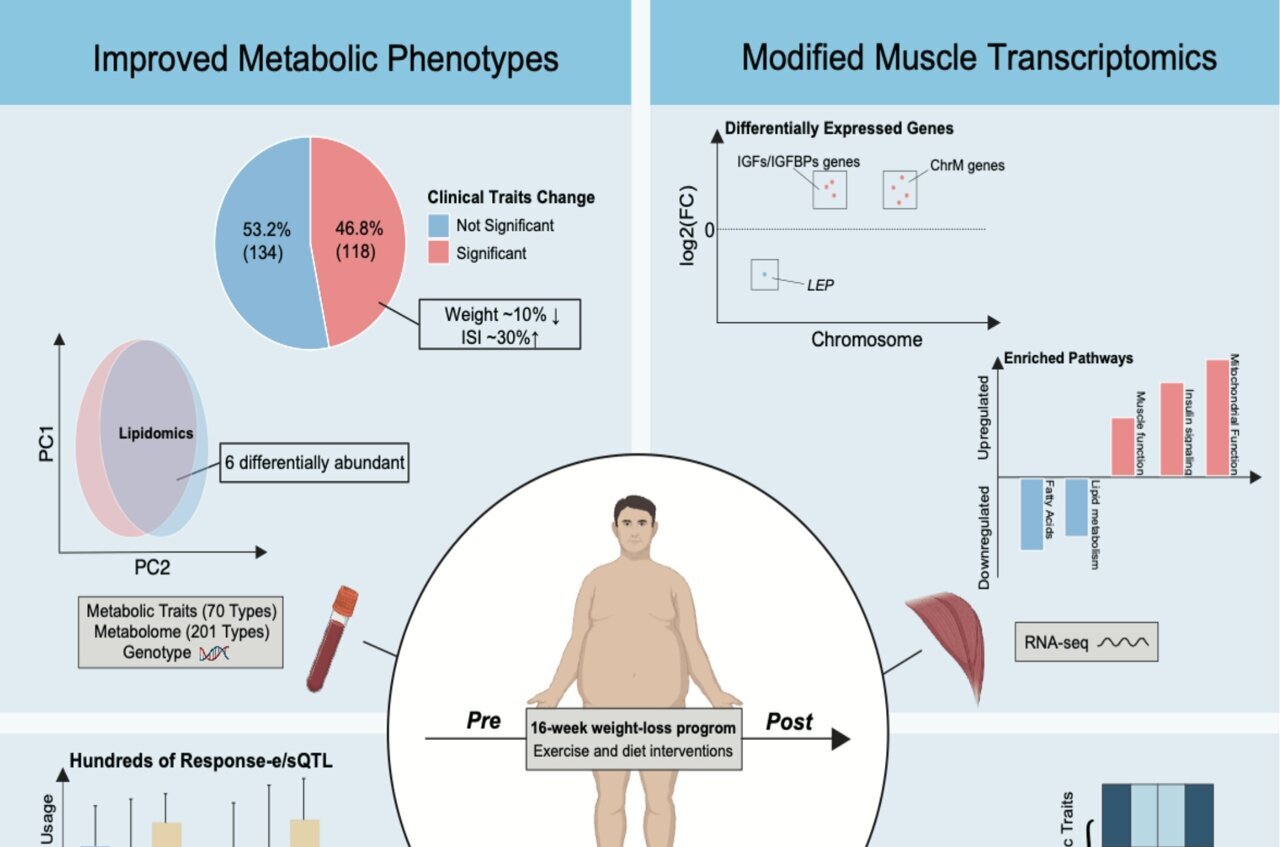
Over nearly three years, the team established a rigorously designed lifestyle intervention cohort known as the Singapore Adult Metabolism Study—Phase 2 (SAMS2). They recruited 265 overweight or obese East Asian adults to participate in a 16-week program involving supervised exercise and dietary changes. After screening and sample collection, 54 individuals provided paired skeletal muscle biopsies before and after the intervention.
Key Findings and Implications
Using longitudinal samples, the researchers performed transcriptome sequencing, genetic profiling, and detailed clinical measurements. This allowed them to analyze changes in gene expression and splicing patterns in skeletal muscle in response to lifestyle interventions. The study produced the first integrated longitudinal dataset of genetic regulation and gene expression in an Asian population undergoing lifestyle changes. This dataset serves as a valuable molecular resource for understanding how lifestyle factors influence metabolic disease risk and lays the foundation for future precision health strategies tailored to Asian populations.
Participants lost about 10% of their body weight and improved insulin-stimulated glucose uptake by approximately 30%. Transcriptome analysis revealed 505 genes that changed after the intervention, particularly those involved in mitochondrial and insulin signaling pathways. Further genetic analysis using Quantitative Trait Locus (QTL) mapping identified hundreds of gene regulatory variants showing evidence of G × L interaction.
Of these, 4.2% of expression variants (eQTLs) and 7.3% of splicing variants (sQTLs) were specific to people of East Asian ancestry. When compared with 12 existing Asian-based genetic studies, 16 colocalized genes were found to be linked to metabolic traits, including known risk genes like ANK1 and CRTC3. Interestingly, the effect of several genetic risk factors weakened after the intervention, suggesting that lifestyle changes may help reduce the impact of genetic risks.
Future Directions and Goals
Building on this work, the research team plans to expand the study to include female participants and other Asian subgroups to better understand sex and ancestry-related variations in gene–lifestyle interactions. They also aim to apply advanced technologies such as single-cell and spatial transcriptomics sequencing to explore the response of different cell types within muscle tissues to lifestyle changes with greater resolution.
Assistant Professor Liu emphasized the long-term goal of identifying potential genetic targets that can inform personalized treatments for obesity and diabetes. By understanding the interaction between lifestyle and gene regulation, the team hopes to guide the development of more effective therapies tailored to an individual's unique genetic background.

Posting Komentar untuk "Lifestyle Changes Alter Gene Regulation in Asian Skeletal Muscle"
Posting Komentar