
Novo Nordisk Q2 Surpasses Earnings, Misses Sales, GLP-1 Drugs Struggle in US
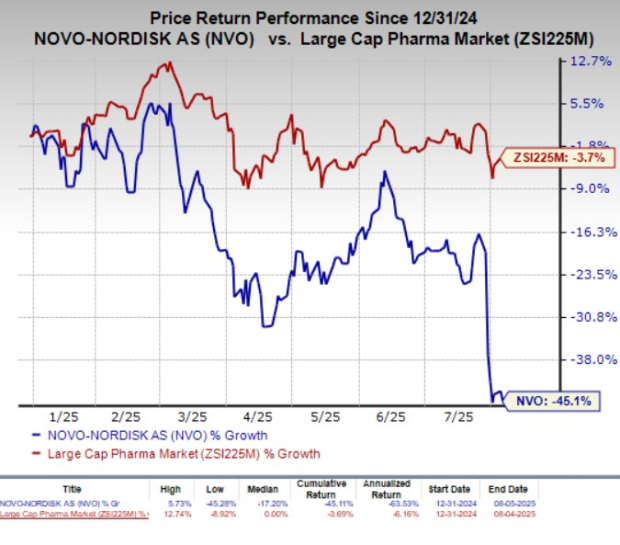
Novo Nordisk's Q2 2025 Performance and Outlook
Novo Nordisk A/S (NVO) reported second-quarter 2025 earnings of 97 cents per American Depositary Receipt (ADR), surpassing the Zacks Consensus Estimate of 93 cents. This marks a significant improvement from the 65 cents per ADR recorded in the same period last year. The company’s revenues reached $11.68 billion, reflecting a 13% increase year over year in Danish kroner (DKK) and an 18% rise at the constant exchange rate (CER). This growth was driven by higher sales in Diabetes and Obesity Care, as well as increased revenue in Rare Disease. However, total revenues fell slightly short of the Zacks Consensus Estimate of $11.79 billion.
The company operates under two main segments: Diabetes and Obesity Care, and Rare Disease. In the Diabetes and Obesity Care segment, sales amounted to DKK 71.94 billion, representing a 17% increase. Within this segment, Fiasp, a fast-acting insulin, saw a 5% decline in revenue, while NovoRapid experienced a 26% increase. Human insulin revenues dropped by 26%, and Premix insulin (Ryzodeg and NovoMix) rose by 11%. Sales of long-acting insulins, including Tresiba, Xultophy, Levemir, and Awiqli, declined by 2%.
Ozempic, which has seen strong market adoption, generated DKK 31.8 billion in sales for the quarter, up 15%. Rybelsus, on the other hand, recorded DKK 5.65 billion in sales, down 1%. Victoza sales fell by 57% during the reported quarter. Obesity Care products, including Saxenda and Wegovy, saw a 53% increase in sales to DKK 20.37 billion. Wegovy’s sales reached DKK 19.53 billion, up 75%, but its growth rate has slowed due to the availability of illegal compounded versions in the U.S., its largest obesity market.
In the Rare Disease segment, sales climbed 28% to DKK 4.92 billion. Sales of rare blood disorder products reached DKK 3.1 billion, up 13%, while hemophilia A product sales declined by 1%. Hemophilia B product sales also decreased by 4%. NovoSeven, however, saw a 16% increase in sales to DKK 2 billion. Sales of rare endocrine disorder products surged by 100% to DKK 1.42 billion.
Cost and R&D Trends
Sales and distribution costs increased by 19% in the quarter to DKK 17.53 billion, primarily due to promotional activities for Wegovy in the U.S. International operations also contributed to the cost increase through the launch of Wegovy and promotional efforts for Ozempic. Research and development (R&D) costs, however, decreased by 26% to DKK 11.69 billion. This decrease was mainly due to a DKK 5.7 billion impairment loss related to ocedurenone and other intangible assets recorded in the previous year, partially offset by increased investment in late-stage clinical studies and research activities, particularly within the Obesity Care segment.
Revised 2025 Guidance
Novo Nordisk recently revised its 2025 guidance for both sales and operating profit growth. The company now expects sales to grow between 8% and 14%, down from the previous range of 13% to 21%. Operating profit is projected to grow between 10% and 16%, compared to the earlier estimate of 16% to 24%. This revision reflects weaker-than-expected momentum for key drugs Wegovy and Ozempic, especially in the U.S. market. The continued use of unregulated, compounded GLP-1 alternatives has impacted Wegovy’s performance, despite the FDA ending its compounding grace period in May 2025.
Wegovy’s slower-than-expected uptake across both insured and cash-pay channels is attributed to modest market expansion and growing competition. While initiatives like NovoCare and telehealth have spurred some growth, overall adoption remains below expectations. Ozempic is also facing increased competitive pressure in the U.S. diabetes market. International rollouts of Wegovy are progressing, but demand in certain regions has been slower than anticipated. On the profit side, the lower operating profit outlook is tied to reduced sales expectations, although partially offset by cost controls. The updated forecast also includes a mid-single-digit drag from the acquisition of three Catalent manufacturing sites.
Market Share and Competitive Landscape
Novo Nordisk’s global diabetes value market share declined by 1.4% over the past year to 32.6% due to increased competition from Eli Lilly (LLY), which markets its tirzepatide medicines as Mounjaro for diabetes and Zepbound for obesity. Despite being on the market for less than three years, LLY’s Mounjaro and Zepbound have witnessed strong sales driven by rapid demand. LLY is scheduled to report second-quarter results on August 7 before the opening bell.
Despite these challenges, Novo Nordisk remains focused on reinforcing its leadership in diabetes care, targeting a global market share of over one-third by 2025.
Future Prospects and Pipeline Developments
Despite weaker-than-expected second-quarter revenues, Novo Nordisk is looking to regain momentum through expanded indications for its semaglutide drugs and progress on several new candidates for diabetes and obesity. These efforts aim to counter increasing competition from Eli Lilly, particularly in the U.S. market. The FDA is currently reviewing Novo Nordisk’s application for a 25 mg oral Wegovy for obesity, with a decision expected by year-end. A positive outcome could boost revenues, as no other oral GLP-1 treatments for obesity are currently on the market.
Another filing seeks approval for Wegovy to treat metabolic dysfunction-associated steatohepatitis, which is currently under FDA review. NVO has also filed Rybelsus for cardiac event prevention in diabetes. Label expansion is also being sought for Ozempic in treating peripheral artery disease in the U.S. and the EU. Beyond metabolic diseases, NVO is expanding its rare disease segment, with late-stage progress on Mim8 for hemophilia A and recent FDA approval of a broader label for its Alhemo injection for hemophilia A or B with/without inhibitors.
Novo Nordisk remains optimistic about increasing Wegovy sales in the second half of 2025 through initiatives such as NovoCare Pharmacy and CVS’ exclusive formulary coverage, effective July 1, 2025, where the drug is now the only GLP-1 medicine covered for obesity.

Posting Komentar untuk "Novo Nordisk Q2 Surpasses Earnings, Misses Sales, GLP-1 Drugs Struggle in US"
Posting Komentar