
PepsiCo's Pricing Power vs. Volume Struggle: What's Fueling Growth?
PepsiCo’s Strategic Moves Amid Volume Challenges
PepsiCo, Inc. has demonstrated a mixed performance in its second-quarter 2025 results, showcasing the company's ability to capitalize on pricing power while simultaneously dealing with volume pressures, especially in North America. The beverage and snack giant exceeded expectations with an earnings per share (EPS) of $2.12 and revenues reaching $22.73 billion for the quarter. However, the company continues to face challenges related to declining volumes across several business segments.
To counteract this trend, PepsiCo has focused on strategic pricing and value-creation initiatives. The company is investing in affordability entry points, everyday low pricing, and value packs to retain consumers in a market where demand is moderating. This approach has allowed the company to maintain top-line growth despite softer consumption trends.
One of the key factors contributing to PepsiCo’s resilience is its multi-layered productivity strategy. By leveraging artificial intelligence, upgrading enterprise resource planning systems, and integrating operations in North America, the company aims to drive cost savings. PepsiCo anticipates a 70% increase in productivity in the second half of 2025, largely driven by Frito-Lay. Plant closures and reductions in fixed costs have helped support margins and free up capital for innovation and value offerings. Despite stable margins, the slow growth in volume remains a concern regarding long-term brand strength and category leadership.
PepsiCo is confident that its pricing-led strategy will not only sustain profitability but also lead to a rebound in volumes. The company plans to relaunch core brands like Lay’s and Tostitos with cleaner labels, expand its permissible snacking portfolio, and focus more on away-from-home consumption. These efforts are expected to reinvigorate consumer engagement. With consistent international growth and improved competitiveness in the U.S. market, PepsiCo is betting on a balanced approach that includes pricing precision, operational discipline, and brand innovation to return to long-term growth in the coming quarters.
Competitors in the Beverage Industry: Coca-Cola and Keurig Dr Pepper
In the highly competitive beverage industry, PepsiCo faces strong competition from two major players: The Coca-Cola Company (KO) and Keurig Dr Pepper (KDP). Each of these companies has leveraged its unique strengths to capture market share and drive growth.
Coca-Cola continues to emphasize its brand strength and global reach to maintain its leadership in the non-alcoholic beverage sector. Despite facing similar volume pressures, Coca-Cola’s pricing power and brand loyalty have enabled it to deliver strong margin performance. Its dominance in sparkling beverages, particularly with Coca-Cola Zero Sugar, combined with its presence in over 200 markets, reinforces its position as a formidable competitor to PepsiCo.
Keurig Dr Pepper, on the other hand, benefits from a hybrid portfolio of hot and cold beverages, anchored by its leadership in single-serve coffee systems and popular soft drink brands such as Dr Pepper and Canada Dry. The company has a strong foothold in at-home consumption trends, especially with its Keurig brewers. Recent moves toward premiumization, strategic partnerships, and a focus on functional beverages highlight its agility in responding to changing consumer preferences.
PepsiCo’s Stock Performance and Valuation
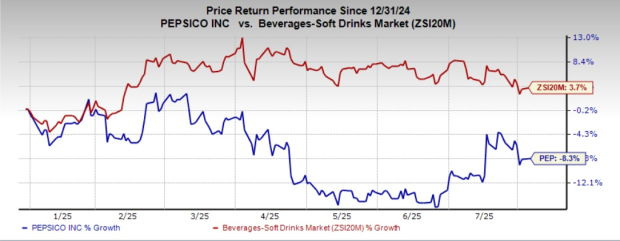
PepsiCo’s stock has experienced a decline year-to-date, losing approximately 8.3%, compared to the industry’s growth of 3.7%. From a valuation perspective, PEP trades at a forward price-to-earnings ratio of 16.88X, slightly below the industry average of 17.39X.
Analysts’ estimates suggest that PepsiCo’s 2025 earnings are expected to decline by 1.8% year-over-year, but 2026 earnings are projected to grow by 5.2%. In the past 30 days, the company’s EPS estimates for both 2025 and 2026 have moved upward.
Currently, PEP stock carries a Zacks Rank #2 (Buy), indicating a positive outlook. Investors interested in exploring other stocks with strong buy ratings can review the complete list of today’s Zacks #1 Rank (Strong Buy) stocks.

Posting Komentar untuk "PepsiCo's Pricing Power vs. Volume Struggle: What's Fueling Growth?"
Posting Komentar