
PGR vs. BRK.B: Which Insurer Offers a Safer Investment?
Growth Prospects in the U.S. Auto Insurance Market
The U.S. auto insurance market is expected to reach $349.37 billion by 2025, with an average spending per capita of $1,020. Despite a slowdown in rate increases, the average cost of full coverage car insurance is anticipated to hit a record high of $2,101 per year. This projection comes from the State of Auto Insurance in 2025 report.
The industry is set for growth driven by increased awareness of the need for insurance, technological advancements, evolving car ownership trends, rising costs of ownership, and the emergence of online platforms. Two major players in this space, The Progressive Corporation (PGR) and Berkshire Hathaway Inc. (BRK.B), are positioned to benefit from these trends.
Key Factors for PGR
Progressive is one of the largest auto insurance groups in the U.S., leading in motorcycle and boat policies, commercial auto insurance, and among the top 15 homeowners carriers based on premiums written. A significant portion of its revenue comes from auto insurance, with plans to expand into homeowners and commercial insurance.
Personal auto insurance remains a critical component of Progressive’s business, contributing about 90% of Personal Lines net premiums written and 75% of total company premiums. The segment is expected to grow due to rate increases, higher new personal auto applications, increased advertising spend, and improved customer retention through personalized pricing programs like Snapshot.
Progressive has maintained a strong underwriting performance, with an average combined ratio under 93% over the past decade, significantly better than the industry average of over 100%. The company has also embraced digital transformation, including AI technologies, to enhance its competitive edge.
Its comprehensive reinsurance program helps mitigate risks from catastrophic events, ensuring balance sheet integrity. Progressive has shown consistent improvements in net margin, with a 950 basis point increase over the last two years. The company's return on equity stands at 35.4%, far exceeding the industry average of 7.8%.
Key Factors for BRK.B
Berkshire Hathaway is a diversified conglomerate with over 90 subsidiaries across various industries, including insurance. Its insurance segment contributes approximately one-fourth of total revenues. GEICO, a key subsidiary, is the second-largest auto insurer in the U.S. However, it has faced challenges such as losing market share to competitors like Progressive and struggling with inflation, higher accident frequency, and slow rate adjustments.
In response, Berkshire has taken steps to modernize its operations, including launching a telematics program and investing in technology-driven underwriting. These efforts aim to improve pricing and risk assessment.
Despite these initiatives, BRK.B’s return on equity is lower than the industry average at 6.9%. The company maintains a strong financial position, with over $100 billion in cash reserves and minimal debt. However, its EPS estimates for 2025 show a decline of 6.7% compared to the previous year.
Performance and Valuation Metrics
Progressive is trading at a price-to-book multiple of 4.37, below its five-year median of 5.37. In contrast, Berkshire Hathaway’s price-to-book multiple is 1.53, slightly above its five-year median of 1.48.
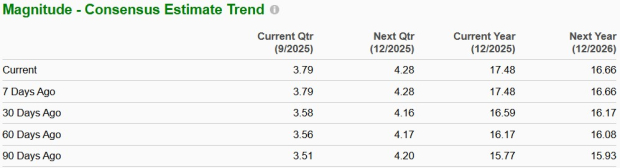
Looking at earnings forecasts, PGR is expected to see a 16.5% increase in 2025 revenues and a 24.4% rise in EPS. BRK.B, on the other hand, is projected to have an 8.5% revenue increase but a 6.7% decline in EPS.
Conclusion
Both PGR and BRK.B have demonstrated resilience in navigating cost challenges and improving net margins. However, Progressive outperforms in terms of return on equity and overall financial health, earning a VGM Score of A compared to BRK.B’s D. With a Zacks Rank of #2 (Buy), PGR appears more attractive to investors than BRK.B, which holds a Zacks Rank of #3 (Hold).

Posting Komentar untuk "PGR vs. BRK.B: Which Insurer Offers a Safer Investment?"
Posting Komentar