
The Power of "Pick-Me" Women: Why Some Conservatives Embrace Tradition Over Change
The Enduring Power of Wicked and the Politics of Female Conservatism
In 2009, the world was a different place. Barack Obama was in the White House, the Labour Party was in power in the UK, and on Broadway, Elphaba had already been defying gravity for six years. Meanwhile, in the film He’s Just Not That Into You, Ginnifer Goodwin played a character who needed to be coached by a f*ckboy bartender, Justin Long, on how to read men. Early on, he told her she wasn’t the exception—she was the rule. If a guy was treating her like he didn’t care, he genuinely didn’t. No exceptions.
By the end of the movie, however, Justin Long was taking Ginnifer in his arms and saying, “You’re my exception.” Being picked out as the exception is intoxicating. For those of us socialized as little girls, being told we’re “not like other girls” can be the first time we feel powerful. It can feel like the price of entry, both in romantic love and politics. This is true even for those of us who identify as lesbian, queer, gender non-conforming, or trans.
Twenty years after its Broadway debut, the musical Wicked is once again making headlines. Perhaps the enduring power of Wicked lies in its exposure of a universal truth about conservatism and women in power. Glinda, the more conservative of the two main characters, believes in the system, is famously “Popular,” and understands how to charm those in power. Elphaba, on the other hand, is more talented but ends up villainized, dehumanized, and hunted down for the color of her skin. Whether in Westminster, Washington, or the magical land of Oz, women are faced with a choice: be a Glinda the Good or a Wicked Witch.
In other words, make the system work for you and be held up as the exception, or challenge oppressive structures and face character assassination. The intensity of the character attacks on figures like Dianne Abbott and Angela Rayner can feel akin to decrying them as witches.
In Western society, female conservatism is still often linked to Christian ideas of female purity. When Trump Press Secretary Karoline Leavitt regularly excoriates her predecessor, Karine Jean Pierre, and panellists on The View, she uses rhetoric steeped in the moral superiority of a Christian missionary. Her criticism conflates political dissent with incompetence and immorality while invoking an almost Victorian fearmongering of female hysteria. In this way, she discredits often Black, brown, and queer women who disagree with her as “deranged.”
In the UK, Margaret Thatcher and current Conservative leader Kemi Badenoch are held up as poster girls to prove that conservatism cannot be inherently misogynistic or racist. This is an act of willful ignorance. Badenoch couches her anti-trans hate speech in British “common sense,” positioning her views as logical and therefore male, in opposition to ideas of female frailty, insanity, and emotionality.
Women are more easily allowed to succeed when they uphold systems of oppression. The conservative woman’s brand of girl power is grounded in her credentials as a wife, mother, and Christian—identities that link her to structures of male power. Conservative women, above all else, defend their position as the acceptable woman in the room.
I was walking into a music festival called Mighty Hoopla with my girlfriend when I noticed a group of girls dressed in frilly mini-dresses and cowboy boots. I have a sparkly pink pair myself, but for a queer music festival where one is usually more likely to see throngs of scantily clad gay men and queer people pushing the edge of gendered fashion, this group of uniformly hyper-feminine young women was notable.
A few minutes later, we saw another group dressed almost identically, then another. My girlfriend’s eyes widened, “Conservative is hot again.” I was wearing a black tank top that said “Dyke” in diamantés across my chest. As we walked home that night, a man shouted at us in the street. My girlfriend and I dropped hands. I covered my chest the rest of the way home. The world outside my front door is feeling more and more conservative.
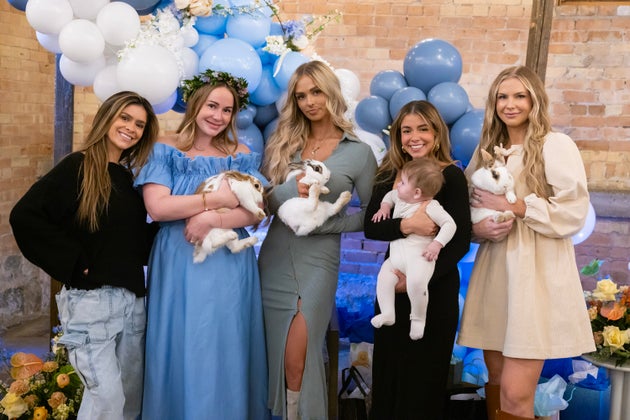
Fashion always says something about the politics of the day. Conservatism is indeed on trend. Like Maggie Thatcher clutched her pearls in the 1980s, conservative women are now brandishing cross necklaces and curling irons. The new reality show Secret Lives of Mormon Wives has been a hit, sparking the “Utah curls” trend and launching the cast into international stardom.
“Trad Wives” like Hannah Neeleman are blowing up social media. Her Ballerina Farm account boasts 9.9 million followers on TikTok. The Conservateur is a growing lifestyle empire with a mission to “bring back traditional femininity,” which co-founders Jayme Franklin and Isabelle Redfield, both in their mid-twenties, see in direct opposition to “more of this feminist, progressive lifestyle.”
As a femme lesbian, I like a flouncy pilgrim sleeve and a curly blowout as much as the next girl. I love glamour, I love beauty, and I love fashion, but femininity and feminism are not mutually exclusive.
It might be America that The Conservateur is “Making Hot Again,” but women on both sides of the Atlantic are being pulled in. The gloss of beauty hacks and girl bossing covers thinly veiled hate speech and the systematic oppression of others, all to be told “You’re our exception.”
Just as the lure of being held up as “the exception” has kept women chasing men who “just aren’t that into them,” in 2025, it’s ennobling a generation of conservative women.
In ROTUS: Receptionist of the United States, queer Irish-American comedian Leigh Douglas plays Chastity Quirke—a rising Republican aide whose faith in the system begins to crack. Blending political satire, theatre, and stand-up, the show explores the role of conservative women in upholding patriarchal power. Inspired by real-life figures like Cassidy Hutchinson and Alyssa Farah, ROTUS is a sharp, darkly funny portrait of loyalty, ambition, and the courage to break ranks.
ROTUS will be at the Gilded Balloon from 30th July to 24th August. For tickets and more info, visit https://tickets.gildedballoon.co.uk/event/14:5380/

Posting Komentar untuk "The Power of "Pick-Me" Women: Why Some Conservatives Embrace Tradition Over Change"
Posting Komentar