
The universe's first confirmed black hole: A cosmic giant from the beginning
A New Window into the Early Universe
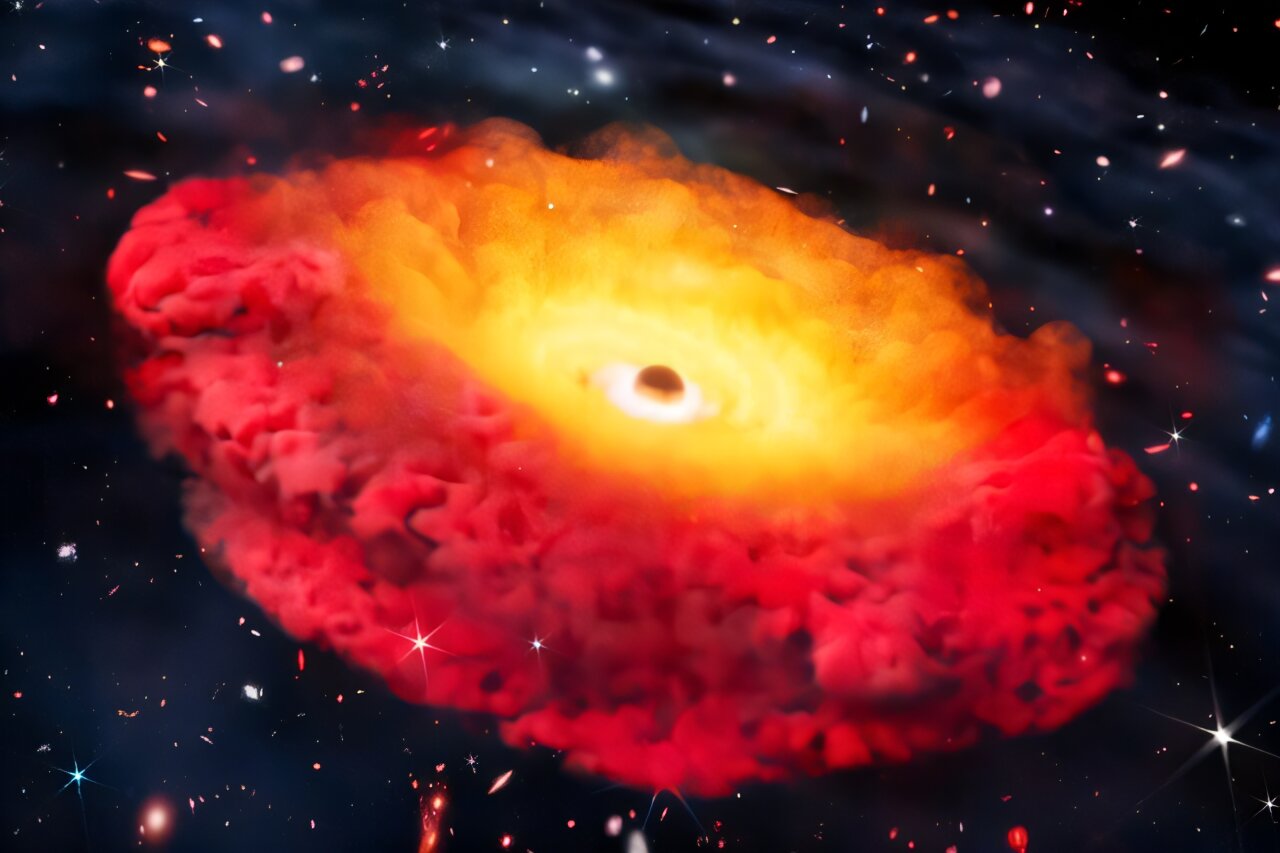
An international team of astronomers, led by researchers at The University of Texas at Austin's Cosmic Frontier Center, has made a groundbreaking discovery. They have identified the most distant black hole ever confirmed, located in a galaxy known as CAPERS-LRD-z9. This celestial object existed just 500 million years after the Big Bang, placing it 13.3 billion years back in time. At that point, the universe was only 3% of its current age, offering a rare and valuable opportunity to study this enigmatic era.
"This is about as far back as we can practically go with current technology," said Anthony Taylor, a postdoctoral researcher at the Cosmic Frontier Center and lead on the discovery team. "We're really pushing the boundaries of what we can detect."
The research was published in the Astrophysical Journal Letters, and it marks a significant step forward in understanding how black holes formed and evolved in the early universe.
Understanding Black Holes Through Spectroscopy
To identify black holes, astronomers rely on spectroscopy, which splits light into different wavelengths to analyze an object’s characteristics. For black holes, scientists look for signs of fast-moving gas. As gas spirals into a black hole, the light from gas moving away from us shifts toward redder wavelengths, while light from gas moving toward us shifts toward bluer wavelengths.
“There aren’t many other things that create this signature,” explained Taylor. “And this galaxy has it.”
The team used data from the James Webb Space Telescope (JWST) through its CAPERS (CANDELS-Area Prism Epoch of Reionization Survey) program. Launched in 2021, JWST provides unprecedented views of the universe, and CAPERS focuses on observing the outermost edges of space.
Discovering a New Class of Galaxies
CAPERS-LRD-z9 initially appeared as a small speck in the program’s images but soon revealed itself to be part of a new class of galaxies known as "Little Red Dots." These galaxies are compact, red, and unexpectedly bright, existing only in the first 1.5 billion years of the universe. Their discovery was a surprise, as they looked nothing like galaxies observed with the Hubble Space Telescope.
“This was a major surprise from early JWST data,” said Steven Finkelstein, a co-author on the paper and director of the Cosmic Frontier Center. “Now, we’re trying to understand what these galaxies are and how they formed.”
CAPERS-LRD-z9 may help answer some of these questions. For one, it adds to evidence suggesting that supermassive black holes are responsible for the unexpected brightness of Little Red Dots. While such brightness typically indicates a large number of stars, these galaxies exist at a time when forming so many stars would be unlikely. Instead, black holes can emit tremendous light and energy as they consume material.
A Massive Black Hole in a Young Galaxy
The black hole in CAPERS-LRD-z9 is estimated to be up to 300 million times the mass of our sun, making it half the mass of all the stars in its galaxy. This is an unusually large black hole for such an early period in the universe’s history.
Finding such a massive black hole so early on offers valuable insights into how these objects developed. In the later universe, black holes had more time to grow. But one that existed in the first few hundred million years suggests that early black holes may have grown faster than previously thought or started out much larger than models predict.
“This adds to growing evidence that early black holes grew much faster than we thought possible,” said Finkelstein. “Or they started out far more massive than our models predict.”
Future Research and Insights
To further study CAPERS-LRD-z9, the team hopes to gather more high-resolution observations using JWST. These could provide deeper insights into the galaxy and the role black holes played in shaping Little Red Dots.
“This is a good test object for us,” said Taylor. “We haven’t been able to study early black hole evolution until recently, and we are excited to see what we can learn from this unique object.”
As astronomers continue to explore the cosmos, discoveries like CAPERS-LRD-z9 push the limits of our understanding and open new doors to uncovering the mysteries of the early universe.

Posting Komentar untuk "The universe's first confirmed black hole: A cosmic giant from the beginning"
Posting Komentar