
Trump Raises Tariffs on India to 50% Over Russian Oil Deals
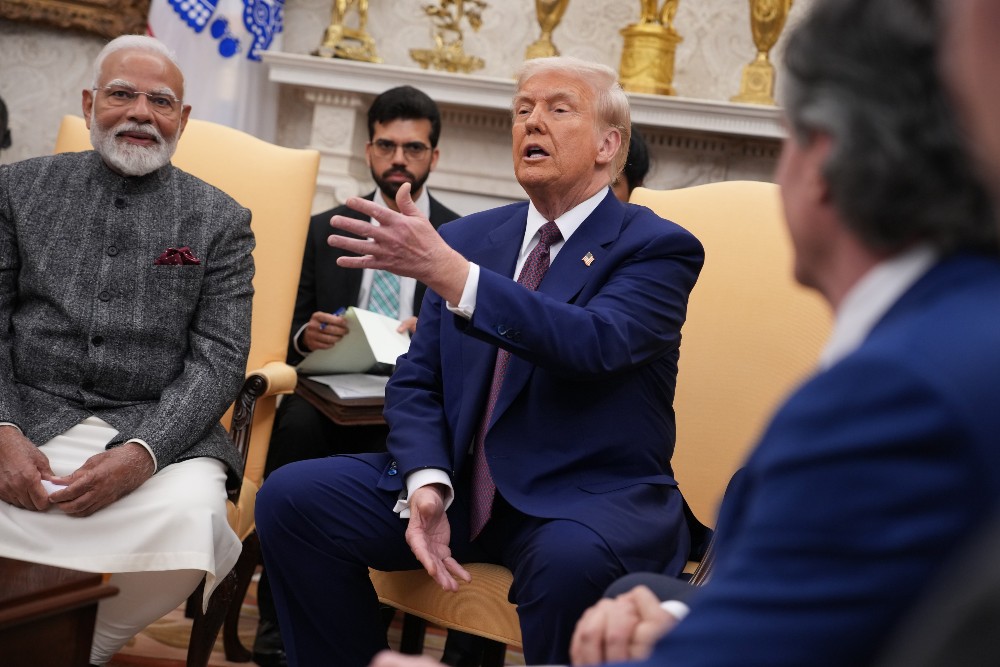
Trump Imposes Additional Tariffs on India, Raising Overall Rate to 50 Percent
President Donald Trump has taken a significant step in his ongoing efforts to address the U.S. trade relationship with India by imposing new tariffs on its imports. This move is a direct response to India’s continued purchase of Russian oil, which Trump claims poses an "unusual and extraordinary threat" to the United States due to the ongoing conflict in Ukraine.
The White House released an executive order that outlines the rationale for the new ad valorem duty, which is set at 25 percent. This rate will be added to existing tariffs, including the 25 percent duties already scheduled to take effect on Thursday under Trump’s broader "reciprocal" tariff policy. The new tariffs are expected to come into force within 21 days, though goods already loaded onto vessels bound for the U.S. before that date and arriving before September 17 will not be affected.
Trump cited a directive from the Biden administration, specifically Executive Order 14066, which declared a state of emergency and imposed trade and financial sanctions on Russia for its aggression against Ukraine. Trump extended this order for one year in April, reinforcing the justification for the latest action.
India's exports to the U.S. represent a significant portion of its economy, with about 18 percent of India's exports destined for the U.S. This accounts for roughly 2 percent of India’s gross domestic product (GDP). According to UBS, the new tariffs could impact $8 billion worth of Indian exports, particularly in sectors such as apparel, textiles, chemicals, and jewelry.
Despite these challenges, some industries may be spared the brunt of the new tariffs. Sectors like pharmaceuticals, semiconductors, and electronic products, including those produced by Apple in India, are likely to remain unaffected. However, India faces a 50-percent duty on steel and aluminum due to a separate global executive order that affects all export markets.
India Responds to U.S. Tariff Action
The Indian Ministry of Foreign Affairs quickly responded to the announcement, with an official spokesperson stating that the U.S. has targeted India’s oil imports from Russia. The statement emphasized that India’s imports are based on market factors and aimed at ensuring energy security for its 1.4 billion people.
"The United States has in recent days targeted India's oil imports from Russia. We have already made clear our position on these issues, including the fact that our imports are based on market factors and done with the overall objective of ensuring the energy security of 1.4 billion people of India," the spokesperson said.
The statement further criticized the U.S. for imposing additional tariffs on India, noting that several other countries are also taking similar actions in their own national interests. India reiterated that these actions are unfair, unjustified, and unreasonable, and vowed to take all necessary steps to protect its national interests.
Growing Ties Between India and China
As tensions with the U.S. escalate, Indian Prime Minister Narendra Modi is reportedly planning a visit to meet with Chinese President Xi Jinping on August 31. This will be Modi’s first visit to China in seven years, as he attends a summit hosted by the Shanghai Cooperation Organisation (SCO), an international and economic security organization founded by Russia and China, along with several Central Asian nations.
India and China, despite longstanding territorial disputes over their shared border in the Ladakh region, have been working toward improving relations. Recent years have seen increased economic ties, with China being India’s second-largest trading partner, accounting for $127.7 billion in bilateral trade last year.
Both nations are founding members of the BRICS Alliance, which includes Russia and Brazil—two countries that have recently become targets of the Trump administration’s trade policies.
Trump’s Diplomatic Moves
Just hours after announcing the new tariffs on India, Trump shared news of a productive meeting between his special envoy, Steve Witkoff, and Russian President Vladimir Putin. He stated that "great progress was made" during the discussions and that he updated European allies on the situation. Trump emphasized that all parties agree the war in Ukraine must end, and the U.S. will work toward that goal in the coming weeks.
Broader Implications
The imposition of these tariffs highlights the complex web of international trade relationships and geopolitical tensions. As the U.S. continues to navigate its stance on Russia, it is also reshaping its trade policies with key partners like India and China. These developments are likely to have far-reaching effects on global commerce and diplomatic relations.

Posting Komentar untuk "Trump Raises Tariffs on India to 50% Over Russian Oil Deals"
Posting Komentar