
Citigroup's Cost-Cutting Push: Boosting Returns?
Citigroup's Strategic Transformation and Cost-Cutting Measures
Citigroup, Inc. is undergoing a significant transformation aimed at creating a more efficient and streamlined banking operation. As part of this initiative, the company has restructured its operating model and leadership framework. This change has led to a simpler and more direct management structure that supports the bank’s strategy of increasing spans of control while reducing bureaucracy and unnecessary complexity.
In January 2024, Citigroup announced plans to cut approximately 20,000 jobs, or about 8% of its global workforce, by 2026. The company has already made substantial progress, having reduced its headcount by over 10,000 employees so far. These cuts are part of a broader effort to streamline operations and improve efficiency across the organization.
The bank is also focusing on simplifying its processes and platforms, with a strong emphasis on automation to reduce manual tasks. Citigroup is increasingly integrating artificial intelligence (AI) tools into its operations to support these efforts. While these cost-cutting and transformation initiatives may affect near-term profitability, they are expected to lead to stronger, more sustainable returns beyond 2026.
Financial Projections and Expense Management
Management expects total expenses for 2025 to be $53.4 billion, slightly lower than the $53.9 billion recorded in 2024. Revenue is projected to grow at a compound annual growth rate (CAGR) of 4-5% by 2026. Additionally, the company aims to achieve $2-2.5 billion in annualized run rate savings by 2026.
When compared to its competitors, such as Bank of America (BAC) and Wells Fargo (WFC), Citigroup’s expense management strategies highlight both similarities and differences. Bank of America has maintained prudent expense management in the past, but its non-interest expenses have shown a four-year CAGR of 4.9% through 2024 due to continued investments in technology and personnel. These costs have remained elevated, with management expecting expense growth to be flattish in the second half of 2025.
In contrast, Wells Fargo has been actively working on cost-cutting measures since the third quarter of 2020. These efforts include streamlining its organizational structure, closing branches, and reducing headcount. As a result, non-interest expenses have seen a negative CAGR of 1.3% over the last four years (ended 2024). The trend continued in the first half of 2025, driven by efficiency initiatives. For 2025, non-interest expenses are expected to be $54.2 billion, slightly lower than the $54.6 billion reported in 2024.
Performance and Valuation Metrics
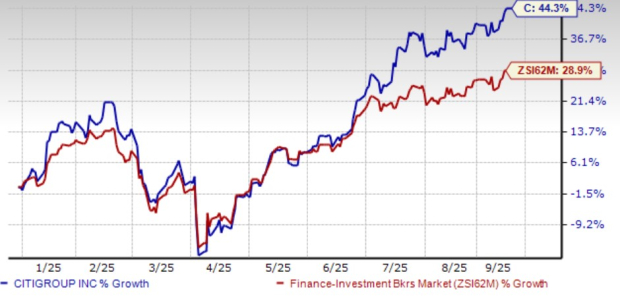
Citigroup’s stock has performed well year-to-date, gaining 44.3% compared to the industry’s 28.9% growth. From a valuation perspective, the stock trades at a forward price-to-earnings (P/E) ratio of 10.95X, which is below the industry average of 14.95X.
Analysts expect strong earnings growth for Citigroup in the coming years. The Zacks Consensus Estimate suggests that earnings will increase by 27.6% in 2025 and 27.8% in 2026, with both estimates being revised upward over the past 30 days.
Currently, Citigroup holds a Zacks Rank of #2 (Buy), indicating positive investor sentiment. Investors looking for other high-potential stocks can refer to the complete list of today’s Zacks #1 Rank (Strong Buy) stocks.

Posting Komentar untuk "Citigroup's Cost-Cutting Push: Boosting Returns?"
Posting Komentar