
Capital One Sues FDIC Over Wrongful Fees
Legal Dispute Between Capital One and the FDIC
Capital One, a major financial institution, has recently filed a lawsuit against the Federal Deposit Insurance Corp. (FDIC) over what it claims is an unfairly high and incorrectly calculated special assessment fee of $474.1 million. This fee was imposed to replenish the Deposit Insurance Fund (DIF) after the collapse of Silicon Valley Bank and Signature Bank in early 2023. The case was submitted to the federal court in Alexandria, Virginia.
Understanding the COF Matter
The failure of Silicon Valley Bank and Signature Bank led to their takeover by the FDIC. A significant portion of their deposits exceeded the standard FDIC insurance limit of $250,000, leaving these deposits uninsured. As a result, the FDIC used funds from the DIF to compensate the affected depositors. To refill the depleted DIF, the regulator introduced a special assessment on the largest banks in the country.
Capital One argues that the FDIC mistakenly classified a $56 billion intercompany position between its two subsidiaries as an uninsured deposit, which significantly increased the fee the bank was required to pay. According to the company, using its revised December 2022 call report, its liability should have been approximately $325 million.
Over the past two years, Capital One has repeatedly informed the FDIC that this intercompany position was wrongly treated as a deposit in the special assessment, calling the invoice inaccurate. However, the FDIC has continued to demand payment based on what the bank considers an incorrect calculation.
Despite attempts to resolve the issue amicably, the FDIC advised the bank to either pursue an administrative appeal or take legal action. Capital One has now asked the court to declare that the intercompany position does not qualify as a deposit and that the FDIC’s special assessment was miscalculated. The bank asserts that it does not owe the additional $149 million plus penalties sought by the regulator.
Additional Legal Challenges for Capital One
This lawsuit is part of a growing list of legal troubles for Capital One. Last month, the New York Attorney General, Letitia James, filed a lawsuit against the Capital One-owned Zelle app, accusing the payment platform of failing to implement essential safety measures that allowed fraudsters to steal over $1 billion from consumers. In June, social media creators also sued the bank, alleging that its free browser extension deprived them of commissions on sales generated through their content.
Capital One's Stock Performance
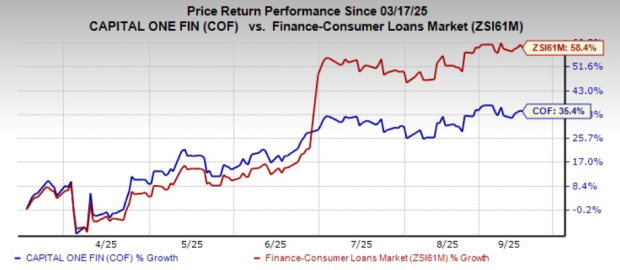
In the past six months, Capital One's shares have risen by 35.4%, outperforming the industry's growth of 58.4%. Currently, the company holds a Zacks Rank of #3 (Hold). Investors can view the complete list of today’s Zacks #1 Rank (Strong Buy) stocks for more insights.
Regulatory Issues Faced by Other Banks
Other major banks are also facing regulatory scrutiny. Last month, Deutsche Bank AG was fined HK$23.8 million ($3.05 million) by Hong Kong’s Securities and Futures Commission (SFC) for multiple regulatory breaches, including fee overcharging, misclassification of product risk, and failure to disclose investment banking relationships in research reports.
The SFC found that between November 2015 and November 2023, the bank overcharged clients approximately $39 million in management and custodian fees due to the failure to apply discounted fee rates and misstatements in fund valuations.
Similarly, JPMorgan agreed to pay $330 million to settle ongoing and potential claims related to the 1MDB sovereign wealth fund. The settlement was announced after Swiss regulators found JPMorgan guilty of failing to prevent money laundering in transactions linked to 1Malaysia Development Berhad.
The $330 million payout will go toward Malaysia’s Assets Recovery Trust Account and comes without any admission of liability from the bank. As part of the agreement, both JPMorgan and Malaysia will withdraw all pending appeals connected with the lawsuit.

Posting Komentar untuk "Capital One Sues FDIC Over Wrongful Fees"
Posting Komentar