
Tailored Pulsed Power Modulator Enhances Semiconductor Biasing
Advancements in Semiconductor Processing with Tailored Pulsed Power Technology
A significant breakthrough has been made in the field of semiconductor manufacturing, thanks to a research team led by Dr. Jang Sung-roc at the Electrophysics Research Center of the Korea Electrotechnology Research Institute (KERI). The team has developed a "tailored pulsed power modulator for bias," which promises to revolutionize ultra-precision semiconductor processing.
The concept of a bias device is crucial in semiconductor fabrication. It applies a force—typically a voltage—that pulls ions within plasma to make them collide forcefully with a semiconductor wafer. This process is essential for several key steps, including etching (cutting the surface), cleaning (removing contaminants), and deposition (pressing thin films uniformly and firmly onto the wafer).
Currently, radio-frequency (RF) power supplies are widely used in the industry to apply this bias voltage. However, their simple alternating waveforms have limitations when it comes to the precision required for advanced semiconductor microfabrication. As a result, there is a growing interest in pulsed power supplies, which can deliver tailored bias forces even for complex and demanding processes.
Pulsed power supplies work by storing energy at low power over an extended period and then discharging it instantaneously at high power. This allows for precise control over the strength of the pulses, enabling semiconductor substrates to be etched as narrowly and deeply as needed. This makes the technology applicable across various fabrication processes.
Despite their advantages, conventional pulsed power supplies face challenges, particularly in terms of power loss during instantaneous high-power discharge. For tailored bias applications, the technical requirements are even more stringent. Pulses reaching several kilovolts must be stably controlled within an extremely short duration of 2.5 µs (1/250,000th of a second) and discharged at a high frequency of 400 kHz (400,000 times per second).
KERI, with over a decade of experience in developing pulsed power technologies, recognized these challenges and launched an initiative to achieve domestic production of pulsed power supplies for semiconductor bias processes. Dr. Jang Sung-roc’s team made a groundbreaking advancement by introducing "soft switching," a technique that reduces power loss during pulse discharge.
Soft switching involves switching the device at points where the voltage (V) or current (I) is near zero. This significantly reduces stress on the device and cuts power loss by over 78%. Additionally, this innovation helps address heat generation issues, leading to smaller power supplies, higher power density (output per volume), and longer lifespan.
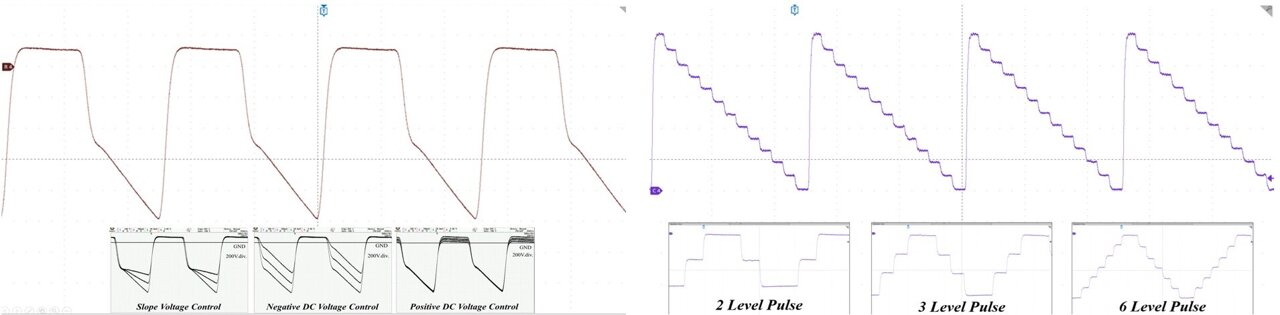
To further expand the technology's applicability, the research team introduced a tailored pulsed power supply that incorporates two methods: "ramped" mode, which uses inclined waveforms for compact and precise processing, and "stepped" mode, which generates the various shapes required for semiconductor fabrication.
This advancement opens up possibilities beyond semiconductors, making the technology suitable for other industries such as environmental engineering, defense, and healthcare, where pulsed power is essential.
The technology was validated inside a semiconductor process chamber through collaboration with the Plasma E.I. Convergence Research Center of the Korea Institute of Fusion Energy. During the demonstration, the team observed the unique waveforms created by the tailored pulsed power supply, confirming its applicability.
Building on this success, KERI plans to lay the groundwork for commercialization by applying the tailored pulsed power supply to actual etching and cleaning equipment in joint research with the Korea Institute of Machinery & Materials and the Korea Institute of Fusion Energy.
Dr. Jang emphasized that process innovation using tailored pulsed power will greatly enhance semiconductor performance, making electronic devices smaller, faster, and longer-lasting. He added that the technology will be a major asset for companies struggling to adopt next-generation processes due to a lack of pulsed power solutions.
Having secured patents for this achievement, KERI aims to drive commercialization and broaden the application of its tailored pulsed power technology in next-generation industrial processes through industry-academia-research collaboration and technology transfer.

Posting Komentar untuk "Tailored Pulsed Power Modulator Enhances Semiconductor Biasing"
Posting Komentar