
The Man Betting His Future on Latin America's Top Company
A New Era for MercadoLibre
Ariel Szarfsztejn didn’t just step into the spotlight. He leaped. The incoming chief executive officer of e-commerce and fintech giant MercadoLibre Inc. bounded onto a Mexico City stage that was aglow in blue and yellow neon lights pulsating from towering replicas of the company’s signature delivery boxes.
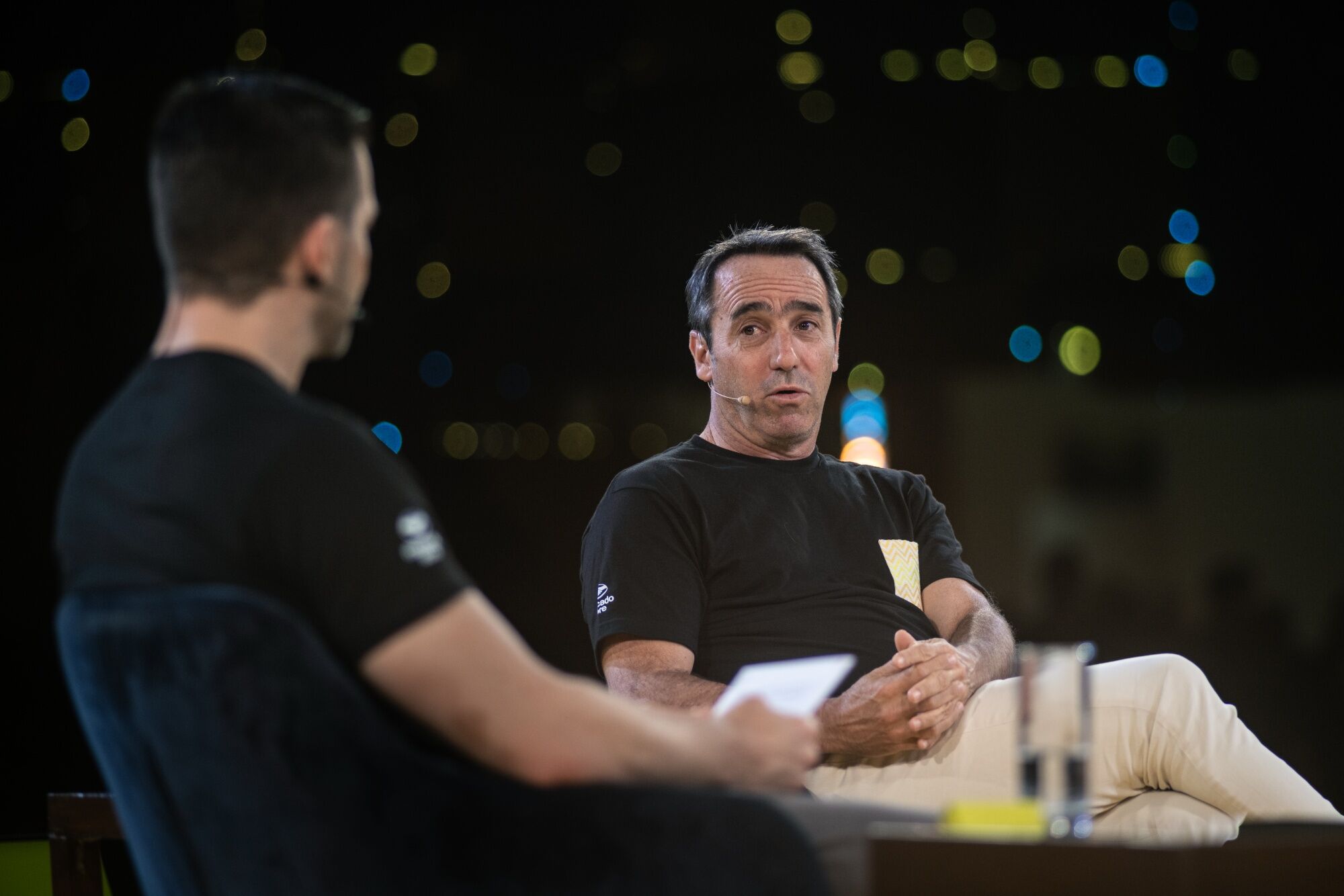
Szarfsztejn took a seat alongside CEO and co-founder Marcos Galperin to headline the glittering Sept. 10 event that gathered some 8,000 MercadoLibre vendors, partners and employees. Clad in de rigueur black T-shirts with a discreet corporate logo, jeans and sneakers, the duo was making its first major public appearance since the company announced the leadership transition in May.
A 44-year-old tennis aficionado from Argentina, Szarfsztejn carried himself with the exuberance of a startup founder — balanced with the weight of responsibility of a managerial heir to Latin America’s most valuable company. In an interview months before he takes over in January, he made lofty pronouncements on the company's future while avoiding specific forecasts.
“MercadoLibre is the largest company in Latin America and it is still growing at a startup pace,” Szarfsztejn said following his debut. “There is no growth limit.”
With a market value approaching $120 billion, MercadoLibre processed nearly $200 billion in payments last year and shipped a record-breaking 1.8 billion items across 18 countries in Latin America. It continues to invest billions in the region.
“The opportunities for the next 26 years are equal to or greater than those we experienced in the first 26 years,” said Szarfsztejn, who has spent eight years behind the scenes running the company’s e-commerce division.
The millennial executive will need to tap all his energy to build on MercadoLibre’s dizzying success. And when it comes to Big Tech, look no further than Apple Inc. and Dell Technologies Inc. to witness a fraught hand-off from star founder to low-key successor.
But analysts are overwhelmingly bullish. Neha Agarwala at HSBC said MercadoLibre has no key man risk like Elon Musk, who happens to be one of Szarfsztejn’s tech idols.
“Galperin’s shoes won't be easy to fill, as he developed MercadoLibre into Latin America's largest e-commerce platform,” said Dan Wasiolek, senior equity analyst at Morningstar. “But we think Szarfsztejn's leadership and expertise make him a logical choice to maintain the company’s stout network advantage.”
On stage in Mexico City, the outgoing boss alluded to a natural transition. “I am handing the keys to Ari at the best moment,” said Galperin, 53, who will become executive chairman on Jan. 1. “We’ve worked very well over the past eight years, and now he’s taking over my role because he’s a great example of our culture.”
The Evolution of a Tech Giant
MercadoLibre started as a modest auction website in 1999 and evolved from a classifieds site to a robust marketplace. In 2003 it launched a payments arm to facilitate online sales, and then ballooned to encompass financial services from credit cards to high-yield savings accounts, loans and crypto.
Founded in Argentina and now headquartered in Montevideo, Uruguay, MercadoLibre employs over 100,000 people, from just 15,000 in 2020, when the Covid-19 pandemic drove consumer uptake of e-commerce and digital payment apps. In 2025 alone the company pledged to invest at least $13.2 billion across the region and its various divisions.
A Swift Rise Through the Ranks
In contrast to Galperin and the clutch of executives who launched MercadoLibre and remain in C-suite roles, Szarfsztejn wasn’t present at the creation. After a few years at Boston Consulting Group, he had been running the hotels unit at digital travel company Despegar.com Corp. when then-CFO Pedro Arnt pitched a strategy role. At first, it seemed like a step backward.
“I knew the caliber of the people. But I wasn’t convinced by the role,” he recalled telling Arnt at the time in a podcast. “I can’t sit at that table.”
But after nearly a dozen coffee meetings, he was drawn to the company’s ethos that values ideas over titles or tenure. Szarfsztejn signed on in 2017 as head of strategy — a role that had been used by the company as a seedbed for promising candidates — and “by day two” felt confident he had made the right decision.
“Ariel had a combination that really drew us, which is the capacity of operating at a strategic level — from his time in consulting — but also to get involved at the micro level and handle the details,” said Arnt, now chief executive officer of payments firm DLocal Ltd, about MercadoLibre’s decision to recruit Szarfsztejn. “He’s clinical in identifying the heart of an issue and doesn't beat around the bush. He's very demanding of his teams, but in a good way.”
The move kicked off a swift rise through the corporate ranks. Within a year, he was tasked with leading the shipping division, spearheading a logistics push that led to million-dollar investments, from high-tech warehouses and distribution centers to planes and electric vehicle fleets to expedite shipping.
During his tenure at the helm of logistics, the team exploded from 60 people to 70,000. In 2021, Galperin asked co-founder Stelleo Tolda to step aside from the top job at the e-commerce division to test out Szarfsztejn, eyeing the newcomer’s potential.
“The development of the logistical network, led by Ari, was faster and more successful than we had imagined,” Arnt added. “From that, he was beginning to emerge as one of the most promising leaders of that generation.”
Navigating Challenges and Opportunities
MercadoLibre is tested by competitors on all sides. In e-commerce, Amazon.com Inc. has carved out a presence in Brazil and Mexico, MercadoLibre’s two biggest markets. From further afield, Chinese e-commerce platforms like Temu are flooding the region with ultra-cheap goods, upending price expectations and prompting governments from Mexico to Chile to levy new import taxes.
“The threat is there unless government interventions with tariffs level the playing field,” said DISCOVER TRENDStelligence analyst Poonam Goyal.
Szarfsztejn said the company adapts to new regulations with agility, and even with the new levies, sales remain buoyant in key markets like Mexico. He maintains there’s room for exponential growth. “There’s space for e-commerce to double or triple in not-so-many years, it’s up to us to execute it,” he said.
A self-described introvert, Szarfsztejn studied economics at Universidad de Buenos Aires and later did an MBA at Stanford University, like Galperin. He lives in Buenos Aires with his wife and two daughters and enjoys reading sports biographies. He’s a fan of Rafael Nadal.
Investors have taken the leadership transition in stride so far, with shares steady at around $2,300 apiece since the May announcement. After the company posted annual revenue of about $21 billion last year, analysts say it’s the right time for a change at the top.
“The market is happy with the timing because it is coming from a position of strength and not weakness,” said HSBC’s Agarwala. “It’s comforting to have someone who is plugged into the commerce business and understands how to make money out of fintech.”
Fintech: The Next Frontier
Fintech is seen as the biggest growth opportunity for MercadoLibre. The company’s MercadoPago unit has become one of the region’s most popular digital wallets with 68 million monthly active users. But competitors like Brazil’s Nubank are nipping at its heels, while emerging fintechs across the region are vying to capture its giant under-banked population and traditional banks are pouring resources into digital platforms.
Szarfsztejn is undaunted. The fintech business “allows for multiple winners, unlike e-commerce, where there are typically one or two big winners in each market.”
The company is testing out new projects to determine viability. In Brazil, it’s piloting a pharmacy platform. In Argentina, it’s offering food delivery services to rival Uber Eats and Colombian app Rappi Inc., while in Mexico, the firm is targeting remittance services. It’s also exploring ways to optimize AI for a faster, smoother customer experience.
“We know where the growth is in our core markets,” Szarfsztejn said. “But the opportunity ahead forces us to keep exploring and trying new things all the time.”
MercadoLibre’s neighborhood can be tough, he said. “Latin America is challenging in every way. First because of the region’s geopolitical volatility, infrastructure and logistics which are a big challenge. Also, security.”
MercadoLibre rarely makes acquisitions, preferring to “build from scratch, without shortcuts,” he said. That requires plenty of talent. “Our biggest challenge in MELI is not the ability to do things or have ideas, it’s about having the muscle to develop them, because our scarcest assets are developers.” How to allocate the time of the company’s 20,000 developers is critical, he added.
Szarfsztejn said the opportunity is so vast within Latin America’s population of above 650 million that it’s “very unlikely” they’d ever look to other markets. “My vision is that it would be a bad use of our resources. Why would we seek buyers elsewhere if there’s still so much to do in the region?”

Posting Komentar untuk "The Man Betting His Future on Latin America's Top Company"
Posting Komentar