
U.S. Seeks to Expand Uranium Stockpiles for Nuclear Energy
Strategic Uranium Reserve and Nuclear Energy Expansion
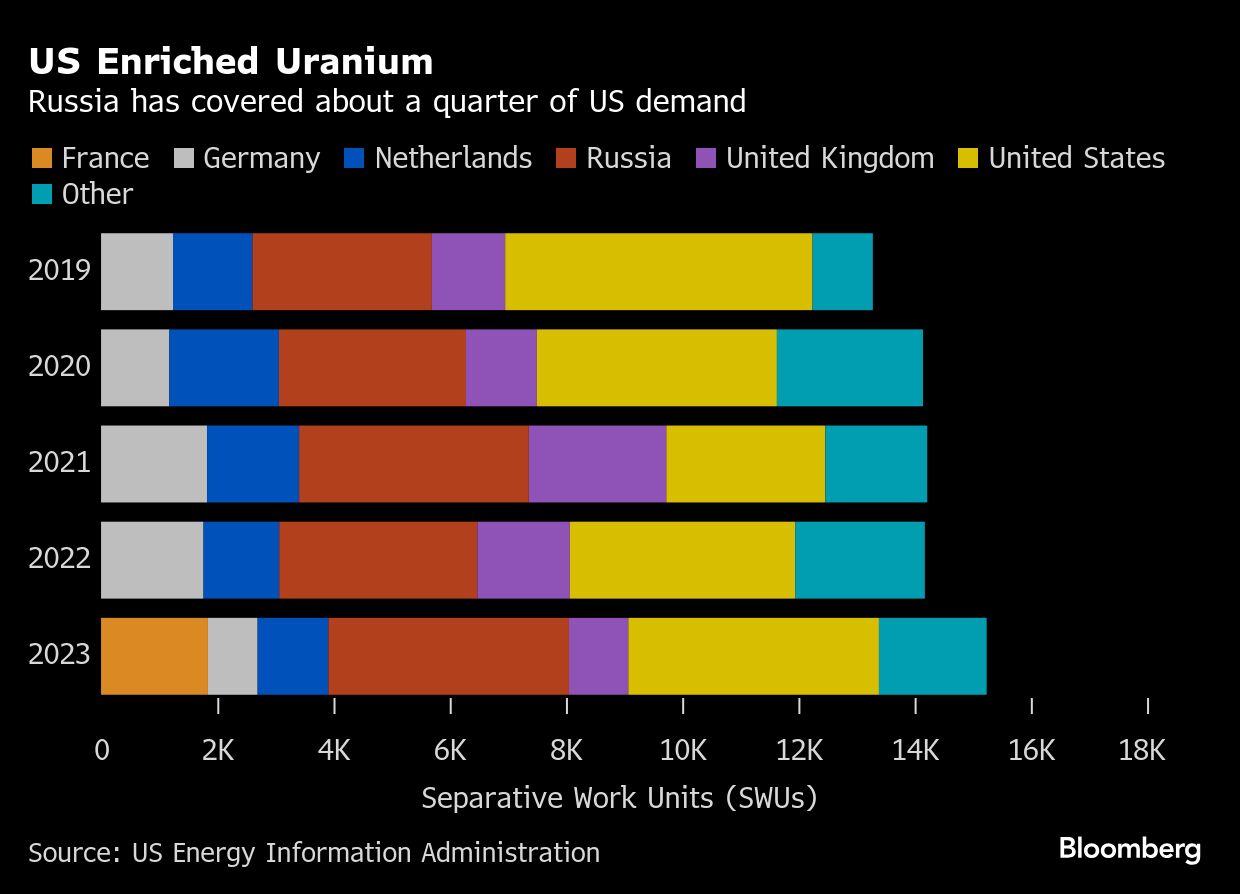
The Trump administration's top energy official has emphasized the importance of increasing the United States' strategic uranium reserve. This move aims to reduce reliance on Russian supplies and bolster confidence in the long-term viability of nuclear power generation. As the demand for electricity rises with the ongoing electrification of the economy, the administration is pushing for a stronger focus on nuclear energy.
US Energy Secretary Chris Wright highlighted this initiative during a recent appearance at the IAEA’s annual general conference in Vienna. He stated that the goal is to eventually eliminate the use of Russian enriched uranium in the US. Wright also expressed hope for rapid growth in uranium consumption from both large reactors and small modular reactors. He emphasized the need for increased domestic uranium production and enrichment capacity to support this expansion.
Following Wright's comments, shares of uranium mining companies saw significant gains. Cameco Corp. rose as much as 9.4%, Centrus Energy Corp. climbed 9.3%, Uranium Energy Corp. surged over 10%, and Uranium Royalty Corp. jumped as much as 13% in US trading.
The concept of a uranium reserve was first proposed by the Trump administration in 2020, with an initial request for $150 million to purchase uranium directly from US producers. Although Congress only allocated half of that amount, the idea gained traction under the Biden administration as well. In 2022, the US Energy Department awarded contracts to miners such as Energy Fuels Inc. and Uranium Energy for the purchase of hundreds of thousands of pounds of uranium for the reserve.
Current data from the International Atomic Energy Agency (IAEA) reveals that the US holds an average of just 14 months of uranium inventory. This is significantly lower than the stockpiles maintained by European and Asian countries. The European Union has enough fuel to power existing reactors for two-and-a-half years, while China maintains stockpiles equivalent to 12 years of current generation.
Wright noted that the US is working diligently to reshape its nuclear-fuel supply chains. In May 2024, the Biden administration passed legislation requiring utilities to shift away from Russian uranium supplies by 2028. However, Russia retaliated by temporarily limiting exports of enriched uranium to the US six months later.
While Wright did not specify the exact amount of additional uranium inventory the US should build, he suggested that the increase could be measured on a sliding scale as more reactors are constructed. Currently, the US has only two commercial enrichment facilities. The largest one, located in New Mexico and owned by the British, Dutch, and German consortium Urenco Ltd., produces fuel for traditional light-water reactors. Another facility in Ohio, operated by Centrus Energy, recently began separating uranium isotopes for new models of advanced reactors that require higher enrichment levels.
The White House issued an executive order in May aimed at accelerating the deployment of advanced reactors. The energy department expects the first of these models to undergo testing by next year.
Historically, the nuclear fuel-making industry has been dominated by state-controlled entities due to the dual-use nature of the industrial processes involved. However, Wright mentioned the potential for private capital to play a larger role in this sector. He pointed to Peter Thiel’s General Matter Corp., a startup focused on enriching uranium, as an example of how private innovation can drive progress.
“Efficiency, innovation, and pace are key,” Wright said. “That’s how you drive progress.”
With ongoing efforts to strengthen domestic uranium production and reduce dependence on foreign sources, the future of nuclear energy in the US looks increasingly promising.

Posting Komentar untuk "U.S. Seeks to Expand Uranium Stockpiles for Nuclear Energy"
Posting Komentar