
Will Weak Markets Keep MercadoLibre's Costs High?
Overview of MercadoLibre’s Market Position
MercadoLibre has become a leading force in Latin America, dominating both the e-commerce and fintech sectors through its Mercado Libre Marketplace and Mercado Pago services. However, the company faces significant challenges as macroeconomic pressures in its primary markets threaten to impact its ability to maintain profitability while continuing to grow.
Inflation across these core markets remains high, with Brazil experiencing an inflation rate of 5.13%, Mexico at 3.57%, and Argentina soaring to 33.6%. These figures indicate that costs are likely to remain elevated for the foreseeable future. In Brazil, transportation and labor expenses continue to rise, while in Mexico, logistics relief is limited. For Argentina, the extreme inflation poses serious challenges for credit operations, making expansion more expensive and complex.
Impact of Macroeconomic Conditions on MercadoLibre
The weak economic conditions have already begun to affect MercadoLibre's performance. During the second quarter of 2025, sales and marketing expenses increased by nearly 50% in dollar terms. This surge was driven by the need for heavier discounts to keep demand steady among inflation-hit consumers. Additionally, logistics expansion added recurring fixed costs, and credit growth reached $9.3 billion, up 91% year over year. However, this growth came at a cost, as the Net Interest Margin After Losses fell to 23% from 31.1%.
Despite strong segmental growth in both commerce and fintech, profitability gains did not match the revenue expansion. MercadoLibre is investing in automation and fulfillment efficiency to manage rising costs, but these efforts may not be enough to stabilize margins in the near term. Operating margin contracted by 210 basis points to 12.2%, showing the pressure on profitability, which is unlikely to ease quickly.
Revenue Projections and Expansion Challenges
The Zacks Consensus Estimate for revenues in the third quarter of 2025 is set at $7.27 billion, with Brazil expected to contribute $3.82 billion, Mexico $1.63 billion, and Argentina $1.66 billion. While MercadoLibre aims for rapid expansion, sustaining this growth will require substantial subsidies, increased logistics spending, and expanded credit exposure. Given the high inflation rates in its core markets, these conditions are expected to keep costs elevated, further pressuring profitability.
Competitive Landscape and Vulnerability
Unlike MercadoLibre, which is heavily concentrated in Brazil, Mexico, and Argentina, other competitors like Amazon and Sea Limited have broader geographic footprints. Amazon operates across North America, Europe, and Asia-Pacific, reducing its exposure to single-region inflation risks. Its scale in developed markets provides a buffer against rising logistics costs in Latin America. Similarly, Sea Limited faces emerging market pressures through Shopee, but its reach extends to Southeast Asia and Latin America, offering better risk distribution compared to MercadoLibre’s three-country focus.
Share Price Performance and Valuation
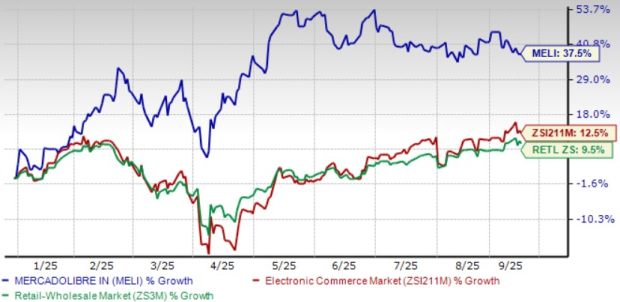
MercadoLibre's shares have risen 37.5% year-to-date, outperforming the Zacks Internet–Commerce industry and the Zacks Retail-Wholesale sector, which saw increases of 12.5% and 9.5%, respectively. From a valuation perspective, MELI stock is currently trading at a forward 12-month Price/Sales ratio of 3.59X, higher than the industry average of 2.26X. The company has a Value Score of D, indicating potential concerns for investors.
The Zacks Consensus Estimate for 2025 earnings is pegged at $44.43 per share, with a recent downward revision of 20 cents over the past 30 days. This estimate suggests a 17.88% year-over-year growth. However, MercadoLibre currently carries a Zacks Rank #4 (Sell), signaling caution among analysts.

Posting Komentar untuk "Will Weak Markets Keep MercadoLibre's Costs High?"
Posting Komentar