
China's J-35 vs. F-15EX: Who Wins?
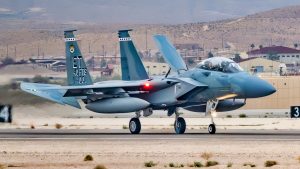
Overview of the F-15EX Eagle II and China’s J-35
The F-15EX Eagle II and China’s J-35 represent two distinct approaches to modern air superiority. The F-15EX is a heavily upgraded version of the classic F-15 Falcon, designed to dominate in open combat with its overwhelming firepower, speed, and survivability. In contrast, the J-35 is China’s latest fifth-generation stealth fighter, developed from the FC-31 Gyrfalcon tech demonstrator. It emphasizes low observability and advanced sensor fusion for a "first look, first shot" advantage in beyond visual range (BVR) combat.
Design and Capabilities
The J-35 features a blended wing-body configuration, canted vertical stabilizers, and internal weapons bays that reduce its radar cross-section. Its diverterless supersonic inlets and radar-absorbent materials further enhance its stealth profile. The aircraft is equipped with an electro-optical targeting system and infrared search and track capabilities, allowing it to detect and engage targets passively. While its top speed is estimated at around Mach 1.8, its stealth and sensor fusion give it a significant advantage in BVR combat.
On the other hand, the F-15EX is not stealthy but compensates with a massive payload capacity, advanced electronic warfare systems, and powerful radar. It can carry up to 22 air-to-air missiles, including long-range standoff weapons like the AGM-158 JASSM. The F-15EX is designed to dominate in open combat and serve as a force multiplier in networked warfare environments. Its top speed exceeds Mach 2.4, and it can operate at altitudes up to 60,000 feet, giving it superior kinetic performance compared to most modern fighters.
Stealth Capabilities
Stealth is a critical factor in modern aerial combat. The J-35 is built from the ground up as a fifth-generation stealth fighter, featuring a low observable airframe with internal weapons bays, radar-absorbent materials, and carefully shaped surfaces to minimize radar cross-section. Its diverterless supersonic inlets and canted vertical stabilizers further reduce its radar signature, making it difficult to detect in BVR combat.
In contrast, the F-15EX is not a stealth aircraft; it retains the conventional design of the original F-15, with large external weapons pylons and a prominent radar cross-section. While it incorporates advanced electronic warfare systems like EPAWSS and passive sensors such as IRST to help detect stealthy adversaries and reduce its vulnerability, it cannot match the inherent low observability of the J-35. Thus, in terms of stealth, the J-35 holds a clear advantage.
Avionics and Internals
In terms of avionics, the F-15EX is equipped with the AN/APG-82 AESA radar, the IRST21 infrared sensor pod, and the Eagle Passive/Active Warning Survivability System (EPAWSS), which provides advanced electronic warfare capabilities. It also features the Advanced Display Core Processor II, one of the most powerful mission computers ever installed in a fighter jet. These systems allow the F-15EX to operate as a command-and-control node, coordinating with other assets in a joint force environment.
Unfortunately, when it comes to the J-35’s electronics and internals, all we can do is speculate. It is believed to include a Chinese-developed AESA radar, helmet-mounted displays, and sensor fusion capabilities similar to those found in other fifth-generation fighters like the F-22 and J-20. Its internal weapons bays can carry up to six air-to-air missiles, typically the PL-15E for long-range engagements and the PL-10 for short-range combat. While it can carry external stores, doing so compromises its stealth profile.
Engine Performance
The F-15EX is powered by two General Electric F110-GE-129 engines, each producing around 29,500 pounds of thrust, giving it exceptional speed, acceleration, and a top speed exceeding Mach 2.4. This high thrust-to-weight ratio allows the F-15EX to climb rapidly, maneuver aggressively, and carry heavy payloads without sacrificing performance.
Comparatively, the J-35 is believed to use either the WS-13X or the more advanced WS-21 engines (sources vary), each generating approximately 21,000 pounds of thrust. While sufficient for supersonic flight and agile maneuvering, the J-35’s engines do not match the raw power of the F-15EX. However, the J-35 compensates with a lighter airframe and stealth-optimized design, prioritizing low observability and efficiency over brute force. As a result, the F-15EX holds the edge in raw engine performance, while the J-35 leverages its engines to support stealth and agility in a more constrained power envelope.
Combat Scenarios
In a BVR encounter, the J-35’s stealth would likely allow it to detect and engage the F-15EX before being seen. Its PL-15E missiles, which are believed to have a range comparable to or exceeding the AIM-120 AMRAAM, could give it a "first look, first shot" advantage. However, the F-15EX’s IRST and electronic warfare systems might allow it to detect the J-35’s emissions or heat signature, enabling it to evade or counterattack.
In a within visual range (WVR) dogfight, the F-15EX would likely have the upper hand due to its superior thrust-to-weight ratio, maneuverability, and missile load. Its ability to carry a large number of AIM-9X Sidewinders and its high-speed performance would make it a formidable opponent. The J-35’s agility and helmet-mounted sighting systems could help level the playing field, but its smaller payload and lower thrust would be limiting factors.

Posting Komentar untuk "China's J-35 vs. F-15EX: Who Wins?"
Posting Komentar