
A Mysterious Gamma-Ray Burst Defies All Expectations
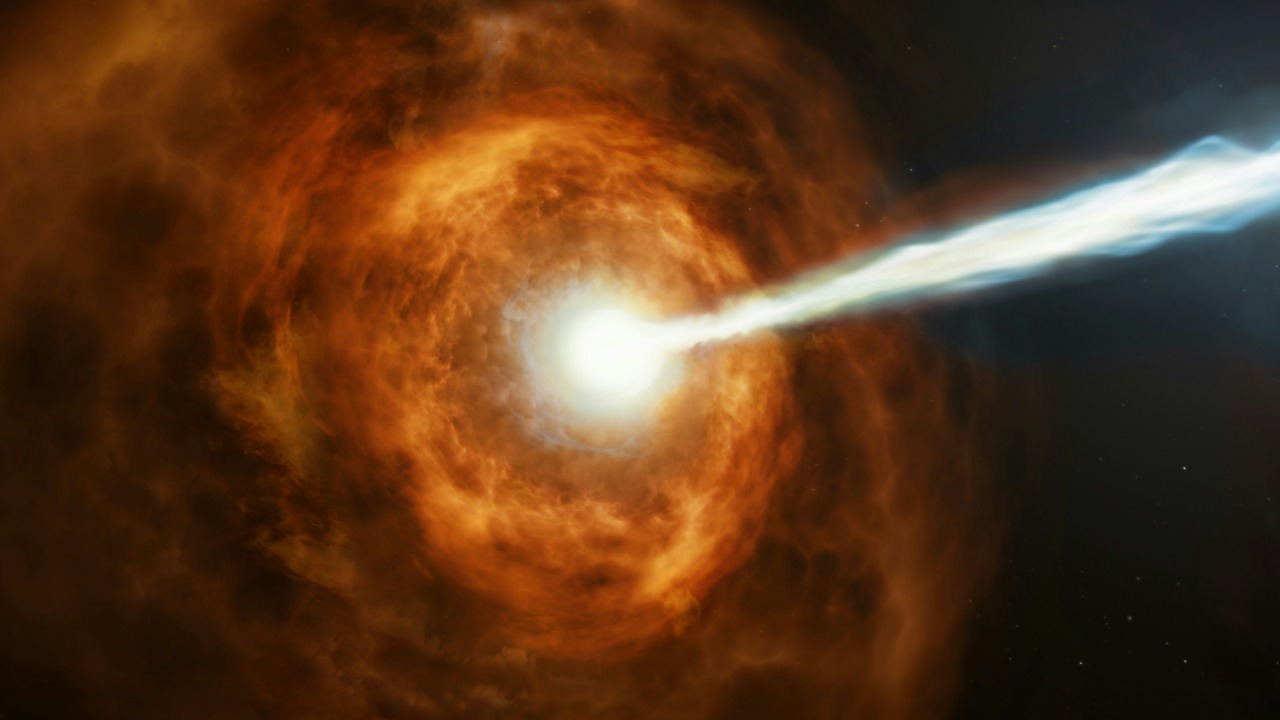
A Burst That Defied Expectations
When a distant galaxy briefly outshines everything around it in high-energy light, astronomers usually have a set of familiar scenarios to consider. Gamma-ray bursts (GRBs) are typically categorized into two main types: short bursts from the collision of stellar remnants and long bursts from the collapse of massive stars. However, earlier this year, a peculiar event known as GRB 250702B broke these conventions, challenging scientists to rethink what they know about these cosmic explosions.
The event did not behave like any standard gamma-ray burst. Instead of a single spike of radiation, it produced multiple bursts over the course of a day, an unusual pattern that immediately caught the attention of researchers. This repeating behavior suggested a unique process at play, one that defied the typical models of stellar explosions.
Breaking 50 Years of Patterns
For half a century, gamma-ray bursts have been classified based on their duration and energy source. Short bursts are linked to mergers of compact objects like neutron stars, while long bursts are associated with the collapse of massive stars. GRB 250702B, however, does not fit neatly into either category. It exhibits the long duration and bright afterglow of a stellar collapse but also shows repeated flares more akin to those seen in merger-driven events.
This anomaly has led to intense debate among astronomers, who are now exploring new possibilities for its origin. Some suggest it could be the result of a merger between two dead stars, while others propose it might be a collapsing giant star that somehow prolonged and modulated its energy release.
A Strange Light Show in a Distant Galaxy
Once the initial gamma-ray flashes were detected, telescopes across the spectrum turned their attention to the source. Optical and infrared images revealed a faint host galaxy and a bright afterglow that slowly faded, a signature of a powerful explosion interacting with surrounding gas. However, the way the afterglow brightened and dimmed, along with the repeated high-energy spikes, suggested that the central engine was not shutting off cleanly as expected.
Follow-up observations indicated that the burst was caused by an extraordinary event, though the exact nature remains unclear. Scientists are still working to determine whether it was a merger or a collapsing star, highlighting the complexity of interpreting such rare phenomena.
Two Possible Explanations
The competing theories for GRB 250702B reflect a fundamental question in astrophysics: how do extreme objects behave? One theory suggests the event could be the product of a merger between compact remnants, such as neutron stars or a neutron star and a black hole. Another proposes that it might be a massive star collapsing in a way that prolongs and modulates the energy release, possibly through a rapidly spinning core or a newborn magnetar.
Despite the uncertainty, the scientific community is actively investigating both possibilities. Researchers have noted that the event is unlike anything they have witnessed before, emphasizing the need for further study to understand its origins.
Unprecedented Observations
The language used by scientists to describe GRB 250702B is particularly striking. Many have called it "unlike anything we have ever witnessed before," highlighting how far the data deviate from established models. This kind of phrasing reflects the challenge of interpreting an event that defies conventional understanding.
The team involved in the discovery has emphasized that the findings are significantly stranger than expected, suggesting that the event may point to an even more exotic black hole or other phenomenon. These observations have sparked widespread interest, with researchers quickly mobilizing a global network of instruments to gather more data.
ESO’s Role in the Hunt for Clues
To better understand GRB 250702B, astronomers have turned to some of the most powerful observatories on Earth and in space. The European Southern Observatory’s Very Large Telescope (VLT) and the James Webb Space Telescope have played a critical role in capturing detailed images and spectra of the event.
These instruments are being used to track the fading afterglow and any slower, redder light from radioactive debris. By combining data from different telescopes, researchers hope to uncover more clues about the nature of this unusual burst.
The Challenge of Repeating Patterns
One of the most puzzling aspects of GRB 250702B is its repeating gamma-ray output. In standard models, a collapsing star produces a single burst as the core implodes and launches jets. Mergers, on the other hand, produce brief but intense flashes. Neither scenario naturally explains the multiple episodes of high-energy emission observed in this case.
Scientists have noted that the burst appeared several times throughout a day, with instruments in the Netherlands detecting its repeated flares. This pattern has become a central focus of the research, as it defies easy explanation and challenges existing theories.
A Broader Pattern of Anomalies
GRB 250702B is not the only recent gamma-ray burst to challenge the field’s assumptions. Over the past few years, observers have documented several events that blur the line between short and long bursts or exhibit unusual afterglows. These anomalies suggest that the traditional two-category system may be too simplistic.
The new burst fits into this emerging pattern of anomalies, pushing the boundaries further by combining a long duration, a bright afterglow, and a repeating high-energy signal. This has led to renewed discussions about the origins of gamma-ray bursts and the need for updated models.
What Future Observations Could Reveal
Currently, GRB 250702B remains in a state of uncertainty, with multiple plausible explanations but no definitive evidence. Continued monitoring of the explosion’s fading light and environment will be crucial in determining its true nature.
Late-time observations can reveal whether a supernova emerges, whether the host galaxy shows signs of recent star formation, or whether any lingering emission hints at a compact remnant. These insights could help scientists refine their models and better understand the physics behind such extreme events.
Why This One Burst Matters
While GRB 250702B may seem like an isolated curiosity, it has significant implications for our understanding of the universe. Gamma-ray bursts are among the brightest beacons in the cosmos, visible across billions of light-years, and they trace some of the most extreme physics in nature.
When one of them behaves in a way that standard models cannot easily reproduce, it signals that our understanding of these extremes is incomplete. This gap can ripple outward into how we think about black holes, neutron stars, and the life cycles of galaxies.
As more data arrive from the VLT, the James Webb Space Telescope, and other observatories, this odd gamma-ray burst may shift from being an outlier to a key that unlocks a richer, more nuanced picture of the most violent events in the cosmos.

Posting Komentar untuk "A Mysterious Gamma-Ray Burst Defies All Expectations"
Posting Komentar