
Don't Waste Energy on Claims of Tiny Japanese Air Generators
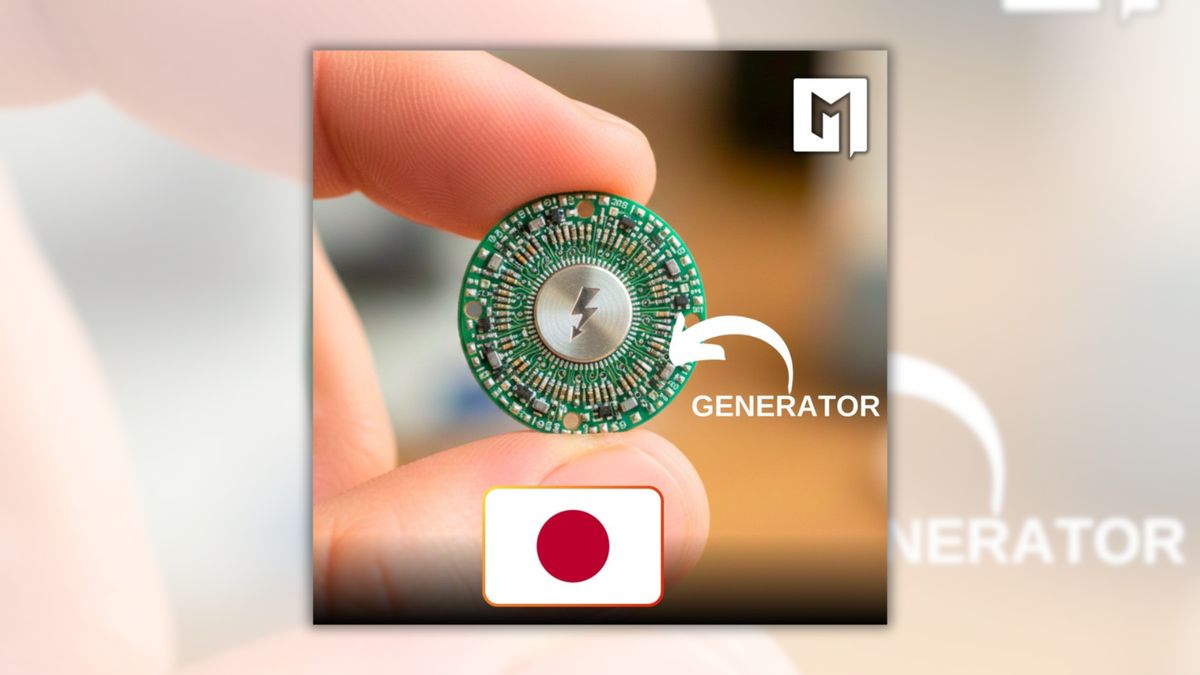
The Claim: A Coin-Sized Generator That Creates Electricity "Out of Thin Air"
In December 2025, a post circulated on social media platforms, including Facebook and Instagram, claiming that Japanese researchers at Kyoto University had developed a coin-sized generator capable of producing electricity "out of thin air." According to the post, this device could generate power 24/7 without any moving parts by harvesting energy from humidity. It was also said to have been successfully tested in rice paddies across Southeast Asia, powering sensors for months.
Similar claims had appeared on social media for months before the December posts, with one version dating back to August 2025. These posts often included images of what appeared to be an AI-generated device shaped like a coin, alongside descriptions that suggested the technology was already in practical use.
However, upon closer examination, these claims were found to be misleading or entirely false.
The Reality: No Evidence of a Kyoto University Invention
HAWXTECH.NET conducted a thorough search to verify the claim, using multiple Google searches such as "kyoto university humidity generator," "Moisture-electric generators kyoto university," and "kyoto university coin generator." Despite these efforts, no credible research or reporting from Kyoto University about such an invention was found.
Further searches for evidence of the device being used in rice paddies in Southeast Asia also turned up nothing beyond the social media posts spreading the claim. Instead, the research team found references to real studies on moisture-based energy generation, but none linked to Kyoto University.
One of the key findings was that much of the research on moisture-electric generators has been led by Chinese universities and laboratories. These devices aim to produce energy from humidity by utilizing properties of water droplets similar to those involved in lightning formation. However, according to a 2023 article from Science News Explores, the power output of these devices is still too low for practical applications.
The Technology Behind Moisture-Electric Generators
Moisture-electric generators are designed to convert humidity into electricity by leveraging the movement of water molecules. This concept has been explored in various scientific papers, many of which focus on improving the efficiency of these devices through the use of different materials.
A project funded by the European Union is also working to enhance the feasibility of this technology. In August 2025, Popular Mechanics reported on a related device that generates electricity from evaporation. While the magazine described the device as having "no moving parts required," it also noted that further improvements were needed before it could be used practically.
Red Flags in the Social Media Posts
Despite the scientific basis of some of the research, the social media posts promoting the Kyoto University generator contained several inconsistencies. For example, some posts claimed the device was "matchbox-sized" while showing an image of a coin-shaped object, suggesting the image may have been generated by artificial intelligence.
Additionally, the image accompanying one of the posts had a watermark that appeared to be altered, raising questions about its authenticity. This image was traced back to an earlier post from August 2025, which also included AI-generated images of rice paddies where the technology was supposedly tested.
Conclusion: A Mixture of Real Research and Misinformation
While the concept of generating electricity from humidity is not entirely fictional, the specific claims about a coin-sized generator developed by Kyoto University lack credible evidence. The information shared in the social media posts appears to be a mix of real scientific research and exaggerated or fabricated details.
As with many viral claims, the posts spread the idea quickly without proper verification. This highlights the importance of fact-checking when encountering seemingly groundbreaking scientific discoveries online.
Related Research and Development
Although Kyoto University did not develop the device in question, there are ongoing efforts to improve moisture-based energy technologies. For instance, a 2025 study published in the Chemical Engineering Journal explored the use of cellulose nanofiber aerogels for moisture-enabled electricity generation. Another article from Science News Explores discussed the potential of such devices to harvest clean energy from humid air.
These developments suggest that while the Kyoto University generator may not exist, the broader field of moisture-based energy is still an area of active research with promising possibilities.
Final Thoughts
The story behind the Kyoto University generator serves as a reminder that not all scientific breakthroughs shared online are accurate. As new technologies emerge, it is essential to approach such claims with skepticism and seek out reliable sources of information.
For now, the coin-sized generator that powers itself from humidity remains a concept rather than a reality. However, the research surrounding it continues to evolve, offering hope for future innovations in renewable energy.

Posting Komentar untuk "Don't Waste Energy on Claims of Tiny Japanese Air Generators"
Posting Komentar