
Giant Sunspot Threatens Earth with Historic Magnetic Storm
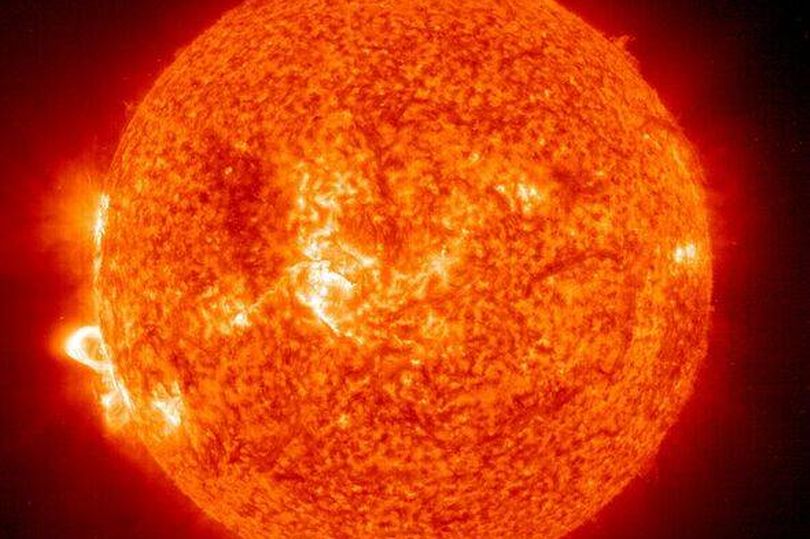
A massive sunspot cluster has appeared on the sun's Earth-facing side, drawing attention from scientists and space enthusiasts alike. This particular formation is roughly the size of the one that caused the most powerful solar storm ever recorded, known as the Carrington Event. However, experts are urging people to remain calm, emphasizing that while auroras and minor technological disruptions may occur in the coming days, this new sunspot cluster is highly unlikely to trigger another event of such magnitude.
The sunspot group, designated AR 4294-4296, consists of two magnetically linked sunspot groups, AR 4294 and AR 4296. It became visible on November 28 as it rotated into view on the sun's western edge. Interestingly, NASA's Perseverance Mars rover had already detected these dark regions a week before they became visible from Earth, as it was monitoring the sun's far side.
• Solar storm tsunami predicted 'to strike earth today' with devastating consequences
• Stephen Hawking’s terrifying ‘dark forest’ alien theory ‘more plausible than ever’
New sunspot cluster approaches 90% of historic Carrington Event sunspot's dimensions.
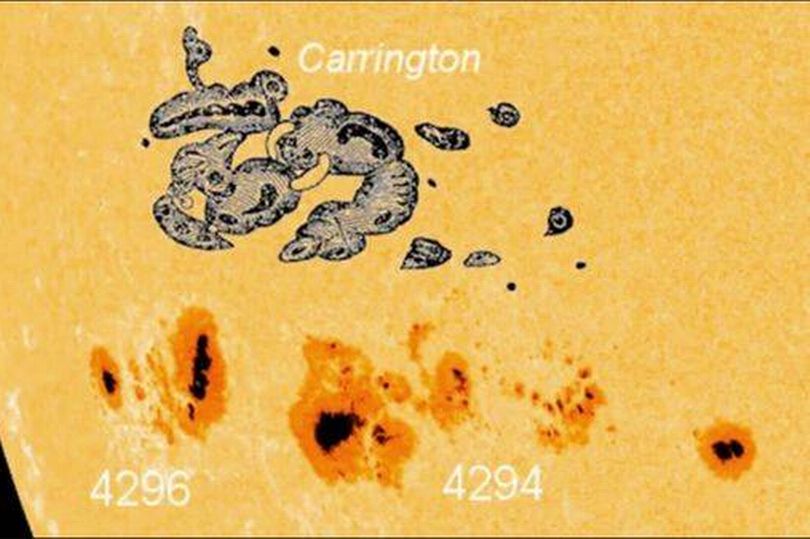
According to reports, AR 4294-4296 measures close to the dimensions of the massive sunspot documented by British astronomer Richard Carrington in September 1859. That sunspot led to the "Carrington Event," the strongest solar storm in human history. While the current complex may appear larger at first glance, its dark regions actually span about 90% of the Carrington sunspot's area.
Sunspots can pose a threat due to their potential to produce intense solar flares and coronal mass ejections (CMEs). These eruptions can cause temporary radio blackouts on Earth and send large clouds of plasma hurtling toward our planet. Such events can disrupt Earth's magnetic field and interfere with electronics, while also creating stunning auroras in the night sky.
Spaceweather.com reports that the new dark spots are "one of the biggest sunspot groups of the past 10 years" and have the potential to release supercharged X-class flares, which are the most powerful category on the National Oceanic and Atmospheric Administration's solar flare classification system. If a CME is unleashed, the resulting solar storm "will be geoeffective," they added.
The record-breaking X45 solar flare from the Carrington Event and its possible impact on modern infrastructure is particularly noteworthy. The Carrington Event unleashed an X45 magnitude solar flare, the strongest ever recorded, although geological evidence suggests even more powerful blasts occurred before human existence. An X45 flare is over five times stronger than the most potent solar flare of the past decade—an X7 blast in October 2024.
Recent simulations suggest that if a similar blast hit Earth today, it would wipe out all satellites in orbit and cause chaos on the ground, potentially damaging parts of the electrical grid, with total damages easily surpassing $1 trillion.
However, size isn't everything when it comes to solar flares. The magnetic field configuration and explosion frequency also play crucial roles. While larger sunspots can potentially trigger more powerful solar flares, size alone doesn't guarantee a massive solar storm. The arrangement of a sunspot's magnetic field and how often it erupts are key factors in determining its maximum explosive potential, meaning some giant sunspots can be entirely harmless.
The magnetic fields of AR 4294-4296 are quite intertwined, suggesting that flares are possible. According to Spaceweather.com, the complex has already released a potential X-class flare while still on the sun's far side. Despite this, experts say there's no clear indication of a superstorm on the level of the Carrington Event in the near future.
Scientists are keeping a close watch on AR 4294-4296's magnetic field for indicators of approaching activity. Researchers will be paying particularly close attention to the magnetic field of the latest giant for hints of upcoming activity. However, if it happens to spin past Earth without any eruptions, the massive dark patches are probably substantial enough to endure more than one journey around the sun, suggesting they could return for "round two" sometime around Christmas.
As the enormous sunspot cluster AR 4294-4296 aims directly at Earth, specialists encourage the public to stay composed and avoid alarm. While auroras and some technological disruptions are possible during the upcoming week, the probability of a second Carrington Event remains minimal. Researchers will continue to carefully observe the complex's magnetic field for indicators of approaching activity and evaluate its potential impact on our planet.

Posting Komentar untuk "Giant Sunspot Threatens Earth with Historic Magnetic Storm"
Posting Komentar