
iBuyPower Element Pro R07 Ready System
Configurations: Power Ready for Everyone
iBuyPower offers both custom-built systems and a wide selection of ready-to-ship RDY models, including the RDY Element Pro R07 featured in this review. This high-performance gaming desktop includes a liquid-cooled AMD Ryzen 7 9800X3D CPU, the Nvidia GeForce RTX 5070 Ti GPU, 32GB of DDR5 RAM, a 2TB SSD, and Windows 11 Home. It also includes an RGB-lit keyboard and mouse and exceeds most competitors with a generous warranty: two years on parts and three years on labor.
Buyers with varying budgets will find a wide range of options. As of this writing, iBuyPower sells eight pages of RDY systems on its website, with additional configurations available through retailers like Best Buy and Newegg. For example, you can upgrade our test machine's CPU to an AMD Ryzen 9 9950X3D, which is $100 more expensive, and swap in an AMD Radeon RX 9070 XT GPU. With this kind of selection, most sensible CPU/GPU combinations are likely to be available in an RDY variant. Of course, you can also choose a custom model that is tailored to your exact desires, which iBuyPower ships within a week.
iBuyPower is typically price-competitive, but our review model, at $2,599, is substantially pricier than the $2,199 Alienware Aurora, which features an Intel Core Ultra 7 265KF and otherwise similar specs. (However, we've seen the iBuyPower model beat the Aurora on sales by at least $100.) Meanwhile, the $1,879 Lenovo Legion Tower 5 Gen 10 includes an older Ryzen 7 7800X3D, as well as a GeForce RTX 5070 and a smaller 1TB SSD. Notably, neither rival offers a standard warranty as extensive as iBuyPower’s, and the RDY 07 edged ahead in many graphics and gaming tests.
Design: A Glass Showcase
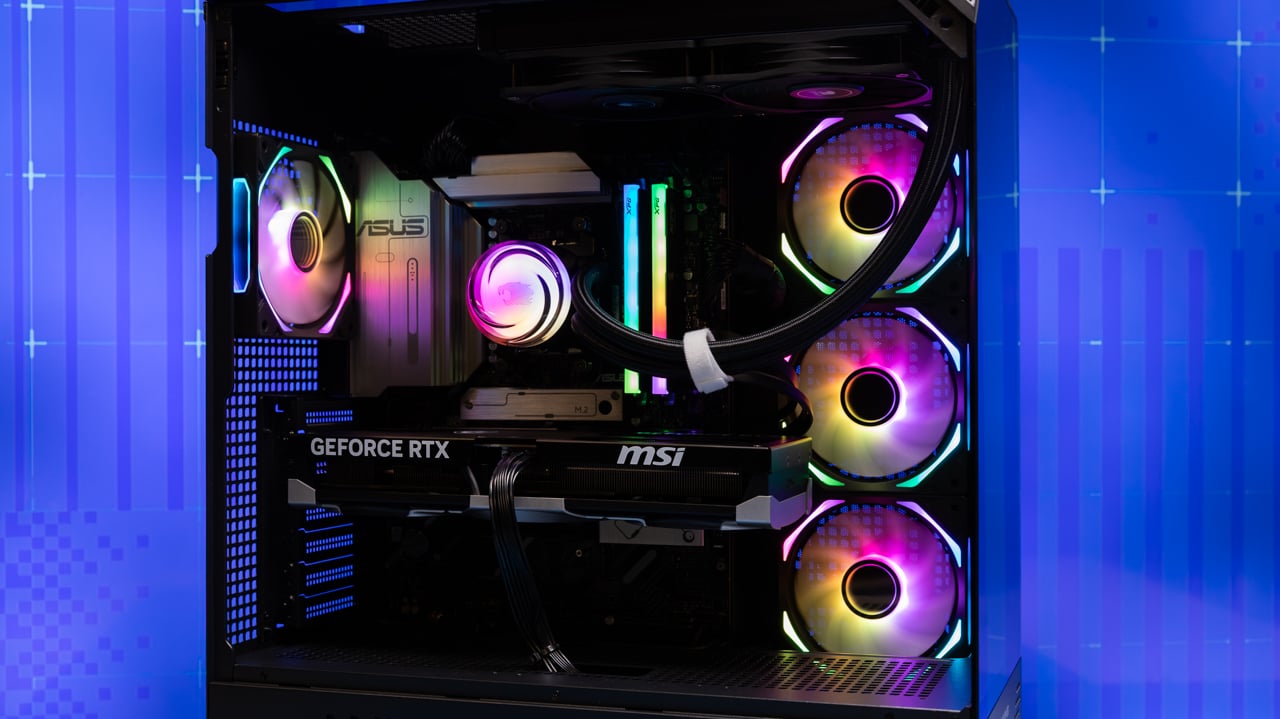
Those seeking a visually outstanding desktop will do quite well with this iBuyPower Element Pro. Its aquarium-style chassis features edge-to-edge front and left panels, offering a seamless interior view. The top panel continues the theme with a mostly glass surface and a cutout for a removable exhaust grate. Combined with the rolled steel framing of the rest of the case, this build exudes a premium, modern aesthetic. Measuring 17.4 by 9.1 by 20 inches (HWD), the Element Pro lands firmly in mid-tower territory.
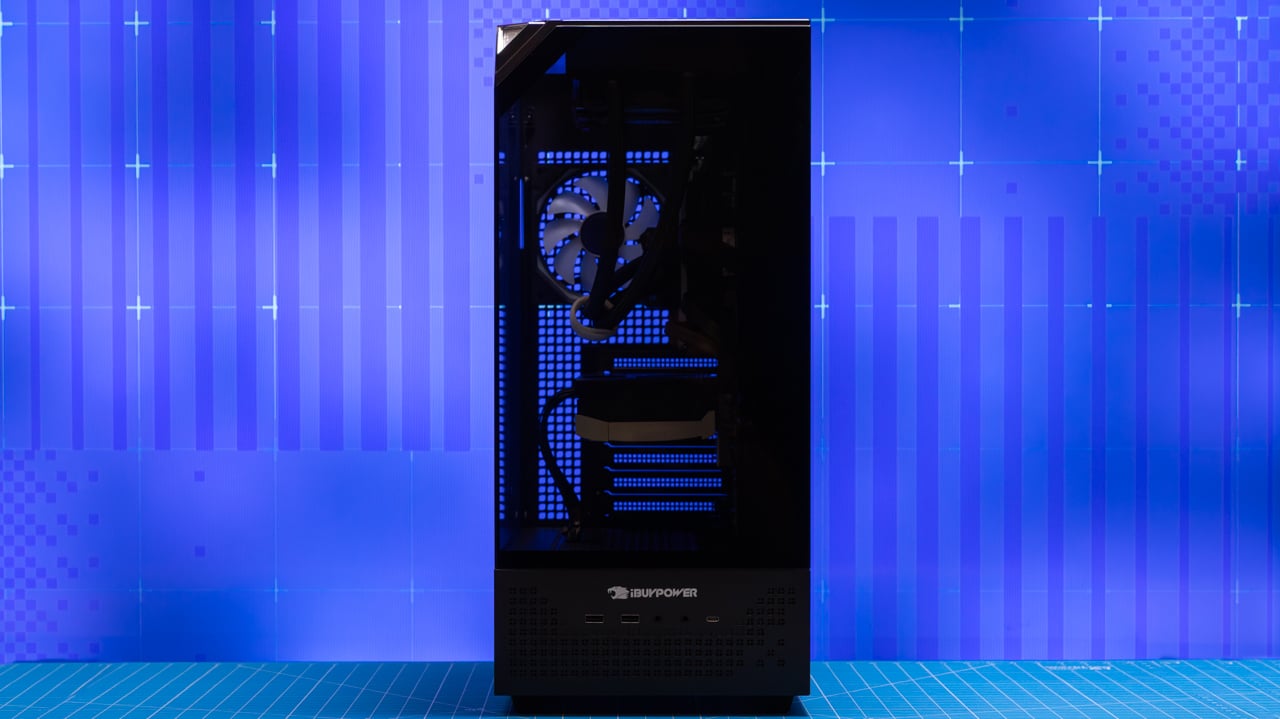
RGB lighting is everywhere inside this tower. Four 120mm fans—three side intakes and one rear exhaust—feature addressable RGB lighting on both the fan blades' housing, creating a layered, vibrant glow. Additional lighting on the CPU waterblock and DDR5 DIMMs adds to the visual spectacle. However, iBuyPower doesn’t preinstall the Asus Armoury Crate software, so users must download it manually to access lighting controls.
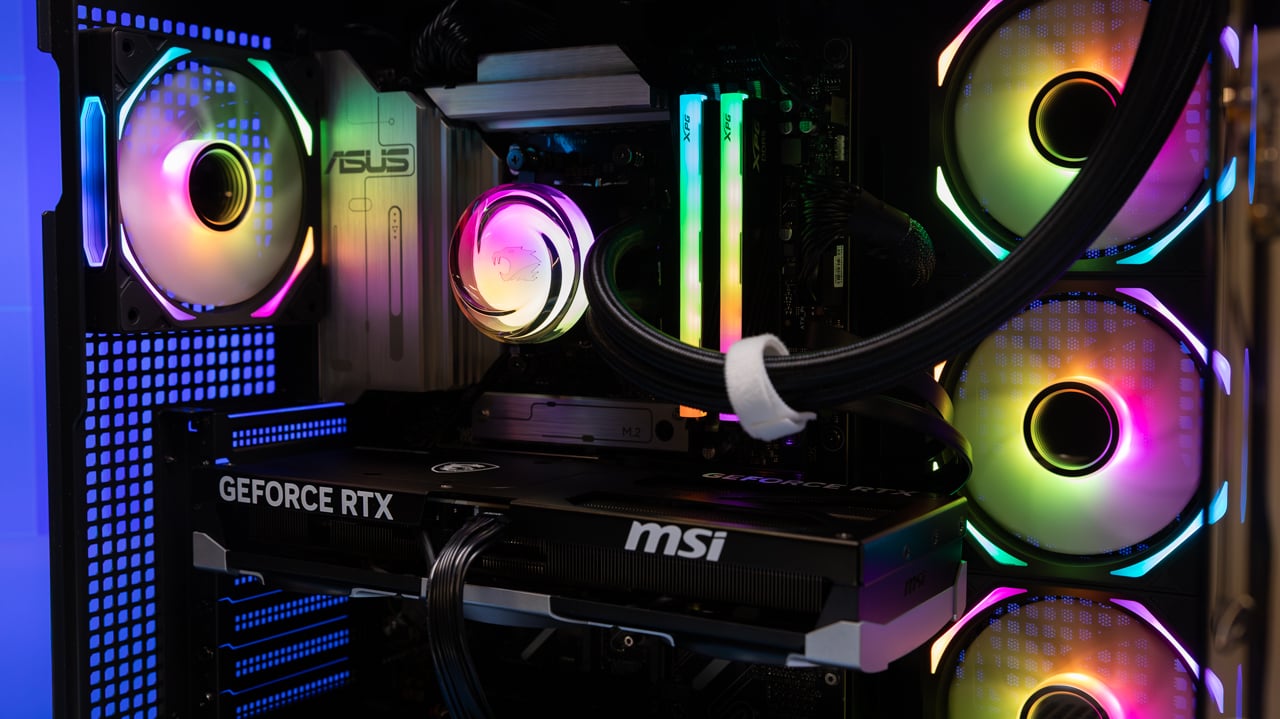
Aura Sync-compatible components include the motherboard, memory modules, and an addressable RGB strip. That strip governs all lighting zones except the DIMMs, which means individual fan colors can’t be customized independently. While it may be possible to add an aftermarket controller for per-fan control, that level of granularity isn’t supported out of the box.
Expansion, Connectivity, and Included Peripherals
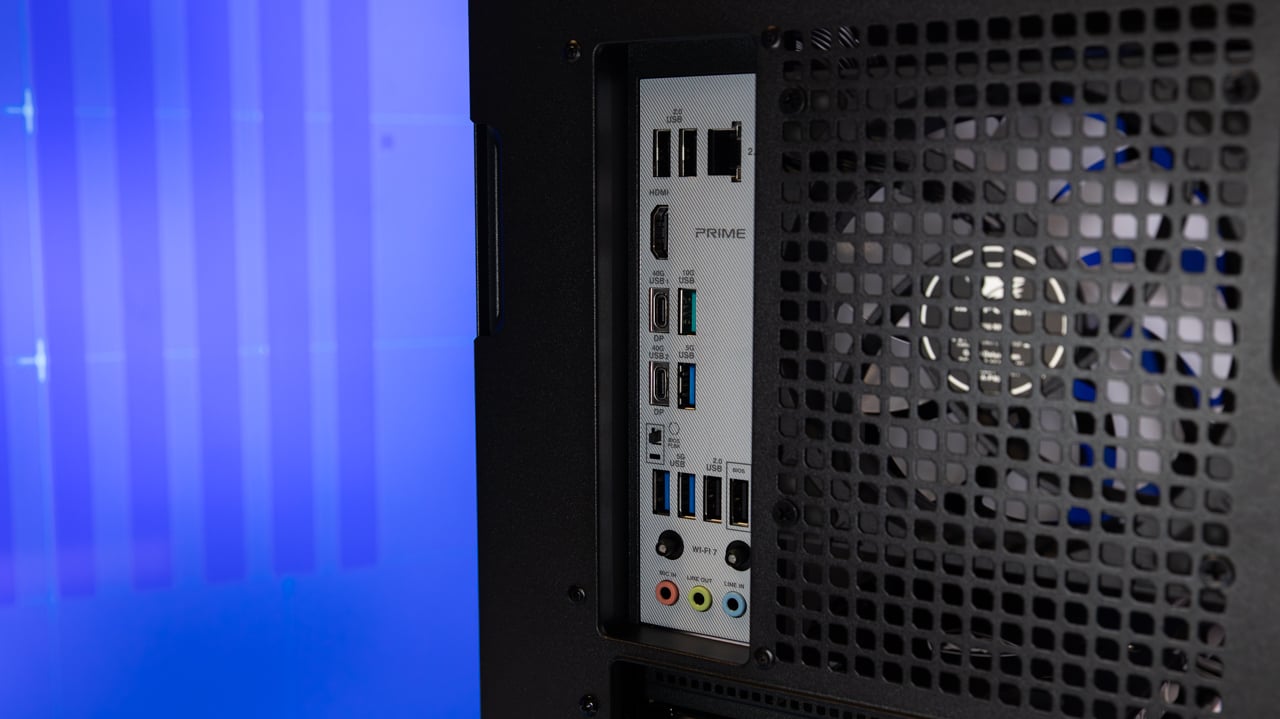
The screwless side panels pop off for quick interior access. Our model's Asus Prime X870-P motherboard, which might differ from what iBuyPower provides in the configuration now, stands out with its silver heatsinks and solid expansion capabilities: four M.2 slots, four DIMM slots, PCI Express 5.0 support, plus Wi-Fi 7 and Bluetooth 5.4 wireless. The case's rear I/O is also excellent, with two USB4 ports, eight USB Type-A ports (including one 10Gbps, three 5Gbps, and four 2.0 ports, one reserved for BIOS updates), a 2.5Gbps Ethernet jack, and audio jacks. The USB4 ports are convenient for high-speed external drives and support DisplayPort output.
Our review unit included the MSI Ventus 3X OC Edition GeForce RTX 5070 Ti. While its triple-fan cooler looks substantial, its lack of RGB lighting seems like a missed opportunity. The GPU ships uninstalled to prevent stress on the motherboard during shipping. While installation is straightforward—I had it up and running within minutes—users unfamiliar with PC assembly may need to seek assistance. Not all iBuyPower systems are this way; I noticed the company offered buyers the option of having the GPU preinstalled on custom models.
The minimal cabling in the main chamber is cleanly routed, though the unsleeved GPU power cables detract slightly from the premium feel. Cable management in the opposite chamber is tidy enough, with zip ties keeping things in place. The non-modular 850-watt power supply contributes to the cable clutter in the lower compartment. The desktop's expansion space features two 2.5-inch bays located behind the motherboard tray and a single 3.5-inch bay in the lower compartment, although accessing the latter requires removing the intake-fan bracket.
The Element Pro does a decent job with acoustics. At idle, the fans emit a low hum that blends into ambient noise. CPU-intensive activity cause the dual 120mm fans on the radiator to ramp up, but the overall noise level is controlled and unobtrusive.
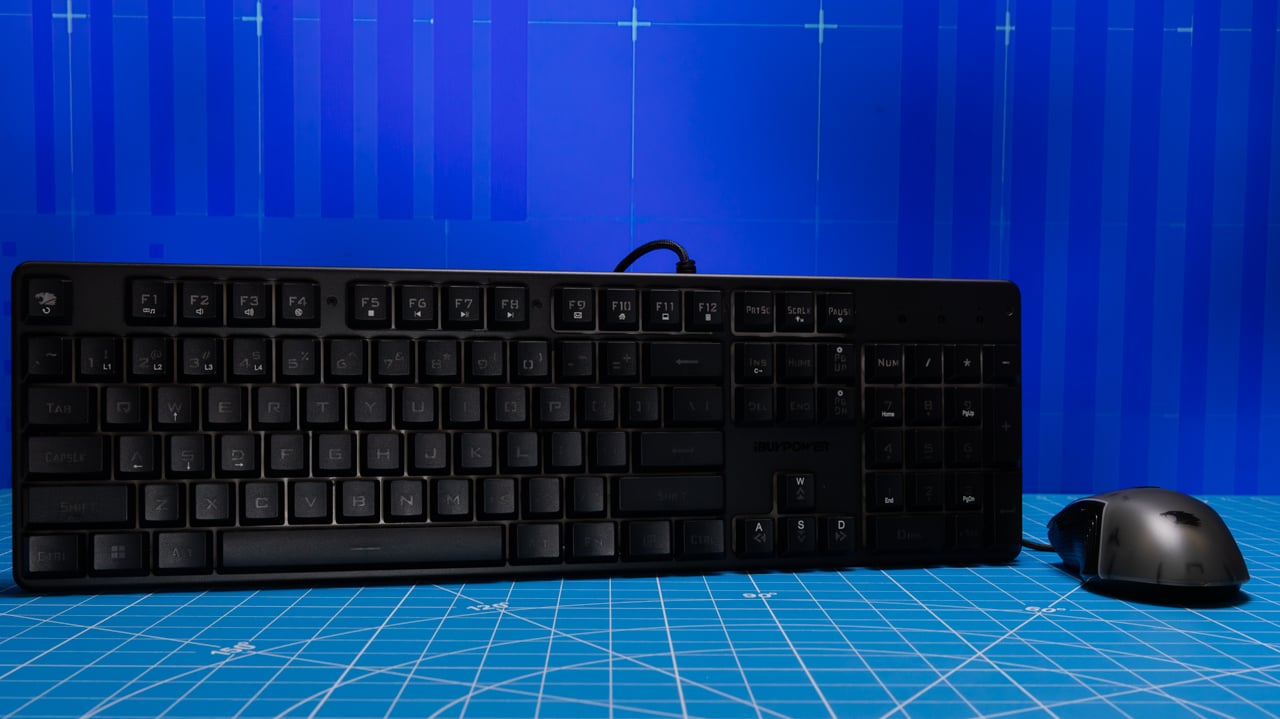
The bundled Chimera KM7 keyboard and mouse combo from iBuyPower is basic, yet a cut above the generic fare often included with prebuilt systems. Neither device supports software-based controls, but both offer on-device adjustments. The mouse features a button underneath to cycle through colors and lighting patterns, with the option to turn off illumination entirely. The keyboard utilizes key combinations: Fn+Scroll Lock to switch modes, Fn+Page Up/Down to adjust brightness, and Fn+Pause to turn off the lighting.
Ergonomically, the mouse is only for right-handers. It fit my medium-size hands comfortably and worked well with my palm-grip style. It includes two side buttons plus a five-step DPI toggle located behind the textured scroll wheel. Meanwhile, the keyboard delivers slightly rubbery but responsive tactile feedback; I had no trouble reaching my usual typing speed in the MonkeyType test. While these peripherals won’t rival premium offerings, they’re perfectly serviceable for getting started.
Performance Testing: Built for Fast Frame Rates
We evaluated the iBuyPower Element Pro in an RDY 07 ready-to-ship configuration featuring a Ryzen 7 9800X3D processor (eight cores, up to 5.2GHz), a GeForce RTX 5070 Ti graphics card, 32GB of DDR5 RAM running at 6,000MHz, and a 2TB PCI Express 4.0 SSD.
For our comparison benchmarks, we put the iBuyPower up against several other gaming rigs. Its closest rival is the Alienware Aurora ($2,299 as tested). Below it sits the Lenovo Legion Tower 5 Gen 10 ($1,879.99). At the high end, we have the compact Corsair One i600 ($4,499.99). For budget-minded buyers, we included the Asus TUF Gaming T500 ($1,299.99). While our iBuyPower configuration isn’t a direct match for all these systems, the company sells variants that align more closely with each.
Productivity and Content Creation Tests
Our primary overall benchmark, UL's PCMark 10, puts a system through its paces in productivity apps ranging from web browsing to word processing and spreadsheet work. Its Full System Drive subtest measures a PC's storage throughput.
Three more tests we rely on are CPU-centric or processor-intensive: Maxon's Cinebench 2024 uses that company's Cinema 4D engine to render a complex scene; Primate Labs' Geekbench 6.3 Pro simulates popular apps ranging from PDF rendering and speech recognition to machine learning; and we see how long it takes the video transcoder HandBrake 1.8 to convert a 12-minute clip from 4K to 1080p resolution.
Finally, workstation maker Puget Systems' PugetBench for Creators rates a PC's image editing prowess with a variety of automated operations in Adobe Photoshop 25.
All these desktops breezed through the PCMark benchmark, where 4,000 points typically mark solid performance. The Element Pro stood out with a near-10,000-point score, an exceptional result that’s rarely surpassed. The Corsair followed closely, with the Alienware slightly trailing. The Element Pro also proved competitive in the PCMark storage test, through Corsair was unmatched there.
The CPU testing tells a more nuanced story. The Element Pro’s Ryzen 7 9800X3D couldn’t match the raw multi-core muscle of the Alienware’s Core Ultra 7 265KF as reflected in Cinebench, Geekbench, and HandBrake results. The Corsair Core Ultra 9 285K dominated, although it falls in a higher tier. Still, the Element Pro excelled in single-core performance, a strength that likely contributed to its top-ranking score in our Photoshop test, where it even edged out the Corsair.
Gaming and Graphics Tests
We challenge all desktops' graphics with a quintet of animations or gaming simulations from UL's 3DMark test suite. The first two, Wild Life (1440p) and Wild Life Extreme (4K), use the Vulkan graphics API to measure GPU speeds. The next pair, Steel Nomad's regular and Light subtests, focuses on APIs more commonly used for game development, like Metal and DirectX 12, to assess gaming geometry and particle effects. Finally, we turn to 3DMark Solar Bay to measure ray tracing performance.
Our real-world gaming testing is based on the in-game benchmarks of Call of Duty: Modern Warfare 3, Cyberpunk 2077, and F1 2024. These three games—all benchmarked at full HD (1080p or 1200p), 2K (1440p or 1600p), and 4K (2160p) resolution—represent competitive-shooter, open-world, and simulation games, respectively.
We run the Call of Duty benchmark at the Extreme graphics preset on desktops. Because the test can produce triple-digit frame rates even on low-end PCs, this approach helps evaluate high-frame-rate performance. Our Cyberpunk 2077 test settings, meanwhile, aim to push PCs to their limit; we run the all-out Ray Tracing Overdrive preset without DLSS or FSR. Finally, F1 2024 represents our test for DLSS effectiveness (or FSR on AMD systems), demonstrating a GPU’s capacity for frame-rate-boosting and upscaling technologies.
While most synthetic 3DMark scores place the iBuyPower Element Pro and the Alienware in a dead heat (save for Steel Nomad), real-world gaming benchmarks clearly distinguish the iBuyPower as the better performer, at least in the CPU-bound 1080p scenarios. There, the Element Pro’s Ryzen 7 9800X3D consistently delivered leading scores, often rivaling the Corsair despite its stronger RTX 5080. That said, the Alienware minimized the gap at GPU-limited 4K resolution.
For gamers, particularly esports players chasing the highest frame rates at lower resolutions, the Ryzen 7 9800X3D is a compelling option. Though it trails the Alienware’s Core Ultra 7 265KF in raw compute, the trade-off is justified for the iBuyPower’s gaming focus. As mentioned, buyers should have little trouble finding an iBuyPower RDY model with a CPU/GPU combo to suit their needs.

Posting Komentar untuk "iBuyPower Element Pro R07 Ready System"
Posting Komentar