
New Device Harnesses Space to Generate Power
A New Approach to Generating Power Using Radiative Cooling
Instead of relying on the sun to produce electricity, a new class of devices generates power by absorbing heat from its surroundings and beaming it into outer space. These devices, which do not require rare or expensive materials, could provide an alternative for ventilating greenhouses and homes, according to researchers.
In 2014, scientists developed superthin materials that can cool buildings without using electricity by radiating heat into space. These materials are designed to emit heat as specific wavelengths of infrared radiation that air does not absorb. This allows the radiation to escape the atmosphere, taking energy with it and cooling the surrounding area through a process known as radiative cooling. Such materials have the potential to reduce the demand for electricity, especially since air conditioning accounts for nearly 15 percent of the electricity used by buildings in the United States alone.
Following this breakthrough, researchers began exploring ways to harness radiative cooling to generate power. Unlike solar cells, which produce electricity from energy flowing into them from the sun, thermoradiative devices could generate power from energy flowing out from them into space.
“Thermoradiative devices operate like solar cells in reverse,” explains Jeremy Munday, professor of electrical and computer engineering at the University of California, Davis. “Rather than pointing them at a hot object like the sun, you point them at a cool object, like the sky.”
However, these early devices typically required semiconductor electronics that relied on rare or costly materials to function efficiently. In a recent study, Munday and his colleagues investigated the use of Stirling engines, which are mechanically simple and do not depend on exotic materials. “They also directly produce mechanical power—which is valuable for applications like air movement or water pumping—without needing intermediate electrical conversion,” he says.
Combining Stirling Engines with Heat-Radiating Antennas
At the core of a Stirling engine is a gas sealed within an airtight chamber. When the gas is heated, it expands, increasing pressure in the chamber; when cooled, it contracts, reducing pressure. This cycle of expansion and contraction drives a piston, generating power.
Unlike internal combustion engines, which require large temperature differences to generate power, Stirling engines are highly efficient even with small temperature variations.
“Stirling engines have been around since the early 1800s, but they always operated by touching some warm object and rejecting waste heat into the local, ambient environment,” Munday says. The new device, however, is heated by its surroundings and cools when it radiates energy into space.
The new system combines a Stirling engine with a panel that functions as a heat-radiating antenna. The researchers tested the device outdoors at night.
Over the course of a year, the device demonstrated more than 10 degrees Celsius of cooling most months, which the team converted into over 400 milliwatts of mechanical power per square meter. They used the invention to directly power a fan and also connected it to a small electrical motor to generate current.
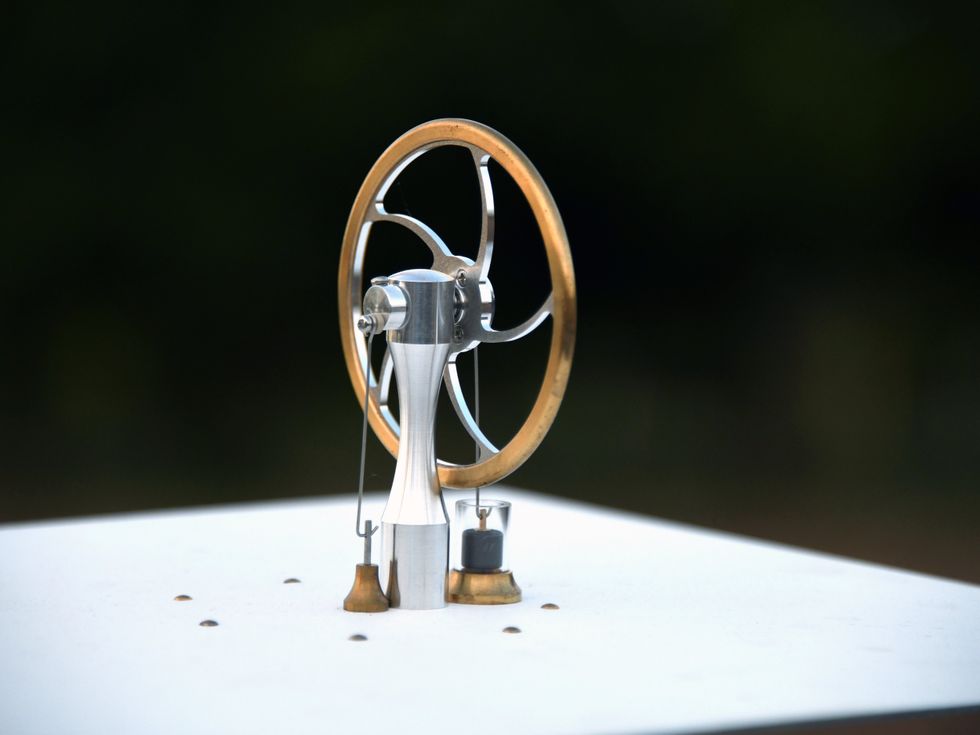
Close-up of Jeremy Munday’s experimental engine, which resembles a mechanical pinwheel and is mounted on a metal sheet.
Jeremy Munday
Applications and Future Improvements
Although the power output of the new device is much lower than that of solar photovoltaics—roughly two orders of magnitude lower—Munday emphasizes that the goal is not to replace solar power. Instead, the device enables useful work when solar power is unavailable, such as at night, without requiring batteries, wiring, or fuel.
The researchers calculated that the device could generate more than 5 cubic feet per minute of air flow, meeting the minimum air rate required by the American Society of Heating, Refrigerating and Air-Conditioning Engineers to minimize health risks in public buildings.
Potential applications include circulating carbon dioxide within greenhouses and improving comfort in residential buildings. Munday and his colleagues believe there are many ways to further improve the device’s performance. For example, replacing the air inside the device with hydrogen or helium gas could reduce internal friction.
"With more efficient engine designs, we think this approach could enable a new class of passive, around-the-clock power systems that complement solar energy and help support resilient, off-grid infrastructure," Munday says.
In the future, the team plans to test the device in a real greenhouse as a first proof-of-concept application. They also aim to engineer the device to function during the day. The scientists detailed their findings in the journal Science Advances.

Posting Komentar untuk "New Device Harnesses Space to Generate Power"
Posting Komentar