
Sugars in Bennu support life's cosmic beginnings
A New Window into Life’s Origins
In a fragment of rock no heavier than a paperclip, scientists have found molecules that could rewrite humanity’s understanding of life’s beginnings. The discovery of sugars essential to life—such as ribose and glucose—in pristine samples returned from the near-Earth asteroid Bennu has confirmed the presence of building blocks that could have played a crucial role in the emergence of life. This finding suggests that the components necessary for biology were widespread in the early Solar System.
The most striking evidence is the detection of ribose. On Earth, ribose forms the molecular backbone of RNA, the messenger molecule that stores genetic information and catalyzes chemical reactions. According to Yoshihiro Furukawa of Tohoku University, who led the analysis, “The new discovery of ribose means that all of the components to form the molecule RNA are present in Bennu.” RNA’s central role in the “RNA world” hypothesis, which posits that RNA preceded DNA in early life, makes this extraterrestrial source of ribose a tantalizing clue in the search for life’s origins.
Another significant component is glucose, the most abundant sugar in the Bennu samples at 0.35 ± 0.05 nmol per gram. As a universal energy currency in terrestrial biology, it feeds metabolic pathways ranging from glycolysis to the pentose phosphate cycle. In addition to ribose, the researchers identified lyxose, xylose, arabinose, and galactose—all confirmed through gas chromatography–mass spectrometry in stringent contamination-free conditions. The OSIRIS-REx team curated the material in high-purity nitrogen at NASA’s Johnson Space Center, ensuring the sugars were untouched by Earth’s biosphere—a critical advantage over meteorite finds that often suffer terrestrial alteration.
Bennu’s Chemistry and Prebiotic Processes
Bennu’s chemistry offers a window into ancient prebiotic processes. Abundant phyllosilicates, carbonates, and evaporite minerals were inferred from mineralogical analysis, indicating that its parent body had suffered aqueous alteration. Hot-water extracts exhibited an alkaline pH of 8.23 ± 0.02, suggesting that the rock was once permeated by weakly basic brines. Such fluids are rich in calcium and magnesium ions, known catalysts for the formose reaction—a pathway where aldehydes such as formaldehyde polymerize into increasingly complex sugars. Laboratory simulations under asteroid-like conditions have reproduced ribose, arabinose, and xylose in similar proportions to those seen in Bennu, favoring the hypothesis that these molecules were synthesized in situ rather than inherited intact from the interstellar medium.
This geochemical environment also contained ammonia, detected in unexpectedly high concentrations in Bennu’s organics. Ammonia can react with aldehydes to form amino acids and nitrogen heterocycles, and the presence of ammonia alongside nucleobases, phosphates, and amino acids in Bennu’s regolith suggests a chemically rich setting capable of producing multiple classes of biomolecule precursors. Indeed, all five nucleobases used in DNA and RNA had been found in earlier analyses of the same samples, meaning that Bennu harbors a complete molecular toolkit for RNA assembly.
The Engineering Behind the Discovery
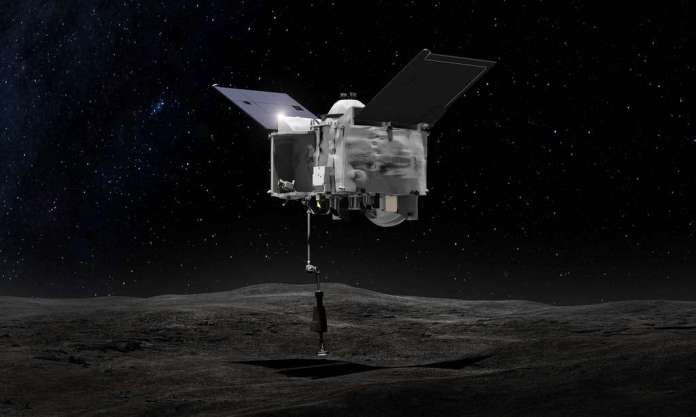
This discovery was made possible by the engineering precision of the OSIRIS-REx mission. After traveling 7.1 billion kilometers over seven years, its Touch-And-Go Sample Acquisition Mechanism collected 121.6 grams of regolith in October 2020. The return capsule withstood atmospheric entry at 43,000 km/h and 2,900°C, its heat shield material tested in NASA Ames’ Arc Jet facility, to ensure that Bennu’s fragile organics—ribose among them—survived intact to reach the clean rooms on Earth.
For astrobiologists like Danny Glavin at NASA’s Goddard Space Flight Center, the implications go far beyond Bennu. “These building blocks of life were distributed from the outer solar system all the way into the inner solar system,” he said. “They were everywhere, ubiquitous, which really makes me more optimistic that not only could these building blocks have enabled life on Earth but potentially elsewhere—Mars, Europa, the outer solar system.”
Implications for the Search for Life
The ubiquity of such molecules bolsters the case that asteroid impacts could have seeded young planets with raw material for biology. Senator and retired astronaut Mark Kelly echoed that view, calling the findings “pretty exciting” and a spark for “larger questions about life in the universe.” While the sugars themselves do not evidence living organisms, their extraterrestrial origin preserved in a body untouched by Earth’s contamination provides a rare and direct glimpse of prebiotic chemistry beyond our planet.
For the science-curious observer, Bennu’s microscopic cargo may be one of the clearest signs yet that the recipe for life is written into the fabric of the solar system.

Posting Komentar untuk "Sugars in Bennu support life's cosmic beginnings"
Posting Komentar