
The Secret on Your Face: The Unique Body Part Humans Have
The Unique Anatomy of the Human Chin
When we look at the vast diversity of life on Earth, it's easy to see how much we have in common with other animals. From our skeletal structure to the way our internal organs function, human biology is a variation of a theme that exists throughout the animal kingdom. Even our closest relatives, the great apes, share many of our physical traits. However, there is one feature that stands out as an exception: the chin.
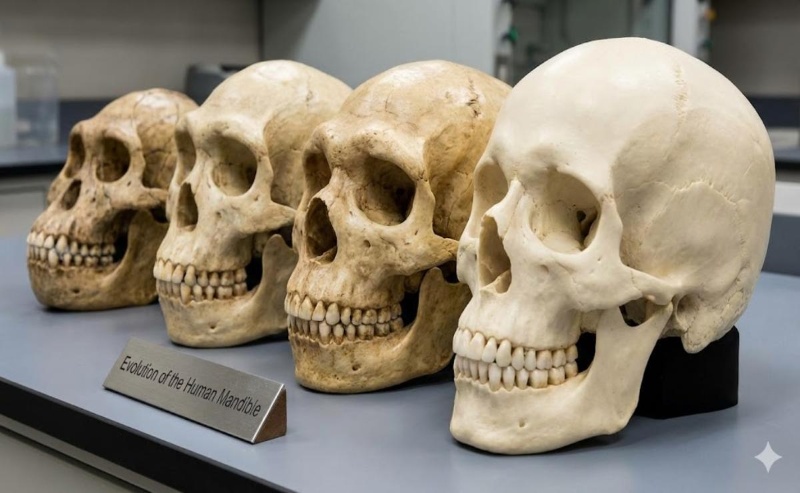
This seemingly ordinary part of our face is actually an evolutionary enigma. No other species—whether it’s a chimpanzee, gorilla, or even our extinct relatives like Neanderthals—has what scientists call a "true chin." It is one of the most distinctive features of the modern human skull, yet its purpose remains a mystery.
What Exactly Is a Chin?
Biologically, a chin is a specific bony protrusion on the lower jaw that slopes forward. While many animals have jaws that jut out, this isn't considered a true chin. In all other primates and ancient hominids, the lower jaw slopes backward, away from the teeth. Humans are the only species with this unique forward-pointing structure.
In evolutionary science, physical traits usually serve a clear purpose. They help animals survive by improving their ability to eat, defend themselves, or attract mates. The chin, however, doesn’t seem to have an obvious function. This makes it one of the greatest unsolved mysteries in evolutionary biology because it appears to defy the rules of natural selection.
Leading Theories About the Chin
Over the years, scientists have proposed several theories to explain the origin of the chin. One of the most popular ideas is related to chewing. As humans evolved, our faces became flatter, and our teeth grew smaller compared to our ancestors. Some researchers believe the chin developed as a structural support to reinforce our shrinking jawbones against the forces of chewing.
Another theory connects the chin to another uniquely human trait: complex speech. This hypothesis suggests that the chin provides essential anchoring points for the muscles involved in tongue movement and speech production. Without this extra bone, the precise articulations needed for human language might not be possible.
Other Possible Explanations
Some scientists suggest that the chin may have evolved through sexual selection. Just as a peacock’s tail is used to attract mates, a prominent chin could have signaled health, strength, or genetic fitness in early humans. If people found chins attractive, the trait would have been passed down, even if it didn’t offer a survival advantage.
The most controversial theory, however, is that the chin is simply an accident. Known as the "spandrel" theory, this idea comes from architecture, where a spandrel is a non-functional space between arches. According to this view, as the human face shrank over time to make room for a larger brain, the chin was just leftover bone that didn’t serve any purpose. In this case, the chin would be a useless byproduct of other evolutionary changes.
The Mystery Continues
Despite decades of research, the exact reason for the human chin remains unclear. It continues to challenge our understanding of evolution and reminds us that there is still much we don’t know about our own bodies.

Posting Komentar untuk "The Secret on Your Face: The Unique Body Part Humans Have"
Posting Komentar