
US Opportunity in Armenia: Why TRIPP Could Be the Turning Point
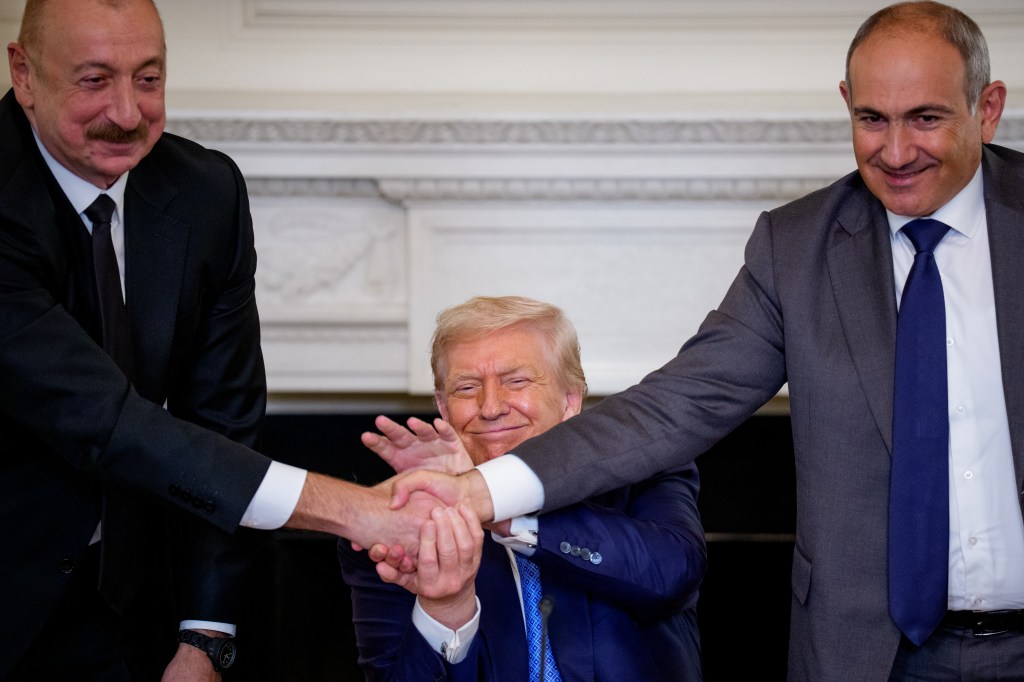
For the first time in a generation, there is reason to believe the United States and Armenia may be on the cusp of building a genuine strategic partnership. The TRIPP initiative (Trump Route for International Peace and Prosperity) does more than calm tensions between Armenia and Azerbaijan: It reflects a fundamental shift in Washington’s posture toward Armenia, one that increasingly views the country as a plausible partner for meaningful security and economic cooperation.
The new dynamic is subtle but unmistakable. While formal guardrails are still emerging, U.S. officials have begun encouraging Yerevan to purchase American equipment, technology and training. This is more than a bureaucratic formality. It is a deliberate, calibrated test—an invitation for Armenia to take the first steps toward a long-term security cooperation relationship with the United States.
American foreign military sales are about far more than hardware. When a partner government purchases U.S. equipment, it effectively buys into an ecosystem—one that includes maintenance, spare parts, training, logistics, lifecycle support and shared doctrine. Over time, this creates interoperability, trust and a durable alignment of interests. Armenia has an opportunity to move toward compatibility with Western defense systems and away from dependence on America’s adversaries. For a small democracy in a volatile neighborhood, that opportunity is not trivial.
Armenia’s most immediate objective is straightforward: rebalance Washington’s approach to the South Caucasus. For decades, the Armenian diaspora focused primarily on pressing Congress to deter Azerbaijani aggression. Today, after the loss of Artsakh and with Armenia seeking to break free from Russia’s security orbit, the more pragmatic priority is different—institutionalizing a direct security partnership with the U.S. government.
TRIPP fits neatly into this shift. The Armenian Ministry of Defense will serve as the implementing body, with border security as the program’s initial focus. Because Armenia lacks a professionalized border guard, its armed forces are the only coherent security structure available. In practice, TRIPP represents a forward-deployed U.S. security assistance package, backed by roughly $150 million in planned support for equipment, technical assistance and training. The channel now exists. If Yerevan demonstrates seriousness and discipline, TRIPP could anchor an entirely new era of U.S.–Armenia security cooperation.
The logic extends well beyond defense. A stable, balanced South Caucasus benefits every major regional actor—including Turkey, Europe and Central Asia. For Washington, Armenia offers something rare: a transparent, well-regulated border with Iran at a time when monitoring regional flows is increasingly important. Armenia itself is changing quickly. Corruption has been curbed. Foreign investors are arriving. The tech sector is booming. In the absence of oil and gas, the country has developed a diversified, entrepreneurial, knowledge-driven economy. By comparison, Azerbaijan remains dependent on hydrocarbons and far less open to Western business practices.
With or without U.S. involvement, Armenia is positioned to play an outsized role in next-generation technology development. The question is whether the United States chooses to be at the center of that evolution—or watches as others fill the vacuum. Companies like NVIDIA, Synopsys, Microsoft, Adobe and Cisco have made substantial investments in the country in recent years. U.S. engagement now ensures that Armenia’s technological rise occurs within the American economic and standards framework, benefiting U.S. companies, investors and supply chains. For U.S. policymakers and companies alike, Armenia is starting to look less like a peripheral concern and more like a smart bet, confirming the emergence of Armenia’s technology sector.
Finally, attaching President Donald Trump’s name to TRIPP gives the initiative a unique form of political insulation. It becomes harder for opponents to dismiss or sabotage, and much harder for bureaucratic inertia to bury. Paradoxically, heightened visibility may be its greatest protection. Skeptics will note that Trump’s initiatives are often polarizing or short-lived. But this is different. The relevant interests—a reform-minded Armenian government, a U.S. national security establishment wary of Russian, Iranian and Chinese influence, and a U.S. president eager to leave a foreign-policy imprint—are aligned more closely than they have been at any point since Armenia’s independence.
TRIPP will not solve every challenge Armenia faces, and it will not replace the need for careful diplomacy. But as a strategic opening, it is real. It is significant. And if both sides manage it responsibly, it could become one of the most consequential and mutually beneficial ventures in the South Caucasus in decades. The door is open—wider than ever before. Armenia and the United States should step through it together.
Julian Setian is the president and CEO of SOS International, LLC (SOSi), among the largest private technology and services integrators in the defense and government services industry. He is also the founder and chairman of Exovera, a data analytics and software company.
The views expressed in this article are the writer’s own.

Posting Komentar untuk "US Opportunity in Armenia: Why TRIPP Could Be the Turning Point"
Posting Komentar