
A giant helium cloud escapes a distant planet, spotted by JWST
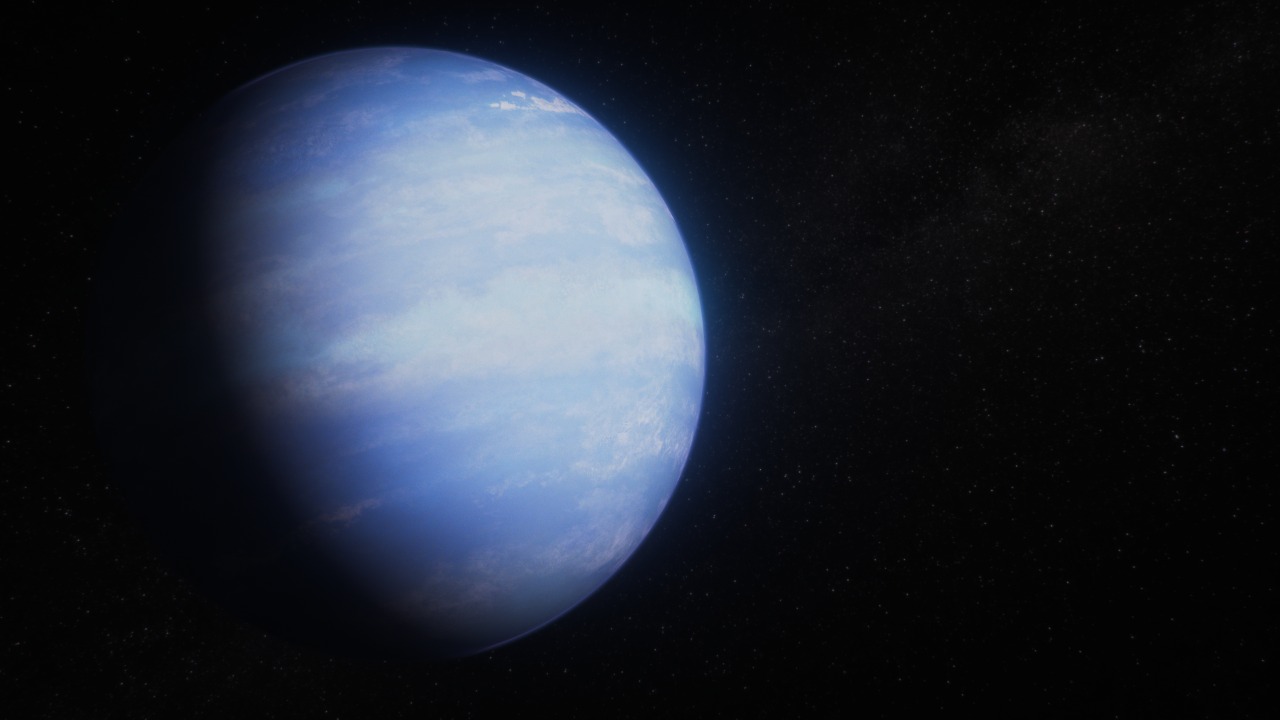
The James Webb Space Telescope Observes a Planet in the Process of Disintegration
The James Webb Space Telescope has captured a distant world in the process of disintegrating, with its outer layers peeling away into space as a massive cloud of helium. This planet, known as a "super-puff," possesses the mass of a giant planet but has the density of cotton candy. It is shedding its atmosphere so dramatically that the escaping gas extends far beyond the planet itself. This observation represents one of the clearest real-time demonstrations yet that planets are not static objects in space, but rather evolving entities whose fates are determined by the struggle between gravity and starlight.
By tracking this helium cloud as it streams away, astronomers are transforming a spectacular cosmic scene into concrete data about how atmospheres survive, change, or disappear. These observations go beyond showcasing the power of a new telescope; they open a window into how these "super-puffs" form, how long they can last, and why some planetary systems end up with bare rocky cores while others retain their gaseous envelopes.
Meet WASP-107b, the "Super-Puff" on the Brink
The planet at the center of this cosmic drama is WASP-107b, a gas giant orbiting a star approximately 200 light-years away in the constellation Virgo. It is comparable in mass to Neptune but closer in size to Jupiter, which means its density is extraordinarily low—more like a swollen balloon than a compact planet. This unique combination of a large radius and small mass earns it the "super-puff" label and makes it especially vulnerable to losing its outer layers. The new observations have turned this theory into direct evidence, as highlighted in work describing a sprawling helium cloud around the planet.
Because WASP-107b orbits very close to its host star, it is exposed to intense radiation that heats its upper atmosphere and causes it to puff up further. Its low gravity, relative to its size, struggles to hold onto this heated gas, allowing it to escape into space in a slow but relentless leak. Earlier studies had already suggested that this world was losing material, but the new observations show that the process is not a subtle trickle. Instead, the helium is being driven off in a structure so large that it reshapes how we think about the boundary between a planet and the space around it.
How JWST Caught a Helium Cloud in the Act
To observe a planet's atmosphere escaping, astronomers needed a tool capable of separating the faint fingerprints of specific gases from the glare of the host star. The James Webb Space Telescope was designed for exactly this kind of work, with infrared instruments that can dissect starlight passing through a planet’s atmosphere during a transit. When WASP-107b crossed in front of its star, the telescope recorded subtle changes in the spectrum that revealed a huge envelope of helium surrounding and trailing the planet.
What makes this detection stand out is not just the presence of helium, but the fact that the cloud is so extended it effectively turns the planet into a comet-like object. The escaping gas absorbs starlight at specific infrared wavelengths, and by measuring how that absorption changes over time, researchers can map the shape and motion of the cloud. The result is a dynamic picture of a helium envelope that swells far beyond the planet’s visible disk, confirming that JWST is not only a powerful observatory for distant galaxies but also a precision tool for watching exoplanets evolve in real time.
Why Helium, and Why This Matters for Exoplanet Science
Helium is a particularly useful tracer of atmospheric escape because it is both abundant in giant planets and relatively easy to detect in the infrared. When high-energy radiation from the star hits the upper atmosphere of WASP-107b, it energizes helium atoms and helps drive them outward, where they can be detected as they drift away. While helium escape has been observed on other exoplanets before, WASP-107b marks the first time astronomers have watched an extended helium cloud evolve in such detail, a milestone that is underscored in reporting that notes that while helium escape has been seen elsewhere, this case stands out for the way WASP is shedding its atmosphere.
For exoplanet science, this matters because helium is acting as a visible marker for a much larger process. The same forces that strip helium are also likely removing hydrogen and other light gases, gradually changing the planet’s composition and structure. By quantifying how much helium is escaping and how fast, researchers can estimate how long WASP-107b can keep its bloated envelope before it thins into something more compact. In that sense, the helium cloud is not just a curiosity, it is a clock that tells us where the planet sits in its life story and how quickly it might be transformed into a very different kind of world.
A “Super-Puff” Chasing Its Own Atmosphere
The new observations paint a picture of a planet that is almost literally chasing after its own atmosphere as it streams away. As WASP-107b orbits its star, the helium cloud is shaped by stellar radiation and the planet’s motion, creating a trailing structure that can wrap around and extend far behind it. Descriptions of the system liken it to a strange “super-puff” frantically pursuing the gas it is losing, a vivid image that captures how the planet’s low gravity and close-in orbit combine to produce such an extreme scene.
From my perspective, this behavior turns WASP-107b into a kind of laboratory for understanding how close-in gas giants respond to intense stellar environments. The planet’s orbit is tight enough that it completes a circuit in just a few days, so each pass in front of the star gives astronomers another chance to watch how the helium cloud shifts and reshapes. That repeated sampling is crucial, because it lets researchers distinguish between a one-off flare-driven event and a sustained pattern of escape. The emerging picture is that this is not a brief outburst but an ongoing process that is steadily eroding the planet’s outer layers.
From Hints to a Full Helium “Leak”
Before JWST, astronomers had already suspected that WASP-107b was losing atmosphere, based on earlier detections of helium and the planet’s unusual density. Those initial findings suggested that gas was being stripped away, but they could not fully map the structure or quantify the escape in detail. The new work builds on that foundation by turning a tentative signal into a clear view of a helium “leak,” confirming that the planet’s extended atmosphere is not just puffy but actively flowing outward.
The analysis behind these results relies on carefully modeling how starlight filters through different layers of gas and how that light changes as the planet moves. By comparing those models with the observed spectra, researchers can infer not only that helium is present but how it is distributed and how fast it is moving. I see that as a powerful demonstration of how exoplanet science has shifted from simply detecting distant worlds to diagnosing their atmospheric physics. In WASP-107b’s case, the diagnosis is clear: the planet is bleeding helium into space at a rate that will reshape it over astronomical timescales.
What the Helium Cloud Reveals About Planetary Evolution
Watching a giant helium cloud peel away from a planet is visually striking, but the deeper payoff lies in what it tells us about how planetary systems change over time. If a “super-puff” like WASP-107b can lose a significant fraction of its atmosphere, it may eventually be stripped down to a denser core, potentially resembling a mini-Neptune or even a rocky super-Earth. That idea helps explain why some close-in planets we see today are bare and compact while others remain swaddled in thick gas, and it turns WASP-107b into a missing link between those populations.
From an evolutionary standpoint, the rate of escape matters as much as the fact that it is happening. If the helium stream is strong enough, WASP-107b could lose a large portion of its envelope within the lifetime of its star, dramatically altering its size and density. If the loss is slower, the planet might retain a bloated atmosphere for billions of years, remaining a “super-puff” for most of its existence. By pinning down the properties of the helium cloud, astronomers are starting to bracket those possibilities, turning a single exotic world into a test case for broader theories of how planets respond to intense stellar radiation and tidal forces.
JWST’s Role in a New Era of Atmospheric Escape Studies
The WASP-107b observations are part of a broader shift in exoplanet research, where the focus is moving from simply counting planets to understanding how their atmospheres behave under different conditions. The James Webb Space Telescope is central to that shift, because its sensitivity and spectral coverage allow it to pick out faint signals like helium escape that were previously at the edge of detectability. In this case, JWST has observed a massive helium structure streaming away from a “super-puff” exoplanet, a result that has been framed as James Webb Space Telescope Spots an Exoplanet Losing Its Atmosphere in a Huge Helium Stream that stretches far beyond the planet itself.
I see this as a template for future studies of atmospheric escape on a wide range of worlds, from hot Jupiters to smaller, potentially rocky planets. By applying the same techniques to different systems, astronomers can build a comparative picture of how factors like stellar type, orbital distance, and planetary mass shape the fate of atmospheres. WASP-107b is an extreme case, but it anchors one end of that spectrum and shows what is possible when a planet’s gravity is too weak to fully counter the energy pouring in from its star. As JWST continues to survey other targets, the helium cloud around this “super-puff” will serve as a benchmark for interpreting more subtle signals elsewhere.
From “Super-Puff” Oddity to Population Clue
When “super-puff” planets were first identified, they seemed like oddities that stretched the limits of planetary formation models. How could a world end up so large and so light without being torn apart or compressed over time? The new helium escape results suggest that at least some of these objects may be transient, caught in a phase where they are still inflated but already losing mass. In that sense, WASP-107b is not just a curiosity but a clue to how an entire class of planets might evolve.
For me, that shifts the narrative around “super-puffs” from being anomalies to being snapshots in a longer story. If many such planets are in the process of losing their atmospheres, then the population of low-density giants we see today may be only a fraction of those that once existed. Some may already have been stripped down to denser remnants that we now classify under different labels. WASP-107b, with its dramatic helium cloud, becomes a Rosetta stone for decoding that history, linking the present-day census of exoplanets to the invisible past when many of them may have looked far more bloated and fragile.
What Comes Next for WASP-107b and Worlds Like It
The story of WASP-107b’s escaping helium is still unfolding, and future observations will be crucial for filling in the remaining gaps. Repeated transits will help determine whether the escape rate is steady or varies with stellar activity, while complementary measurements at other wavelengths could reveal additional components of the outflow, such as hydrogen or heavier elements. The current results already show that JWST can capture an exoplanet dramatically shedding its atmosphere in real time, with a sprawling helium cloud that reflects the planet’s low mass and inflated radius.
Looking ahead, I expect WASP-107b to remain a prime target for testing models of atmospheric escape and planetary evolution. As more data accumulate, astronomers will be able to refine estimates of how much mass the planet is losing and how its structure will change over time. In the broader context, each new measurement of this helium cloud helps turn a dramatic visual into a quantitative tool, one that can be applied across many systems to understand why some planets hold on to their skies while others, like this “super-puff,” let them slip away into the dark.

Posting Komentar untuk "A giant helium cloud escapes a distant planet, spotted by JWST"
Posting Komentar