
Astronomers Discover a Tilted Planet That Defies Explanation
What Makes This Planetary Tilt So Extreme
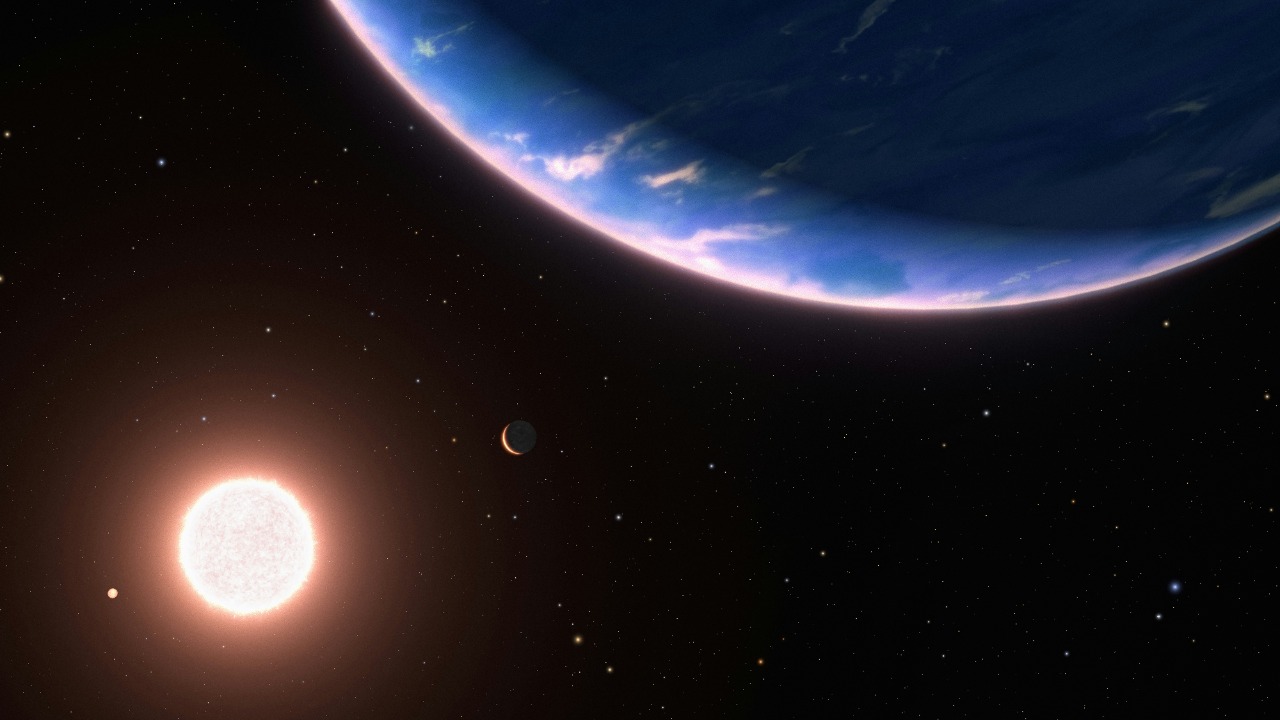
A newly analyzed planetary system has revealed a world orbiting at such a skewed angle that it defies the neat textbook picture of how planets are supposed to form and settle around their stars. The planet’s orbit is so dramatically misaligned with its star’s spin that astronomers are now treating it as a stress test for the standard story of calm, flattened disks giving rise to orderly families of worlds. This "wild tilt" challenges existing theories and raises questions about the formation of other strange planetary systems, including Uranus and the hypothetical Planet Nine.
In a typical young system, planets form in a thin, rotating disk of gas and dust that orbits in the same plane as the star’s equator, so the expectation is that planetary orbits and stellar spin should line up. However, in this newly highlighted system, the orbital plane is tipped so far relative to the star’s spin axis that the geometry looks more like a cosmic cross than a flat carousel. This extreme misalignment is why astronomers describe the angle as wild rather than just slightly off.
To pin down this geometry, researchers tracked how the planet repeatedly crossed in front of its star and compared those transits with the motion of dark starspots on the stellar surface. The rotation period of the star matched the shifts in starspot position seen in the transit data, which allowed the team to reconstruct the orientation of the stellar spin and show that the planet’s path slices across it at a steep angle. This combination of precise transit timing and starspot mapping turns this system from a curiosity into a clean laboratory for orbital dynamics.
How Astronomers Actually Measure a Planet’s Tilt
When astronomers talk about a planet’s tilt in a system like this, they are really referring to the angle between the planet’s orbital plane and the star’s equatorial plane, not the tilt of the planet’s own spin axis. It’s useful to think of the star as a spinning top and the planet as a marble rolling around it; the question is whether the marble’s track lies along the top’s waistline or cuts across it at some odd angle.
In the strongly tilted system, the marble’s track is so skewed that each transit effectively samples a different slice of the star’s surface, which is why the changing pattern of starspot crossings becomes such a powerful diagnostic. To extract that information, observers rely on a network of powerful ground-based telescopes that can monitor tiny dips in starlight as the planet passes in front of the star.
In this case, the same network also picked up subtle changes in brightness caused by cooler, darker starspots rotating in and out of view, which in turn revealed the temperature of the starspots and the star’s rotation period. By tying the timing of those features to the planet’s repeated transits, the team could show that the orbital plane is dramatically misaligned with the stellar spin, confirming that this is not a small perturbation but a strongly tilted configuration that challenges standard formation models.
Why Uranus Is the Solar System’s Cautionary Tale
To understand why this new system is so provocative, I have to look closer to home at Uranus, the oddball of our own planetary family. Uranus is a very cold and windy ice giant that orbits far from the Sun, and its most famous feature is that its spin axis is tipped by about 98 degrees, so it essentially rolls around the Sun on its side. Images from the spacecraft Voyager showed a pale, almost featureless globe, but the geometry is anything but bland, with one pole pointing almost directly at the Sun for long stretches of its 84-year orbit.
That extreme tilt has long been a headache for planetary scientists because the simplest picture of planet formation in a flat disk cannot easily produce a world that is essentially lying on its side. One popular explanation is that Uranus suffered a giant impact early in the history of the Solar System, a collision with a massive protoplanet that knocked it over and left its moons and rings aligned with the new equator. Yet as researchers have pointed out, there is a lingering problem with the giant impact explanation, because the entire early Solar System was a short-lived environment where such a precise, singular event is hard to reconcile with the broader dynamics of the disk.
What Uranus Can (and Cannot) Teach Us About Tilted Systems
Uranus shows that nature is perfectly capable of producing extreme tilts, but it also highlights how many different mechanisms might be at work. In the case of Uranus, the tilt is in the planet’s spin axis, while its orbit around the Sun is still roughly aligned with the rest of the Solar System, which means the underlying physics is not identical to a planet whose entire orbit is skewed relative to its star.
I see Uranus less as a direct analog and more as a warning that simple, single cause stories rarely capture the full complexity of planetary histories, especially when those histories involve violent events like giant impacts or prolonged gravitational torques. The new strongly tilted planetary system pushes that lesson further, because the misalignment is baked into the architecture of the orbit itself rather than just the spin of one world.
Planet Nine and the Idea of Hidden Gravitational Bullies
One of the more intriguing ideas in recent planetary science is that unseen worlds can quietly sculpt the orbits of others, and the hypothetical Planet Nine is the poster child for that concept. Researchers have suggested that a distant, massive planet lurking in the outer Solar System could be responsible for clustering the orbits of several far-flung icy bodies, effectively pulling the Solar System slightly out of its expected alignment.
In that picture, a hidden giant acts as a gravitational bully, tugging on smaller objects and slowly twisting their orbital planes over hundreds of millions of years. The notion that a Mysterious Planet Nine may be pulling our Solar System out of whack is still unproven, but it offers a useful framework for thinking about the strongly tilted exoplanet system.
Why Super-Earths and Sub-Neptunes Complicate the Story
The planet in the strongly tilted system appears to fall into the broad category of super-Earths and sub-Neptunes, worlds that are larger than Earth but smaller than Neptune and that often carry thick envelopes of gas or volatile ices. There is a lack of similar planets in the Solar System, and therefore their origin and atmospheric evolution represent an important challenge for our understanding of planets, because we cannot simply point to a local example and say, “it works like that.”
Instead, astronomers have to infer their internal structures and histories from mass, radius, and orbital data, which makes any extreme configuration, like a wild tilt, especially valuable as a constraint. Recent work on deep volatile reservoirs in super-Earths and sub-Neptunes argues that these planets may hide large stores of water, methane, or other volatiles beneath their atmospheres, which in turn affects how they respond to heating, migration, and tidal forces.
Competing Theories for How a Planet Gets So Misaligned
When I talk to dynamicists about systems like this, three broad classes of explanation usually come up. The first is that the protoplanetary disk itself was tilted relative to the star’s spin, perhaps because of a passing star or an uneven inflow of gas during the earliest stages of formation, so the planet simply inherited a skewed orbital plane from birth.
The second is that the planet formed in a more conventional disk but later migrated inward through interactions with the disk or with other planets, and in the process its orbit was torqued into a new orientation. The third is that a distant companion, perhaps analogous to a Planet Nine, slowly twisted the orbit over time through gravitational resonances.
Each of those scenarios has strengths and weaknesses when applied to a strongly tilted planetary system. A tilted disk can naturally produce large misalignments, but it raises questions about why the star’s spin did not realign with the disk as it accreted material. Migration-driven tilts can explain why the planet ended up close enough to transit, yet they often predict additional planets or debris that might not be observed. A distant companion can generate dramatic inclinations through mechanisms like Kozai cycles, but only if the mass, distance, and eccentricity line up just right.
What This Means for the “Clockwork” View of Planetary Systems
For decades, popular depictions of planetary systems have leaned on the image of a tidy, clockwork-like arrangement of circular orbits in a single plane, a kind of cosmic version of the orreries that Victorian scientists used to demonstrate celestial mechanics. The reality, as the strongly tilted planetary system underscores, is far messier and more dynamic.
Orbits can be stretched into ellipses, stacked at odd angles, or even flipped into retrograde motion, and those configurations are not rare exceptions but part of the natural spectrum of outcomes when gravity, gas, and time interact over billions of years. I see the wild tilt in this system as a particularly vivid reminder that our own Solar System, with its relatively well-aligned planetary orbits, may be more of a special case than a universal template.
More from HAWXTECH.NET
Chinese satellite hits Starlink with a 2-watt laser from orbit
USGS says lava could reach 1,500 ft as thousands get ready to leave
7 Apps That Secretly Record You—and How to Delete Them
A 6.0 magnitude earthquake was just reported in the U.S.

Posting Komentar untuk "Astronomers Discover a Tilted Planet That Defies Explanation"
Posting Komentar