
Bird-Feather-Inspired Ultrablack Fabric Absorbs Almost All Light
The Inspiration from Nature: Creating the Darkest Fabric
The magnificent riflebird, a member of the bird of paradise family found in Australia and New Guinea, has an appearance that captivates both scientists and nature lovers. Adult males of the species Ptiloris magnificus display striking iridescent blue-green patches on their chests and heads, while the rest of their bodies are covered in inky-black feathers. This unique coloration has inspired researchers to develop a new fabric known as “ultrablack,” which reflects an average of 0.13 percent of visible light—making it the darkest fabric created so far.
This development was detailed in a paper published on November 26 in the journal Nature Communications. Scientists have long been fascinated by animals and insects with extremely dark skin, scales, and feathers, including the magnificent riflebird. These creatures exhibit ultrablack hues that reflect less than 0.5 percent of visible light, a trait that serves various evolutionary purposes.
Understanding the Science Behind Ultrablack
Researchers believe that the ultrablackness in these animals is an adaptive feature that helps them in different ways. For some species, it enhances their attractiveness to potential mates, while for others, it allows them to blend into their surroundings and avoid predators. In addition, some creatures may use this intense coloration to regulate body temperature or to send warning signals to would-be attackers.
The science behind the riflebird’s black feathers involves melanin pigment combined with microscopic structures that absorb most of the light that hits them. While scientists have successfully replicated these elements to create synthetic ultrablack materials, these fabrics often come with significant drawbacks. They are expensive to produce, require advanced techniques, and sometimes involve toxic substances. Additionally, they tend to be stiff and uncomfortable, making them impractical for everyday use.
A New Approach to Ultrablack Fabric
To address these limitations, a team at Cornell University developed a more practical alternative. Their process involves a simple two-part method that results in a flexible and breathable ultrablack fabric. It begins with dipping white merino wool knit fabric into polydopamine, a synthetic form of melanin. This step mimics the natural pigmentation found in the riflebird's feathers.
Next, the fabric undergoes a technique called plasma etching. By placing the dyed fabric in a plasma chamber, small amounts of surface material are removed, leading to the formation of nanofibrils—tiny spikes on the fibers that trap incoming light. According to study co-author Hansadi Jayamaha, a fiber scientist and apparel designer at Cornell, “the light basically bounces back and forth between the fibrils, instead of reflecting back out—that’s what creates the ultrablack effect.”
Testing and Applications
Testing showed that the fabric absorbs nearly all visible light, producing a true ultrablack hue. It also maintains its ultrablack appearance from various angles, offering an improvement over existing ultrablack fabrics. The researchers hope to obtain a patent for their innovation and eventually launch a company based on their process.
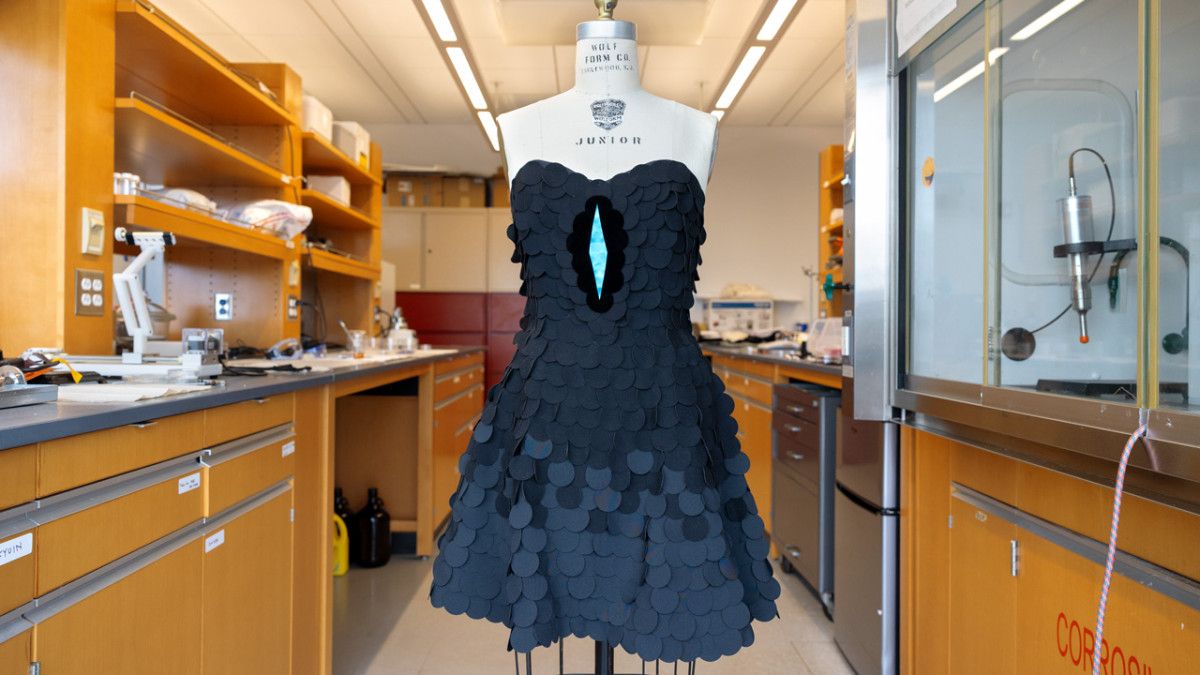
Beyond merino wool, their method could potentially work on other natural materials such as cotton and silk. The fabric has already been used in at least one piece of clothing. Zoe Alvarez, a recent graduate from Cornell with a degree in fashion design and management, incorporated the ultrablack material into a strapless dress. Photos of her garment helped confirm the researchers’ findings, showing that the fabric remains ultrablack regardless of changes in brightness, hue, contrast, and vibrance.
Challenges and Future Possibilities
While the new fabric represents a significant advancement, it does not surpass the blackest human-made material, Vantablack, which reflects only 0.04 percent of visible light. However, Vantablack is not suitable for wearable fabrics due to its lack of air permeability. Despite this, Vantablack has useful applications, such as being used on a satellite scheduled to launch in 2026 to test whether the coating can prevent bright spacecraft streaks from interfering with telescope images.
On Earth, the new method for creating ultrablack fabrics could have valuable applications in light-sensitive devices and thermo-regulated camouflage clothing, according to the study authors. As research continues, the intersection of nature and technology promises to yield even more innovative solutions.

Posting Komentar untuk "Bird-Feather-Inspired Ultrablack Fabric Absorbs Almost All Light"
Posting Komentar