
Can AI Read Minds? This Pedestrian Model Surprises Everyone
A Breakthrough in Autonomous Vehicle Technology
Researchers from Texas A&M University College of Engineering and the Korea Advanced Institute of Science and Technology have introduced a groundbreaking artificial intelligence (AI) system named OmniPredict. This innovative technology marks a significant step forward in making self-driving cars safer by predicting human pedestrian behaviors with remarkable accuracy.
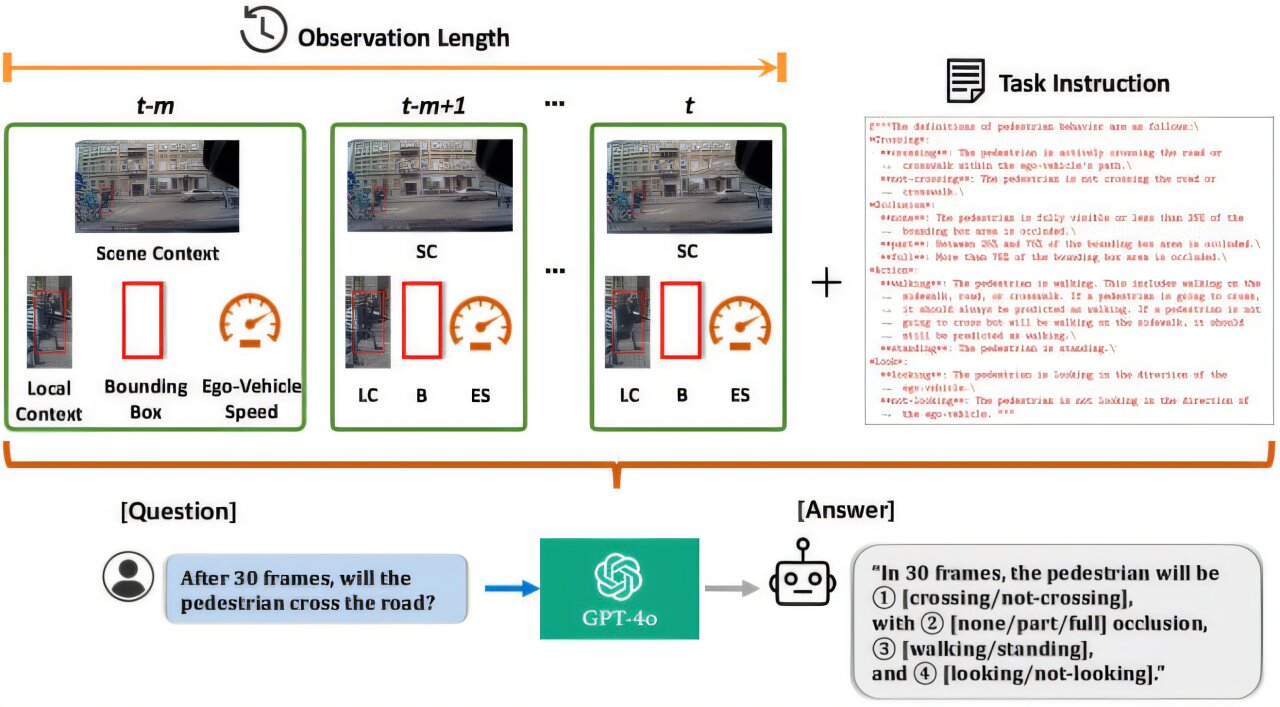
OmniPredict is the first system to apply a Multimodal Large Language Model (MLLM) to anticipate what pedestrians are likely to do next. Unlike traditional systems that rely on visual cues alone, OmniPredict combines visual data with contextual information to make real-time predictions. This approach mirrors the technology used in advanced chatbots and image recognition systems but adapts it to the dynamic environment of urban streets.
Enhancing Street Smarts for Autonomous Vehicles
The introduction of OmniPredict brings a new level of "street smarts" to autonomous vehicles. Instead of merely reacting to pedestrian actions, the AI anticipates future movements, which could revolutionize how self-driving cars navigate crowded areas. This shift could lead to more efficient urban mobility and reduce the number of tense encounters between vehicles and pedestrians.
Imagine standing at a crosswalk knowing that an AI-powered car is not only tracking your position but also planning its movements based on your likely next action. This capability could result in fewer near-misses and smoother traffic flow, as vehicles become better at understanding human motives.
Expanding Applications Beyond Crosswalks
While the primary focus of OmniPredict is on improving safety in urban environments, its potential applications extend far beyond bustling city streets. The system can detect and predict human behavior in complex scenarios, such as identifying threatening cues or signs of stress. This could be particularly valuable in military and emergency operations, where quick decision-making is crucial.
By providing early indicators of risk, OmniPredict could serve as an additional layer of situational awareness for personnel. It aims to augment human capabilities rather than replace them, offering a smarter partner in high-stakes situations.
Testing and Performance
Traditional self-driving systems often rely on computer-vision models trained on extensive datasets. However, these models can struggle with unpredictable conditions like weather changes or unexpected pedestrian behavior. OmniPredict takes a different approach, interpreting scenes and anticipating movements in real time.
The team tested OmniPredict against two of the most challenging benchmarks for pedestrian behavior research—JAAD and WiDEVIEW datasets. Without any prior specialized training, the AI achieved a 67% accuracy rate, outperforming the latest models by 10%. It maintained strong performance even when faced with complex scenarios, such as partially hidden pedestrians or those looking toward a vehicle.
The results, published in Computers and Electrical Engineering, highlight OmniPredict's faster response times, stronger generalization across different road contexts, and more robust decision-making capabilities. These findings suggest promising potential for real-world deployment.
The Future of Autonomous Vehicles
Although still a research model, OmniPredict represents a significant leap toward a future where autonomous vehicles rely less on brute-force visual learning and more on behavioral reasoning. By combining reasoning with perception, the system enables a new form of shared intelligence, making the world not just automated but profoundly more intuitive.
"OmniPredict doesn't just see what we do; it understands why we do it and can now predict when we are likely to take an action," said Dr. Srinkanth Saripalli, the project's lead researcher. If AI-powered cars can read our next move, the road ahead just got a whole lot smarter.

Posting Komentar untuk "Can AI Read Minds? This Pedestrian Model Surprises Everyone"
Posting Komentar