
China Unveils Robot Dog That Maps 10 Million Square Feet
Introducing the Pudu D5: A New Era in Quadruped Robotics
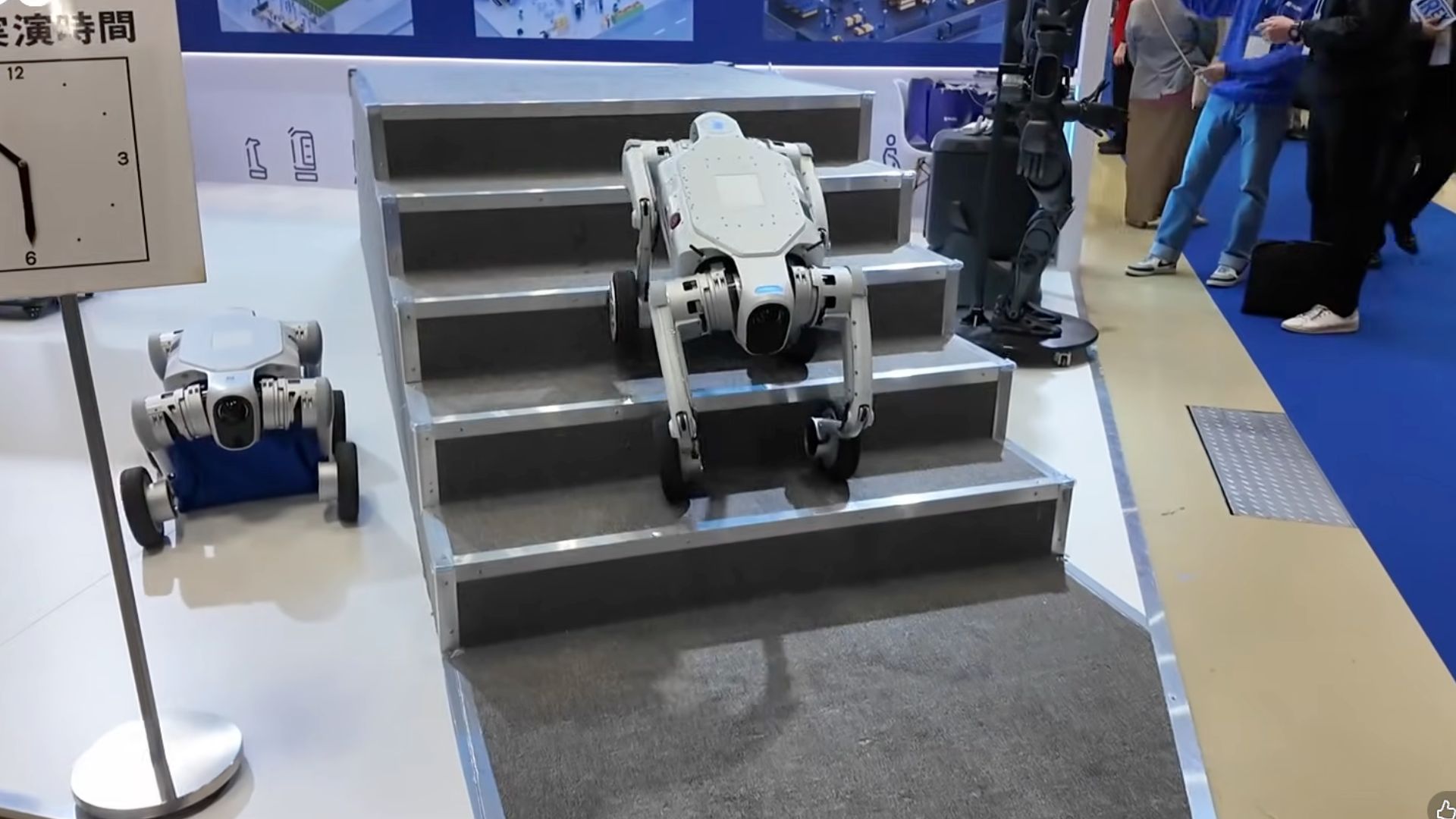
At the Tokyo International Robot Exhibition (iREX 2025), Chinese robotics company Pudu made waves with its latest innovation, the D5. This nearly one-meter-tall robot stands out as a four-legged machine capable of navigating complex environments with ease. During the exhibition, the D5 was seen gracefully descending a set of steps, lifting its right foreleg in what appeared to be a gesture of acknowledgment, and then moving through the exhibition hall on wheels while avoiding obstacles.
This marks Pudu’s second foray into quadruped robotics, following a smaller, less agile model introduced in 2022. The D5 showcases significant advancements in motion-control algorithms, key components, and embodied intelligence, highlighting the rapid progress being made in the field.
Industry-Grade Autonomous Quadruped Robot
According to Pudu, the D5 Series is an industry-grade autonomous quadruped robot that combines high-performance computing with all-terrain capabilities. It includes both legged and wheeled models, making it versatile for a range of applications.
The D5 is designed for fully autonomous operations in demanding and varied environments. Pudu claims the robot can navigate indoor warehouses, rugged outdoor terrains, hazardous inspection sites, industrial delivery routes, and off-road research zones.
Powered by an NVIDIA Orin platform and RK3588 dual-processor architecture, the D5 Series delivers up to 275 TOPS of computing power. This enables real-time processing for tasks such as SLAM mapping, obstacle avoidance, object recognition, and path optimization without human supervision. The robot can map and navigate areas of up to one million square meters, with a single continuous inspection range of 8.6 miles (14 kilometers).
Advanced Perception and Durability
To ensure comprehensive situational awareness, the D5 features four 120° fisheye cameras for complete 360° perception. These are paired with front- and rear-mounted 192-line LiDARs, which generate dense 3D point clouds. This allows operators to implement a “see and solve” approach, improving safety and operational efficiency.
Built for durability, the D5 Series uses high-strength aluminum and closed-loop torque control. It supports stable load carrying up to 66 pounds (30 kilograms) for over two hours. With IP67-rated dust and water resistance and a wide operational temperature range from -20°C to 55°C, the robot is designed to withstand harsh conditions.
Pudu positions the D5 as a critical component in its “multi-form embodied intelligence” strategy. This initiative aims to bridge specialized and humanoid robotics, advancing the company’s vision for intelligent, terrain-ready autonomous machines.
Expanding the Service Robot Portfolio
Shenzhen-based Pudu has built a broad portfolio of service robots, ranging from machines for restaurant and hotel food delivery to cleaning and factory logistics. Since its founding in 2016 by Felix Zhang, a serial entrepreneur and former engineering student at the Hong Kong University of Science and Technology, the company has sold over 100,000 robots across more than 80 countries and regions.
China has emerged as a leader in service robotics, supported by abundant real-world use cases, rapid product iteration, and lower manufacturing costs. Competitors include Keenon Robotics, Yunji Technology, and Robint Technology. Pudu is now expanding into specialized, semi-humanoid, and humanoid robots as part of its next growth phase.
At iREX 2025, in addition to the D5, Pudu showcased its advanced robot ecosystem. This includes specialized, semi-humanoid, and humanoid robots aimed at transforming industries across hospitality and retail, as well as healthcare, logistics, and education. Highlights included the BellaBot Pro for restaurant delivery and advertising, the PUDU T300 Series industrial delivery robots in multiple configurations, and the CC1 Pro and MT1 Max automated cleaning solutions.
Industry Outlook and Challenges
According to a Morgan Stanley research note from December, leading robot manufacturers have set ambitious targets for 2026. Orders announced in the second half of this year already exceed 2 billion yuan (US$282 million). However, analysts have warned that limited operational capabilities may restrict rapid growth in the near term.

Posting Komentar untuk "China Unveils Robot Dog That Maps 10 Million Square Feet"
Posting Komentar