
Electrons Lock in Mismatched Quantum Lego Layers
Understanding Electron Behavior in Layered Materials
Electrons, often considered elusive particles, have long posed challenges for scientists trying to understand their behavior within complex materials. However, a breakthrough by researchers at Cornell University has opened new doors in this field. By employing a novel computational method, they have gained deeper insights into how electrons behave in certain layered materials, particularly those known as "misfits." These materials have crystal structures that don’t align perfectly, creating unique conditions for electron interactions.
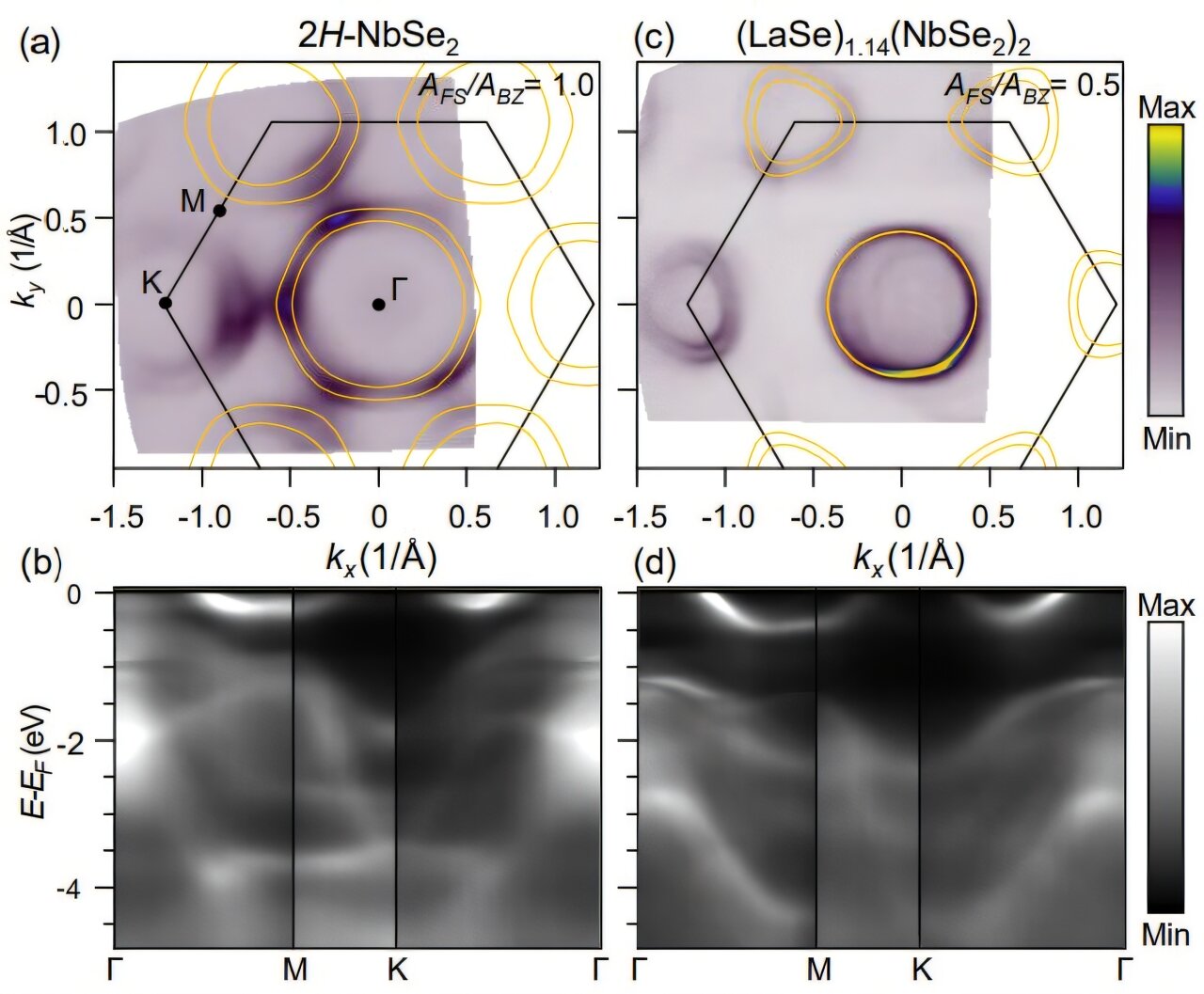
The research team has confirmed that in these misfit materials, electrons mostly remain in their respective layers rather than moving between them. This discovery contradicts previous assumptions that large shifts in energy bands indicated physical electron movement between layers. Instead, the findings reveal that chemical bonding between the mismatched layers causes electrons to rearrange, leading to an increase in high-energy electrons without significant transfer between layers.
A New Approach to Material Design
This research is pivotal for designing materials with specific quantum properties, such as superconductivity. The study, led by Tomás Arias, professor of physics and Stephen H. Weiss Presidential Fellow, highlights the importance of understanding these materials. Arias emphasized that the new computational method allows for a more accurate analysis of electron behavior, which was previously unattainable through traditional means.
The method is based on the idea that electrons primarily react to their immediate surroundings. This foundational research could accelerate the development of materials with desirable properties, including devices capable of powerful electrical cooling.
Insights from the Study
The paper titled "Unmasking Charge Transfer in the Misfits: ARPES and Ab Initio Prediction of Electronic Structure in Layered Incommensurate Systems without Artificial Strain" was published on November 14 in Physical Review Letters. It builds upon decades of research into stacked two-dimensional materials, where scientists have experimented with creating interesting electron behaviors.
Among incommensurate materials, one of the most famous examples is magic twisted bilayer graphene, where two layers of graphene are mismatched with a twist, resulting in superconductivity. In this study, experimentalists analyzed misfit layered heterostructures—compounds alternating a rare-earth metal rock salt layer with hexagonal symmetry.
Key Findings and Methodology
Observations of the material showed an increase in high-energy electrons in the hexagonal layer. However, when Niedzielski calculated all the electrons in a stack of incommensurate materials, he encountered a mystery. The results suggested that many electrons moved to the hexagonal layer, but according to his new method, the actual electron transfer was about six times less than what was observed in experiments.
This method, called MINT-Sandwich, uses a theoretical approach that enables calculations on new materials previously thought impossible. Kourkoutis led the microscopy efforts to image the misfit materials, which were crucial for locating atoms and performing faster calculations.
Implications for Electron Behavior
The study found that electrons remained in their original layers rather than jumping between them. At the microscopic level, electrons act like waves that spread through the material. However, in systems with many electrons, such as in a misfit compound, these waves cancel each other out, making only the area around each electron relevant.
This computational method offers a third source of information about material systems, alongside experiment and theory. It provides precise insights into what happens to electrons, enabling researchers to untangle complex mysteries in material science.
Future Directions
The implications of this research extend beyond just understanding electron behavior. It opens up new possibilities for designing materials with tailored properties, potentially leading to advancements in technology and engineering. As scientists continue to explore these materials, the methods developed by the Cornell team could serve as a foundation for future discoveries.
- More information:
- Drake Niedzielski et al, Unmasking Charge Transfer in the Misfits: ARPES and Ab Initio Prediction of Electronic Structure in Layered Incommensurate Systems without Artificial Strain,
- Physical Review Letters
- (2025). DOI: 10.1103/tmbg-3p94. On
- arXiv
- DOI: 10.48550/arxiv.2407.05465

Posting Komentar untuk "Electrons Lock in Mismatched Quantum Lego Layers"
Posting Komentar