
Fungus Predated Ants by 18 Million Years
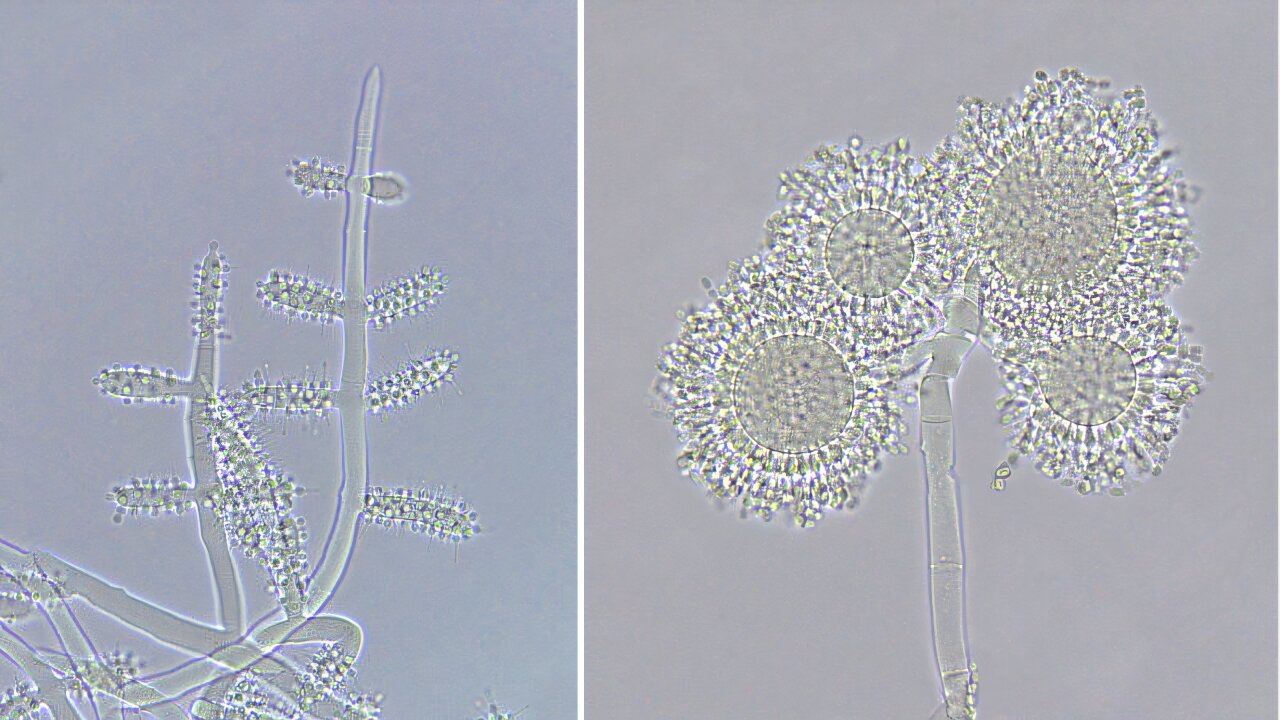
A genus of fungi, once thought to be a parasite of fungi associated with ants, may actually have far more complex ecological roles. According to a study published in the journal Communications Biology, one key piece of evidence is that these fungi appeared 18 million years before the ants they are currently linked with.
The research was based on the analysis of 309 strains of the genus Escovopsis collected across eight countries in the Americas. By examining fragments of their genomes, morphological traits, geographic distribution, and phylogeny—essentially their evolutionary relationships—the researchers were able to trace the connection between Escovopsis and leafcutter ants over 38 million years. The study found that Escovopsis first emerged around 56.9 million years ago.
"Our main hypothesis is that Escovopsis originated alongside ancestral groups of fungus-growing ants and later coexisted with today's leafcutter ants 38 million years ago. Another possibility is that it existed in a different context during those initial 18 million years, such as colonizing leaves or breaking down organic matter," explains Quimi Vidaurre Montoya, the lead author of the study.
Vidaurre Montoya conducted this research as part of his postdoctoral work at the Institute of Biosciences of São Paulo State University (IB-UNESP) in Rio Claro, Brazil.
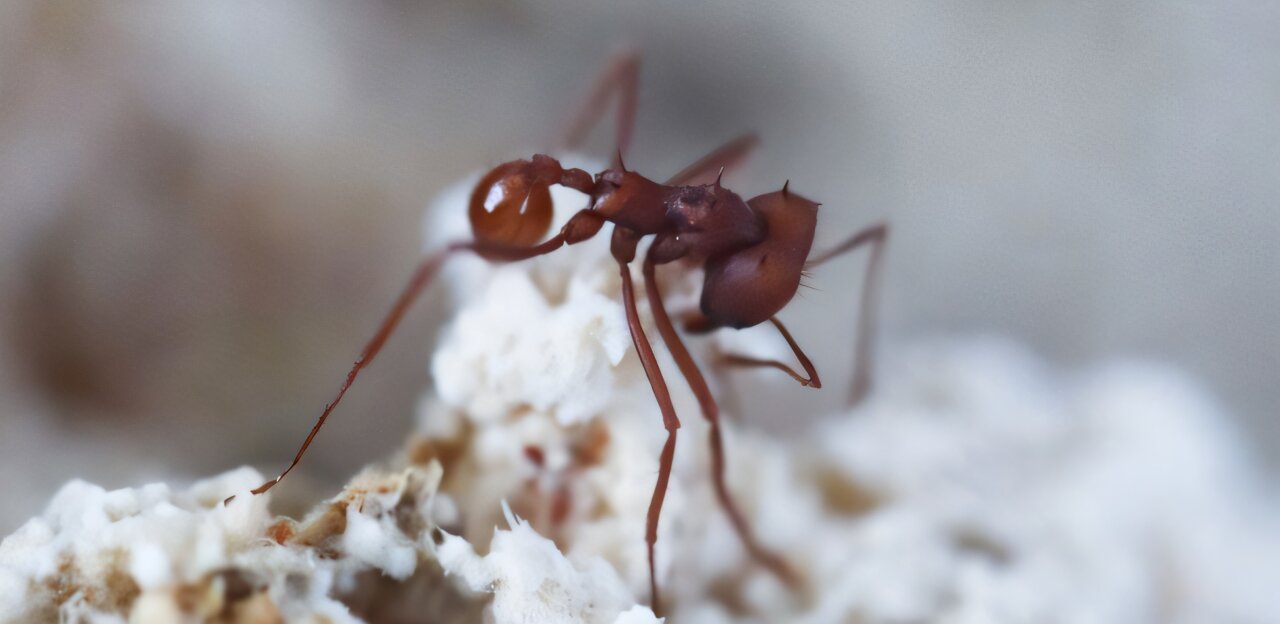
Leafcutter ants (subtribe Attina) cultivate fungi for food. A 2024 study by the same group, published in Science, suggests that this mutualistic relationship began 66 million years ago.
"Currently, our focus is on Escovopsis, a genus of fungi not cultivated by ants but often found in the colonies of some farming ant species. It can kill some of their fungal cultivars, which has led to its portrayal as a 'parasite.' However, only one of the 24 known species is known to cause infections in the fungi grown by ants," Montoya explains.
Adaptations to Anthills
The authors note that Escovopsis has undergone morphological and physiological adaptations over time, likely to increase reproductive efficiency and adapt to life inside anthills. These changes primarily occurred in the vesicles that produce conidia, which are structures used for asexual reproduction.
"The vesicles transition from a globular shape in species closer to the common ancestor to a cylindrical shape in more recent species. These changes may have been responses to barriers imposed by the ants or their symbiotic fungi," Montoya says.
Physiological data show that the growth rate, number of vesicles, and production and viability of conidia gradually increased as the genus diversified. Species with cylindrical vesicles appear to grow faster than those with globular ones. The thinner, elongated vesicles of more recent species produce significantly more viable conidia than older groups with globular vesicles.
"Apparent coevolution exists between ants, their symbiotic fungi, and Escovopsis. We don't know if they evolved to become parasites or if they're opportunists feeding on debris and surviving when the system breaks down. If they were specialized virulent hosts, as some literature assumes, they would destroy the system regardless of its state," Montoya says.
Little-Known Fungi
This study is part of broader research on the genus Escovopsis that began during Montoya’s doctoral studies. He also completed an internship at Emory University in the United States.
At that time, Montoya analyzed the two largest existing collections of these fungi: the IB-UNESP collection and the Emory collection, maintained by Professor Nicole Marie Gerardo, Montoya's supervisor abroad.
One of the early outcomes of this effort was the description of two new genera previously classified under Escovopsis. Two others discovered in the study are still being described. Montoya and André Rodrigues, a professor at IB-UNESP and researcher at the Center for Research on Biodiversity Dynamics and Climate Change, also led the description of 13 new Escovopsis species, with ten more in the process of being described.
"These fungi remain poorly understood from both physiological and ecological perspectives. Therefore, it's too soon to label them all as parasites. Our studies suggest they have other functions and can live in relative harmony within colonies," Montoya believes.
According to the researcher, only the Escovopsis weberi species has been proven to cause infections in fungi cultivated by ants. Experiments by his group and others show that several strains do not kill the fungi when present in the presence of these insects.
In vitro experiments that support the parasitism claim ignore the fact that the affected fungi rely on ants for protection. Evaluating the effect of Escovopsis on mutualistic fungi without considering the ants and their hygiene behaviors, which act as a social immune system, would not make sense.
"Some more virulent fungi are immediately removed by ants when introduced into the colony. However, with Escovopsis, the ants don’t pay much attention to it," the researcher says.

Posting Komentar untuk "Fungus Predated Ants by 18 Million Years"
Posting Komentar