
Giant sunspot reignites Carrington-era fears
Understanding the Power of Sunspots
Solar physicists often remind us that it's not just the size of a sunspot that determines its potential for causing disruption, but rather the complexity of its magnetic field. This insight is especially relevant as a large sunspot complex, known as AR 4294–4296, faces Earth. This group of sunspots is roughly the same size as the one observed by Richard Carrington in 1859, which was responsible for one of the most powerful solar storms in history. While the public may be concerned about a repeat of such an event, experts emphasize that other factors, such as the geometry of the magnetic field and the rate of eruptions, are more critical indicators.
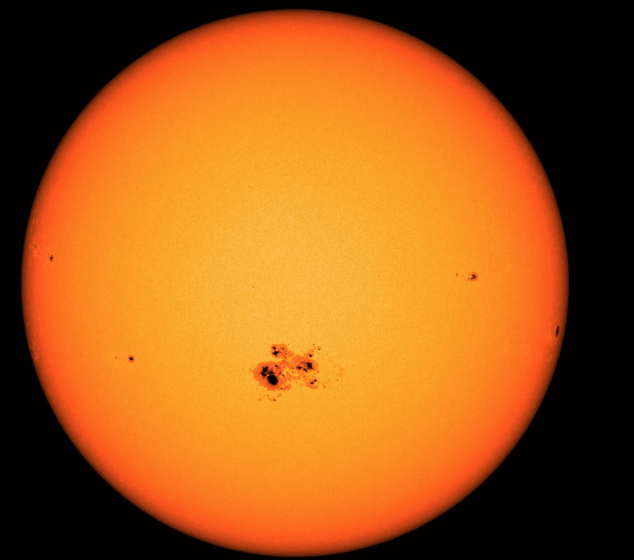
AR 4294–4296 consists of two magnetically entangled sunspot groups that first became visible from Earth on November 28. NASA’s Perseverance rover had already spotted them a week earlier from Mars, offering a rare view of the far side of the Sun. Together, these sunspots cover approximately 90% of the area of the Carrington sunspot. However, their current behavior does not suggest an immediate superstorm. Despite this, they are classified as beta-gamma-delta, which is among the most complex magnetic configurations and could lead to X-class flares—the most intense on the NOAA scale.
An estimated X45 flare would be significantly stronger than any recorded in modern times, surpassing even the X7 flare from October 2024. If such a flare were to strike Earth today, it could disable all satellites in orbit, leading to widespread disruptions in GPS, communications, and power grids. The potential damage in the U.S. could exceed $1 trillion. However, solar activity is complex: some large sunspots remain inactive, while smaller ones can produce disruptive flares if their magnetic fields are properly aligned.
Recent Solar Activity Highlights Complexity
Recent months have highlighted the nuanced nature of solar activity. The current solar maximum has led to a record number of X-class flares. For example, back-to-back eruptions in November caused a G4 (severe) geomagnetic storm. In May, a giant sunspot fifteen times the width of Earth triggered the strongest geomagnetic disturbance in 21 years, resulting in auroras across multiple continents. These events can cause Earth’s upper atmosphere to expand, increasing drag on satellites. During one such storm, the Hubble Space Telescope experienced a daily drop in altitude by tens of meters.
For those worried about these possibilities, science and perspective offer reassurance. Modern infrastructure is not entirely defenseless. Power grid operators can temporarily power down vulnerable components during severe storms, a measure that could have prevented the nine-hour blackout in Quebec in 1989. Satellites are increasingly designed with radiation hardening, and missions beyond Earth’s magnetic shield include instruments to monitor particle flux for protective actions. The ESA’s Vigil mission, set to launch in 2031, will monitor the Sun from an offset vantage point, providing early warnings of Earth-directed eruptions. Concepts like SHIELD aim to extend lead times for such events beyond two hours.
Predictive Measures and Scientific Insights
Understanding the factors that drive flare potential helps reduce speculation. Statistical studies of active regions show that while complex beta-gamma-delta configurations are associated with strong flares, only about 64% of X-class events originate from them. Many of these regions remain quiet. Parameters such as total source field strength—measuring stored magnetic energy—are proving more predictive than size alone. In AR 4294–4296, scientists are monitoring for signs of rising source field strength combined with moderate shear angles, conditions often preceding major eruptions.
Even in extreme scenarios, public impact can be mitigated through awareness and preparation. Evidence-based approaches that focus on current data rather than speculative worst-case scenarios help manage anxiety. It's important to remember that most solar storms—even powerful ones—result in beautiful auroras without lasting harm. While rare "Miyake events" recorded in tree rings indicate the Sun's capacity for particle bursts far exceeding Carrington's scale, these occur over centuries or millennia. As solar physicist Raimund Muscheler notes, “The Carrington event is presumed to be the worst-case scenario. The question is: could they really be much worse?” The answer remains uncertain, but vigilance and science-driven readiness provide the best protection against both the storms themselves and the fear they inspire.

Posting Komentar untuk "Giant sunspot reignites Carrington-era fears"
Posting Komentar