
Green flash at sunset | Space photo of the day Dec. 8, 2025
The Enigmatic Green Flash
As the sun dips behind the Chilean Andes, a fleeting emerald flare appears in the sky. This moment was captured in a photograph taken from Cerro Pachón in Chile by NOIRLab Audiovisual Ambassador Petr Horálek. The image showcases a natural phenomenon known as the green flash — a rare and captivating optical effect.
What is a Green Flash?
Despite its dramatic name, a green flash is not an explosion or a burst of energy. It is simply sunlight that has been bent and split by Earth's atmosphere. White sunlight consists of all the colors of the rainbow. However, as the sun approaches the horizon, its light must pass through a thick layer of the atmosphere. This air acts like a giant prism, refracting (bending) the light based on the wavelength of each color. Shorter wavelengths, such as blue and green, are bent more strongly than longer ones like red and orange.
At the very last moment before sunset, or the first moment after sunrise, the sun’s disk is mostly hidden below the horizon. What you see is a stack of slightly displaced images: the "red sun," the "orange sun," the "yellow sun," and so on, each shifted by tiny amounts. The lower colors disappear first, leaving the uppermost surviving layer dominated by green. This creates a thin glowing band at the top edge of the sun — the green rim. If conditions are just right — clear air, a sharp horizon, and the correct atmospheric layering — this thin rim can appear as a small, detached green spark: the famous green flash.
In reality, a green rim is present at every sunset. However, it is usually too thin and brief (a second or two) for the human eye to notice. Sensitive cameras, high-quality lenses, and fast bursts of images are ideal for capturing this elusive phenomenon.
Where Was It Captured?
This remarkable image was taken on Cerro Pachón in Chile. 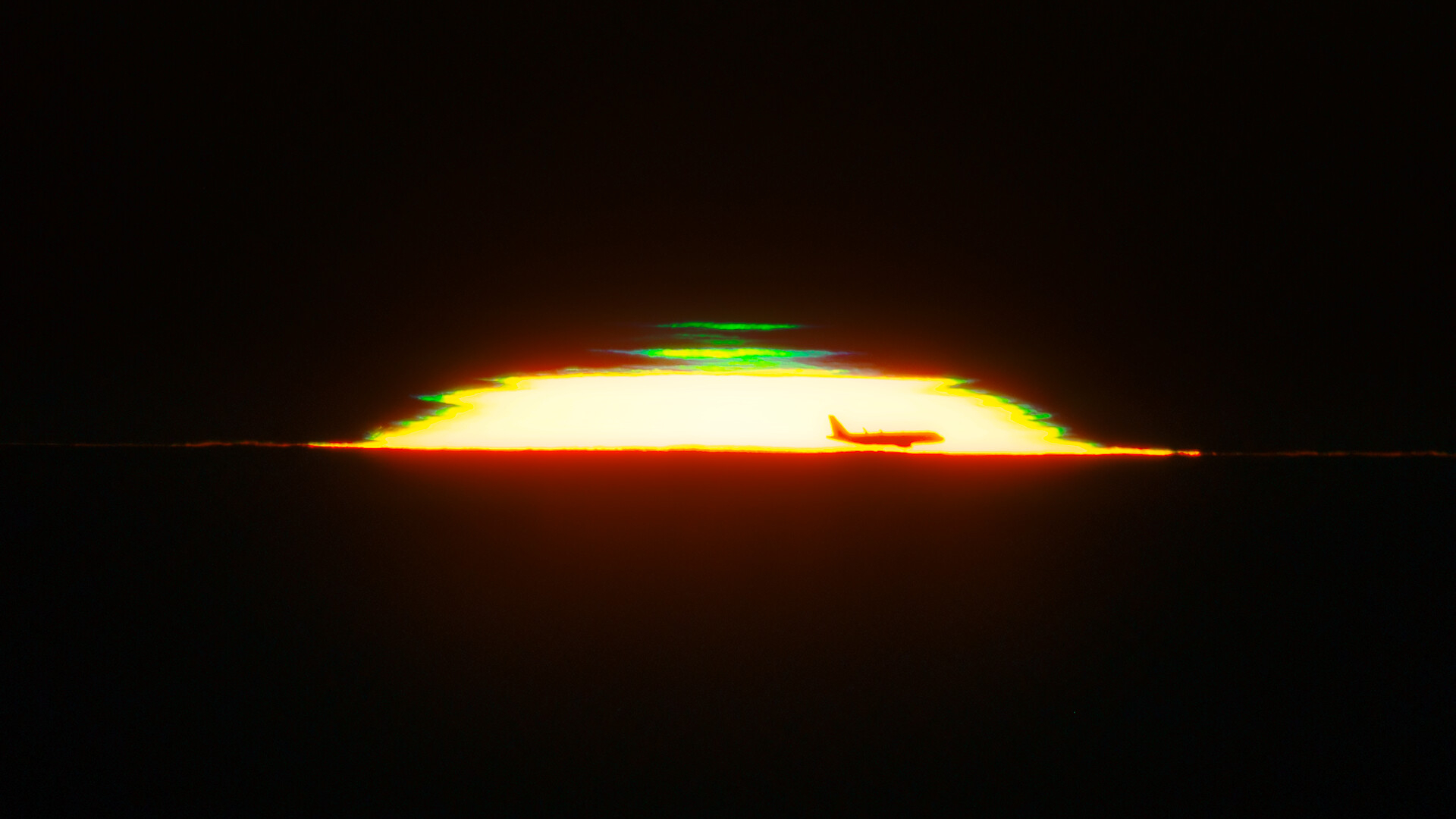
Why Is It Amazing?
There are numerous reasons why scientists find atmospheric optics like the green flash fascinating. The shape, height, and duration of a green flash depend on how temperature, pressure, and density change with altitude. Layers of warm and cool air can act like stacked lenses, creating mirage effects and distorting the sun’s image. By carefully modeling and measuring green flashes, scientists can test how well we understand the vertical structure of the atmosphere near the horizon.
Telescopes located on mountaintops, such as those on Cerro Pachón, observe through the same atmosphere that creates the green flash. The air bends different colors by varying amounts, slightly smearing out starlight into a small rainbow. Instruments called atmospheric dispersion correctors are designed to counteract this effect. Understanding exactly how Earth’s atmosphere splits and bends light — the same physics behind the green flash — helps astronomers improve the clarity of their images and spectra of distant stars and galaxies.
Learn More About the Green Flash
If you're interested in learning more about the green flash and the science behind Earth’s atmosphere, there are many resources available. Explore the fascinating world of atmospheric optics and discover how light interacts with our planet’s skies.

Posting Komentar untuk "Green flash at sunset | Space photo of the day Dec. 8, 2025"
Posting Komentar