
Landman Artisans Reveal Season 2's Audacious Creative Choices and Sheridan's World-Building
Since its debut last year, Landman has become the most-watched original series in Paramount+ history, and Season 2 kicked off with a record-breaking 9.2 million global streaming views in its first 48 hours. The neo-Western drama is set in the rugged and politically volatile oil fields of West Texas, where roughnecks, billionaires, environmental forces, and corporate power brokers collide. Oscar winner Billy Bob Thornton anchors the series as landman-turned-executive Tommy Norris, with Oscar nominee Demi Moore costarring alongside Ali Larter and Andy Garcia, with Sam Elliott appearing in the second season.
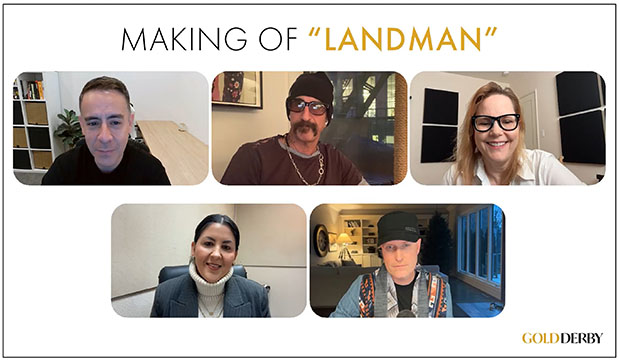
In an exclusive Gold Derby virtual panel, four key artisans behind the hit series: director Stephen Kay, set designer Dawn Brown, assistant costume designer Samantha Pavlat, and composer Andrew Lockington take us inside the creative decisions that shaped this ambitious new season. They join Gold Derby for a revealing Q&A about expanding Taylor Sheridan's oil industry epic into a more intimate and emotionally charged sophomore season. Watch our exclusive video interview above.
Gold Derby: Season 1 established the world. Season 2 raises the stakes. Where did you get to stretch that you couldn't before?
Stephen Kay: There was a lot of learning that had to go on into the first season. In Season 2, we dig into the heart of the family and the heart of the characters. We got to hire a bunch of amazing actors, and it would be a crime not to dig into who they are. So that's the biggest difference - we get to really mine their souls a little bit.
Dawn Brown: Expanding on what Stephen said, we get to develop, we get to see into the worlds of Demi Moore's character, Andy Garcia's character, and we're bringing in Sam Elliott. So, we get to just fill out the world even more. And it's been a fun place to play.
Samantha Pavlat: I didn't work on Season 1, but I watched it and I said to my husband that I want to work on Landman. It's so good! And then a couple of weeks later, [costume designer] Janie Bryant called me and asked, "Do you want to do Landman with me?" I think I just manifested this because I loved all the characters so much and getting to help create them in Season 2 was really amazing and the collaboration was just incredible and so much fun.
Andrew Lockington: I think for Season 2, I'm able to delve into how to make the themes represent relationships instead of people, and really avoid the Peter and the Wolf idea [i.e., the musical composition written by Sergei Prokofiev in 1936, where the orchestra uses different instruments to play themes that represent each character in the story] and draw a lot of comparisons between Angela and Tommy's relationship, and Cooper and Ariana. There's these themes that really represent how people relate to each other. And I think we get more into that as we get further into the season with Tommy and his dad. And we see the parallels with Cooper and Tommy. And now that we all know the characters, I think the music could delve more into what they all have in common.
Stephen, with Taylor Sheridan stepping back from directing Season 2, you're behind the wheel for the whole season. It's a huge responsibility. How did that change your approach to pacing and character?
Kay: Honestly, for me it's not that different. He and I have known each other for a long time and we talked. He was on set probably 90 percent of the time last year in Season 1, just as a producer and as a friend and as an extra set of eyes. So, this season what we got to do, which was cool, was treat it like a movie and show up knowing if we're going to build something in Episode 3, we're going to start building relationships and we've been there together and now we can pay it off in Episode 8. You can do micro adjustments within the relationships. That's a real blessing. It creates an ease with the crew. It creates an ease with the cast. It makes life a lot easier. I loved doing it.
Dawn, given that Landman primarily lives in two worlds - the oil fields and the boardroom - apart from the obvious, what design choices did you and the team have to make to keep those worlds completely visually distinct?
Brown: That's a great question. Well, our team is led by Charisse Cardenas, our production designer. She does a fantastic job of delineating those two worlds, the rough neck world and the billionaires, with material choices. We have high-end glass and steel and stone for the high-end environments. And then we have very rustic metal and woods and, and softer tones for the roughneck worlds. And we keep a warm color palette throughout both worlds. We usually don't use a lot of greens and blues. We mostly keep it very grounded so that it helps connect with the audience.
On that note, the opposite is kind of true for the costumes, because you've got a lot of new characters - corporate, cartel, family - but you've got to keep the show looking visually cohesive. Samantha, how do you keep that going while also giving each character their own distinct look?
Pavlat: I think that the most exciting and the most fun and creative part of this job is that we have so many different characters and worlds to create, whether it's Demi and Cami and how vulnerable she looks sometimes, but also powerful and strong. And then there's Angela, who's a little wild and fun. And then all the roughnecks who are just dirty all the time. It's so fun to get to do all of those characters at all times. And I think that getting to shop all of that and play with the colors together and constantly be looking at how this person has to stay in this color world and this person is in this color world so that it all feels cohesive all the time is a challenge, but also it's a great challenge and it's so creative.
Do you ever notice that the clothes sometimes influence the actor's performance? Can you think of an example from season two where you were like wow this is really clicking for this actor?
Pavlat: In all our fittings, it's so much of a collaboration with each actor. We sit there and we talk about how in this scene, this is how she needs to feel, and this is what's going to help her. Like in the first episode with the white cream Tom Ford suit for Demi. It was such a strong moment for her, because it was cream and soft. It still had this vulnerable feeling for the bathroom scene, which was very important for her to seem vulnerable. And then she has her speech where she walks out in the beautiful suit and you see the full thing in the hallway as she's walking to the speech. We all discussed that in fittings with the actors. So that is a collaboration, where everyone feels comfortable and it really helps create the character.
Andrew, this is your third collaboration with Taylor Sheridan, after Mayor of Kingstown and Lioness. What feels uniquely different about Landman from a musical standpoint to those two shows?
Lockington: It's a completely different palette for sure. Stephen and I worked on other things as well in a totally different universe together. But I think one of the things, well, two things, I'd say first of all, everything is so well established on the production side, the writing, the directing, the acting, the set design, the production design, everything that often composers, when they get to put their layer on top of the storytelling, you end up having to fix things. There's no fixing things because everything is so strong in the storytelling. Music can do something unique and tell a part of the story that visuals can't. And I think what we said earlier, drawing ties between relationships, we might not see Tom and Angela and Ariana and Cooper on screen at the same time. So, visually you could never connect those, but music can do that in a way that visual medium can't.
The big difference is I'd say two things. One, the other two shows that I do with Taylor, music is a lot about tone and setting the feel of where we are and the world we're in. Landman really focuses on people because the world is so well established visually and story wise and with characters and directing that the music can just focus on those relationships. I hope people can relate to the music, so the music would score a relationship in Midland, Texas, the same way it would score a relationship anywhere else in the world. It allows us to be a conduit to getting into that world and experiencing it from the inside, because we can relate to that. That's the aim anyway.
The oil drama naturally invites Western tropes. Did you embrace any of them (twang, grit, open-range sound) or try to subvert them?
Lockington: We experimented with so much. One of the things we experimented with was I recorded the sounds of hitting pump jacks and all the mechanics. That was really cool. But we realized it was just reiterating what was already on screen. And same with the stereotypical twang music, which I think comes across a little bit in some of the source music song choices. But even with those, I think we're all going for more of a human approach than a cultural approach with the music. Certainly, it's influenced by the instrumentation because there's a lot of guitar and dobro and humming and other elements like that, I get the freedom of not having to establish those things because they're already so well done in production.
Stephen, taking the helm for the whole of Season 2 - talk me through a particular risk that you took this season on a scene or a shot or a sequence that you knew you were pushing the envelope - and then it really paid off.
Kay: Honestly, I think it's this season is all a risk because it's not a big flashy, splashy season. What we're doing is saying that we hope you love these people. I think every scene we approach from the inside out. There's an old expression that character is fate. And we make it that the character is going to take the people where they end up going. And we take our time, which in this world is also a risk. We will just sit with Sam and Billy looking out at the sun and there's no rushing it. There's no like, got to get to the next scene. We got to find some drama. Something should blow up so we can move it along. We're not doing that. We're just going, yeah, this is what it's like for a father and a son to stand together. And I think everyone in this group and the entire cast and crew all know that we're trying to come at it in a slightly different way. We're trying to come at it in a way that says people are more important than the events around them. I guess if there's a risk, that's the risk. Not that it feels like a risk, it all just feels like we're telling stories and having a good time doing it.
Dawn, how do you avoid clichés and keep the spaces human and lived in?
Brown: I think it all comes from Charisse and her conversations with Stephen and Taylor about where the characters are going on their journey. We provide complete worlds. We build out these sets 360 degrees to give Stephen and the actors complete freedom to do whatever they need to do.
We will revisit these worlds several times throughout the season. So, we provide a complete immersive experience for these characters. And I don't think there's anything cliché about that. I think we have really strong identifiable worlds. I think you could walk into a world and see if it's the world of Monty and Cami versus the roughneck world. Every place has its distinct fingerprints. Ariana's house versus the M-Tex house; we really try to create a different feel that matches each character's world.
Stephen, when you're given that kind of playground to create in, a real-life set, talk us through how much that really does help the creative process of making something really unique.
Kay: It's invaluable. We've been trying to do that since Yellowstone. If I open this drawer, there's going to be something in here that's specific. That's important. We could fake it to an audience, but you want to be able to have the actor opening a door that feels heavy and feels rich and feels like they're not walking down a hallway that's 14 feet, they're walking down a hallway that's 40 feet. I think we've been really fortunate to be able to go to some amazing locations. It's all part of the breathing organism, and then we get this blessing. I get the real joy of then starting to play with Andrew's stuff on in it and all of a sudden you feel the heartbeat and you go, "Oh, it's alive." I think that's the goal of this whole show. To me, it's all about being human and authentic and everybody involved in this production, starting at the top with Taylor. Everybody is striving for authenticity and humanity. And I think that's what the show is.
Andrew, you sometimes write before footage exists. How does scoring early (before picture) change or improve your process?
Lockington: I love working this way because you're not really scoring the picture earlier. You're creating suites and sketches and building blocks to temp with. And then I get the privilege of going in at the end and tweaking it or sometimes challenging an idea and seeing if Steven and Taylor are cool with going with a different approach playing with it in that way. I love doing it that way because the music isn't just a layer you add at the very end. It ends up being an element that I think can sometimes influence some of the editorial choices. Billy has said some of the acting choices are influenced by what he sees in post that happens in other episodes. So, going back to what we're talking about with strong characters that are vulnerable, Cami being a great example, the music can sometimes tilt it one way or the other and completely undo what has been a tightrope that's been so carefully walked. It's really important to also understand when not to score. And a great example of that would be, and I think it was Episode 2 with Cooper and Billy talking in the car about the cycle of fatherhood. And we chose not to put music there because that would have upset it one way or the other. A lot of these choices are all of us in post making them together. I love working in that way because it's a real team effort. And I think with the music ideas being there as building blocks early on, it allows everyone to have a say and you feel much better at the end of the process that it was a bit of a consensus getting somewhere instead of you adding your layer and crossing your fingers and hoping everybody likes it.
Kay: And just to follow up on that quickly, I think that's another thing that Andrew hit on that in general, we're not trying to tell anybody what to feel. We're just trying to show these people in circumstances and in relationships. And if you want to laugh, laugh. If you want to cry, cry. But this is the world. And I think that is how everybody's got to be in agreement on that or you'll have a project that's at war with itself.
What happens when there is disagreement between the department heads? Is there pushback? Is that something that you welcome on set or in preproduction?
Kay: I wouldn't call it pushback. That's the creative process. Conversation is a part of it. If I'm coming at a scene in a way that an actor isn't, and they say they don't see this that way, that's dialogue. To me, that's the creative process. And that goes all the way through the edit. I think that's the fun of it - we're all making this together. And when you have the level of talent that we have across the board creatively, you want to get the best out of everybody. You don't want to crush anybody's spirit because you want to elevate. It's like being on a sports team. You want everybody to be the best at what they do. I feel like it's always "what if," it's always, "I was thinking maybe" and then you do that. I feel like it's sort of across the board, a collaboration.
Lockington: I would just add to that. I feel like there's permission to be wrong with this team and that I'm encouraged to throw spaghetti against the wall and see if it sticks and try something new. And there's no shame in being wrong. And I think the best ideas come from making mistakes and trying something outside the box. I feel on the music side with the whole team, I'll throw an idea out there and say, "I have no idea if this is right, Taylor, what do you think?" And they'll go, "No, I don't think it's right." Or they'll say, "Wow, really cool. I have an idea for where we could use this," or "I love where you have it, it's a really safe place." And, and I get the impression it's like that with the whole team and we're all encouraged to try and think outside the box, and those things are applauded instead of discouraged.
Taylor Sheridan is a force in this genre. What do you value most about working with him?
Kay: Like I said, we've been friends for a really long time. I value his friendship. He's a creative force that comes from that he was an actor and he comes from character. What I value is I prefer to work that way. I prefer to not try to drive narrative. I worry less about driving story. And what he does is he gives us amazing, conflicted people who are not obvious and who are in circumstances that we haven't seen before. And then he gives us an awesome canvas and a whole mess of paint and then says, go screw around. I think that's rare and we're lucky. I find myself thanking the whatevers often.
Brown: I've been involved with this group for a few shows now. The fact that he writes everything, he is so hands-on and accessible. It's remarkable. I've been in this industry for a long time and I've never quite had an experience like this where the creator of the show is so hands-on. And he has such a unique relationship with all the department heads that he really does provide opportunity for every single department to bring their A-game. We touched on that earlier, but it really is true. Everyone is bringing their very best to this project because you know that your contribution is going to be valued and you're a part of a team. You'll be heard. It's really been an amazing experience.
Pavlat: To piggyback off what Dawn said; it has been incredible. I have always been a fan of the Yellowstone world and all the Taylor Sheridan universe. My first chance to be involved, which was 1923, I was like, "Of course, I would love that." And then to be on Landman Season 2 with Janie, who has created so much trust with Taylor. It's incredible for our department and our team. It's really beautiful what Taylor allows everyone creatively to contribute. And he's so involved, but also there's not a lot of, "Don't do that. don't do this." He lets everyone just create. And I think that's really important. It's the best part of this.
Landman is such a beautiful show to be a part of. I think we're all like, "When are we coming back?"
Lockington: Taylor has so many gifts and one of them is definitely understanding people and relationships. And that's clear in his writing and the way he writes characters, but it's also clear in the way he curates a team. I often tell him he feels like an NFL football coach and he knows what players to put on, where to put them and when to give them direction and when to let them improvise and run their own route. I second what Dawn said too. It feels like there's 10 of him, because if I need any input, I need to reach him or talk to him. It's a text and he's instantly getting back to me. He has more hours in his day than I do in mine, that's for sure.
The show was just renewed, but before we even think about Season 3, what about the remainder of Season 2? Is the audience going to be shocked, appalled, or excited?
Kay: I would say I think they'll be satisfied. I think they'll be pleased. I think it's one of the gifts of working on this kind of material that if you're in it, and if you care about these people, you're happy to go on the ride. I think we get to a place that both satisfies and makes you go, "OK, so let's go, let's do more." I want to see more. It's the superpower of the guy building the worlds.
This article and video are presented by Paramount+.

Posting Komentar untuk "Landman Artisans Reveal Season 2's Audacious Creative Choices and Sheridan's World-Building"
Posting Komentar