
Meet Skhūl: The First Human-Neanderthal Hybrid in History
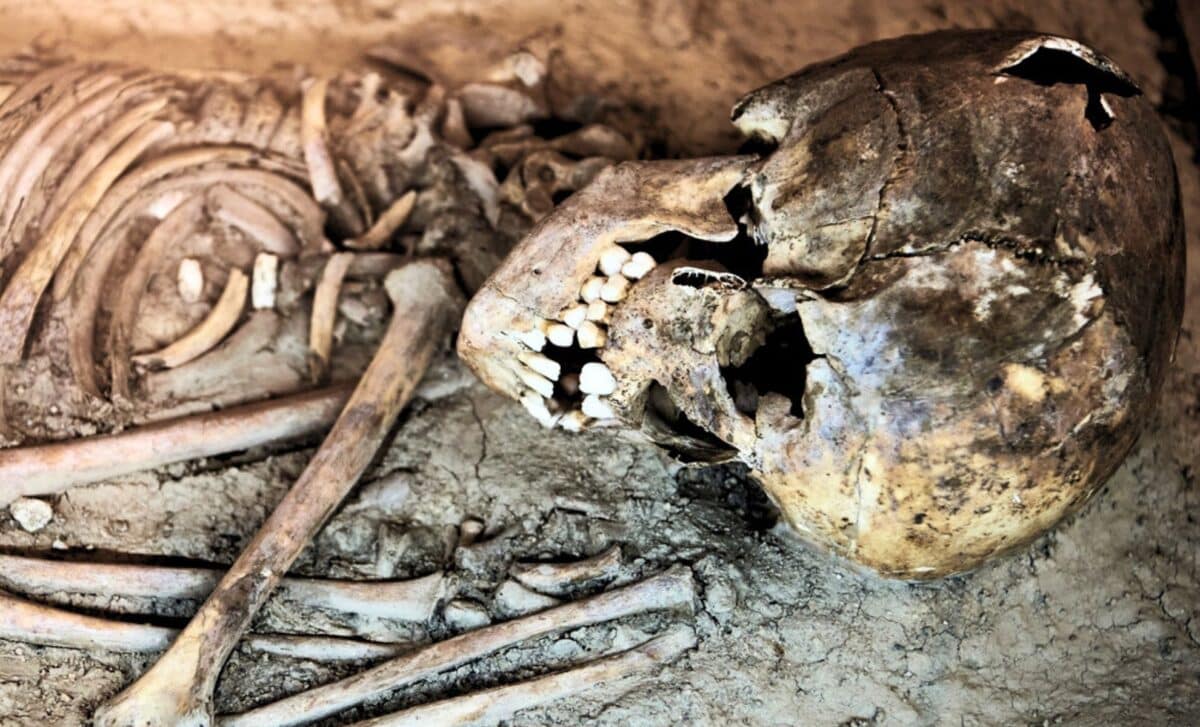
The buried remains of a small child, discovered nearly a century ago in a cave on Israel’s Mount Carmel, are once again at the center of a scientific storm. Long regarded as an early Homo sapiens, the child—known as Skhūl I—may now represent something far more complex: the earliest known human–Neanderthal hybrid, dating back 140,000 years.
This revised interpretation, published in the peer-reviewed journal L’Anthropologie, challenges the long-standing consensus that Homo sapiens and Neanderthals first interbred around 50,000 years ago. If correct, it would mean the two species began mixing at least 100,000 years earlier than previously thought—and potentially in a different geographic corridor than researchers had assumed.

The child’s partial skull and jaw, unearthed in the 1930s, had been stored in collections for decades. But a new digital reconstruction using CT scans and 3D models has revealed a mosaic of anatomical traits, with a skull aligned closely with Homo sapiens and a jaw that strongly resembles Neanderthals.
For lead researcher Israel Hershkovitz, a paleoanthropologist at Tel Aviv University, the findings mark a turning point: “We are not looking at a late hybridization event. This is a population-level genetic exchange happening deep in time.”
A hybrid in plain sight?
The Levant region—an ancient land bridge between Africa, Asia, and Europe—has long been known as a critical zone for early hominin migration. But the idea that this corridor hosted sustained Neanderthal–human interaction as far back as 140,000 years ago rewrites major evolutionary assumptions.
The team used tomographic imaging and virtual reconstructions to reassess Skhūl I’s fragmented remains. They compared them to known fossils of both Homo sapiens and Neanderthals, including other juvenile skeletons.
The results revealed what researchers described as “dichotomous morphogenesis”: the upper skull displays sapiens-like traits—rounded cranium, modern facial structure—while the jaw shows distinct Neanderthal features, such as a receding chin and robust mandibular morphology.

This combination, Hershkovitz said in the report, “could suggest that the child was a second-generation product of a gradually mixing population, not a one-off cross between two individuals.”
The proposed classification: a “paleodeme,” or biologically diverse group emerging from long-term interbreeding between modern and archaic humans.
This insight builds on prior genetic research, including a landmark 2010 study in Science that revealed between 1% and 5% of modern non-African DNA is inherited from Neanderthals. That finding was based on the sequencing of the Neanderthal genome, which showed clear evidence of ancient interbreeding events.
Other studies, such as this Nature review on models of human origins, have pushed for more flexible interpretations of human evolution—ones that allow for gene flow between populations previously considered separate species.
A burial that asks more questions than it answers
The child was not found alone. Skhūl I was one of several individuals buried in what appears to be a collective grave site, possibly with ritual significance. The site, first excavated by Dorothy Garrod in the 1930s, may represent the oldest known intentional burial ground.
This, too, challenges long-standing narratives. Burial practices have long been associated with symbolic thought, cultural continuity, and uniquely human behaviors. But evidence from Skhūl I suggests that such practices were occurring within a mixed hominin population.

“The idea that only Homo sapiens buried their dead with intention is no longer sustainable,” Hershkovitz said. “This community had a clear concept of group identity, respect for the deceased, and possibly territorial behavior.”
Some researchers, however, are urging caution. Antonio Rosas, a senior paleobiologist at Spain’s National Museum of Natural Sciences, said the study raises legitimate questions but does not provide conclusive proof. “Assigning hybrid status based on the divergence between a skull and a jaw is biologically tenuous,” he noted, suggesting that the jaw may have come from a separate individual inadvertently mixed during the burial.
Skepticism and the limits of bone
Despite the study’s implications, critics argue that morphology alone cannot confirm interbreeding. Fossilized anatomy, while rich in historical detail, lacks the precision of DNA. Without direct paleogenomic evidence, claims of hybrid ancestry remain probabilistic rather than definitive.
“Genetic recombination doesn’t distribute neatly between individual bones,” Rosas said. “You don’t get a Neanderthal jaw just because one parent had Neanderthal DNA. The reality is far more complex.”
Skeptics also highlight the preservation issues surrounding Skhūl I. The jaw and skull were separated during the 1931 excavation, and the mandible was reconstructed using plaster. Contamination and misidentification are not unheard of in early 20th-century digs.

Researchers advocating for the hybrid theory have called for aDNA (ancient DNA) analysis to resolve the issue. But extracting viable genetic material from fossils this old, and from the Levant in particular, remains notoriously difficult due to climate-driven DNA degradation.
The issue echoes challenges raised in other cases, such as the Lapedo child discovery in Portugal, another potential hybrid from around 29,000 years ago, which similarly blended traits of both species. That case, though more recent, also raised intense debates about classification and burial interpretation.

Posting Komentar untuk "Meet Skhūl: The First Human-Neanderthal Hybrid in History"
Posting Komentar