
New Cosmic Explosions Unveil Hidden Structures in Star Bursts
A New Era in Understanding Stellar Explosions
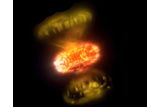
For the first time, astronomers have captured two stellar explosions in ultra-sharp detail as they erupted. What they observed has completely rewritten our understanding of novae. Rather than a single, spherical blast, the new images reveal chaotic jets of gas, delayed explosions of outer layers, and collisions that create shock waves powerful enough to generate gamma rays.
The findings, published in Nature Astronomy, show that novae—once considered simple cosmic firecrackers—are far more complex, varied, and powerful than previously imagined.
"This is an extraordinary leap forward," said John Monnier, a professor of astronomy at the University of Michigan and a co-author of the study, in a press release. "The fact that we can now watch stars explode and immediately see the structure of the material being blasted into space is remarkable. It opens a new window into some of the most dramatic events in the universe."
What Is a Nova?
A nova forms when a white dwarf—a dense, Earth-sized core left behind after a Sun-like star dies—pulls in gas from a companion star. Eventually, that stolen material ignites in a runaway nuclear reaction, brightening the system and hurling gas outward at high speed. But until recently, the first stages of that blast were impossible to observe directly; the expanding shell simply appeared as a single, unresolved point of light.
Understanding how that ejected material moves and collides is crucial for tracing the shock waves that novae produce—especially after NASA's Fermi Gamma-ray Space Telescope revealed that more than 20 novae emit high-energy radiation. Those detections turned novae into unexpected gamma-ray sources and raised new questions about what happens in the first hours and days of an eruption.
Using Interferometry to Capture a Stellar Explosion
To see the earliest moments of a nova, the researchers used interferometry—a technique that links the light from several telescopes to create a much sharper image than any one telescope can provide.
"Instead of seeing just a simple flash of light, we're now uncovering the true complexity of how these explosions unfold. It's like going from a grainy black-and-white photo to high-definition video," said lead author Elias Aydi in the press release.
V1674 Herculis flared and faded so quickly that it ranks among the fastest novae on record. Even so, the images showed surprising structure: two streams of gas shot out in almost perpendicular directions, and when they began to collide, NASA's Fermi telescope detected gamma rays at the same time—a clear sign that the shocks came from those clashing outflows.
V1405 Cassiopeiae took the opposite approach. For more than 50 days, its outer layers stayed close to the star instead of flying outward. Only later did a large shell finally break free, triggering fresh shocks and another rise in gamma rays. Spectra from observatories such as Gemini mirrored those changes, giving astronomers a clear view of a nova that erupts in distinct stages rather than all at once.
Shock Waves and Gamma Rays
The new images show that novae are far more intricate than the simple blasts they were once assumed to be. By revealing how outflows collide, stall, or unfold in stages, the findings help explain the powerful shock waves that generate gamma rays—a connection first uncovered by NASA's Fermi telescope.
The work also strengthens the idea that novae act as natural laboratories for extreme physics, linking what happens on a white dwarf's surface to the high-energy signals we detect from space.
"This is just the beginning," Aydi said. "With more observations like these, we can finally start answering big questions about how stars live, die and affect their surroundings. Novae, once seen as simple explosions, are turning out to be much richer and more fascinating than we imagined."
The Future of Nova Research
As technology advances and observational techniques improve, the potential for further discoveries in this field grows exponentially. These findings not only deepen our understanding of novae but also highlight the dynamic and often unpredictable nature of the cosmos.
By studying these explosive events, scientists can gain insights into the processes that shape the universe, from the formation of elements to the behavior of matter under extreme conditions. Each nova offers a unique glimpse into the life cycle of stars and the forces that govern their evolution.
The study opens up exciting possibilities for future research, encouraging astronomers to explore the complexities of other celestial phenomena with the same level of precision and curiosity. As we continue to unravel the mysteries of the universe, novae will undoubtedly remain a focal point of astronomical inquiry.

Posting Komentar untuk "New Cosmic Explosions Unveil Hidden Structures in Star Bursts"
Posting Komentar