
New Images of Comet 3I/ATLAS Reveal Stunning Glow and Dual Tails
The Fascinating Journey of Comet 3I/ATLAS
The excitement surrounding Comet 3I/ATLAS is growing as this enigmatic interstellar object makes its way closer to Earth. Traveling at an astonishing speed of 153,000 miles per hour, the comet has already passed by the Sun and is now on a trajectory that will bring it closest to our planet on Friday, December 19, 2025. Astronomers are eagerly anticipating this event, while also analyzing the latest images captured by advanced space observatories.
New Insights from Space Telescopes
NASA's Hubble Space Telescope and the European Space Agency's Jupiter Icy Moons Explorer (Juice) have provided valuable data about 3I/ATLAS. These observations offer a fresh perspective on the unique characteristics that set this comet apart from others in our Solar System. As the comet continues its journey beyond the Solar System, more details are expected to emerge throughout the coming year.
The Enigmatic Blue Glow
One of the most striking features of 3I/ATLAS is its brilliant blue glow. A recent image taken by Hubble's Wide Field Camera 3 on November 30 shows the comet approximately 178 million miles from Earth. In this image, the comet appears as a tiny white speck surrounded by a vibrant blue aura. Faint streaks of light in the background represent distant stars, which appear in this manner due to the movement of the comet across the sky.
Earlier, in late July, NASA shared a lower-resolution image of 3I/ATLAS taken by Hubble. This image also highlights the comet's blue glow. But what causes this unusual brightness?
Comets typically become brighter as they approach the Sun, with radiation causing ice to sublimate into gas. This process forms the coma and tail, which reflect sunlight and contribute to the comet's brightness. However, 3I/ATLAS is unusually bright, possibly due to the absence of a dust mantle, which usually moderates a comet's brightness. Unlike other comets that tend to turn redder as their dust reflects scattered sunlight, 3I/ATLAS maintains a blue-green hue, likely due to the ejection of gases such as cyanogen and ammonia.
Two Tails Revealed
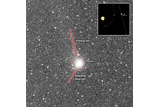
Another image of 3I/ATLAS, captured by the ESA's Juice spacecraft on November 2, showcases hints of two tails. Five scientific instruments aboard Juice were used to study the comet's behavior and composition, while the onboard Navigation Camera (NavCam) captured a snapshot.
Although the full data from the five instruments will not be available until mid-February 2026, the NavCam image provides a glimpse into the comet's activity. The image reveals a bright spot where the coma is located, along with two lines branching off from the coma. One is the plasma tail, composed of electrically charged gas stretching toward the top of the image. The other is the suspected dust tail, a fainter stream of tiny solid particles pointing toward the lower left corner of the image.
Observing an Interstellar Visitor
More images and observations of 3I/ATLAS are anticipated in the coming months as additional telescopes join the effort. Astronomers will continue to monitor the comet as it approaches Earth. Although its closest approach is about 168 million miles away, it is not close enough to pose any threat. Earlier, when the comet passed by Mars on October 3, 2025, it was only 18 million miles away.
The best time to view 3I/ATLAS from Earth is expected to be in early December using a good pair of binoculars or a telescope. According to skylive.com, the comet will traverse the constellations Virgo and Leo before becoming much fainter by the end of the year.
Conclusion
As 3I/ATLAS continues its journey through the Solar System, it offers a rare opportunity for astronomers to study an interstellar visitor. The new images and data collected by Hubble and Juice provide valuable insights into the comet's unique properties. With more observations on the horizon, scientists are excited to uncover even more about this fascinating celestial object.

Posting Komentar untuk "New Images of Comet 3I/ATLAS Reveal Stunning Glow and Dual Tails"
Posting Komentar