
One Side of Earth Cools Faster Than the Other
Understanding Earth's Heat Distribution
Research has revealed that the Pacific hemisphere is losing heat at a faster rate compared to the African hemisphere. This phenomenon is linked to the Earth’s molten interior, which plays a significant role in continental drift. The distribution of heat across the planet is influenced by the presence of landmasses and seafloor surfaces, with landmasses trapping more heat than the ocean floor.
Scientists from the University of Oslo have conducted a study published in Geophysical Research Letters that explores how heat is dissipated across different parts of the Earth. Their findings suggest that one side of the Earth's interior is cooling much faster than the other, and this process has been ongoing for as long as the planet has existed.
The study uses computer models spanning the last 400 million years to analyze how "insulated" each hemisphere was by continental mass. This insulation is crucial because it determines how much heat is retained rather than released. The pattern observed in the research dates back to the time of Pangaea, the supercontinent that existed millions of years ago.
Earth’s interior is red-hot and liquid, providing warmth to the entire planet from within. The Earth also spins, generating both gravity and its magnetic field, which helps maintain the protective atmosphere close to the surface.
Over an extremely long period, the Earth’s interior will continue to cool, eventually resembling Mars. However, the study highlights an unexpected unevenness in heat dissipation. The reason behind this lies in the presence of more landmasses, which act like a Thermos layer, trapping heat.
This contrasts with how most of Earth’s heat is typically lost: through the oceanic lithosphere. According to the study authors, the oceanic lithosphere is the primary site of heat loss. To understand why this occurs, it's essential to consider the concept of continental drift.
The Role of Continental Drift
The Earth’s mantle functions like a convection oven, driving a tectonic treadmill. Every day, the seafloor moves slightly; new seafloor is created from magma erupting at the continental divide, while older seafloor is pushed beneath existing landmasses.
To study the behavior of Earth’s internal heat, scientists constructed a model dividing the Earth into African and Pacific hemispheres. They then divided the Earth’s surface into a grid based on half-degree latitude and longitude.
By combining previous models that account for seafloor age and continental positions over the last 400 million years, the team calculated how much heat each grid cell contains throughout its lifespan. This approach allowed them to determine the overall cooling rate, revealing that the Pacific hemisphere has cooled significantly faster.
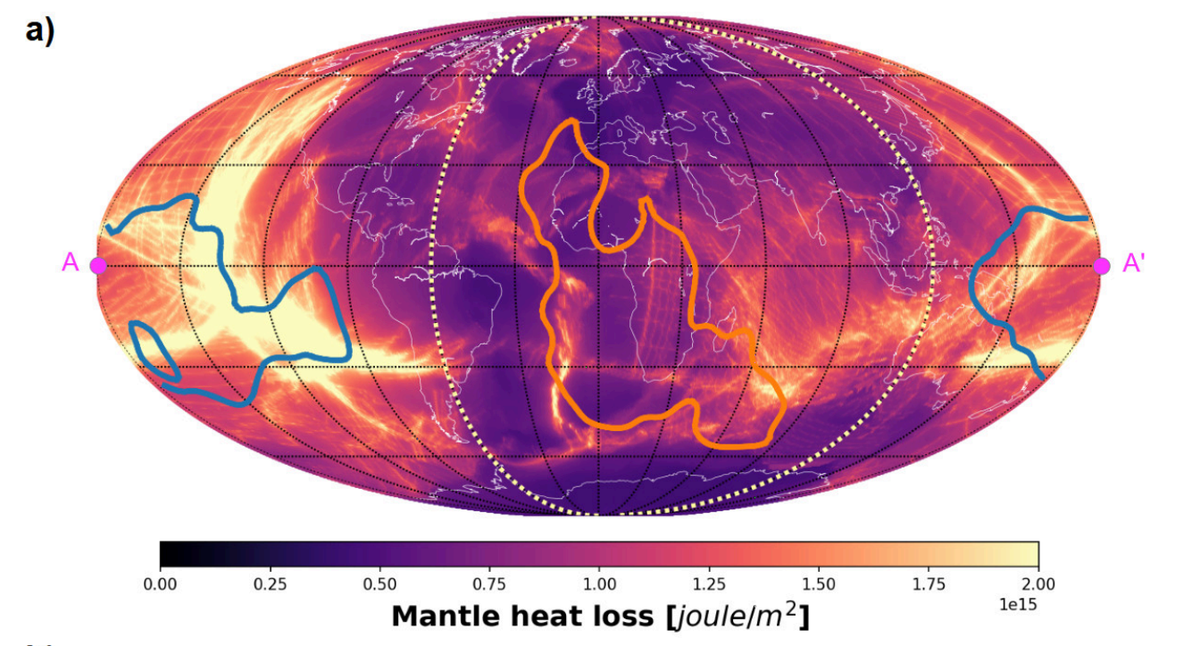
The seafloor is much thinner than landmasses, and the heat from the Earth’s interior is "quenched" by the vast volume of cold water above it. Considering the size of the Pacific Ocean compared to the landmasses of Africa, Europe, and Asia, it makes sense that heat dissipates more quickly from the largest seafloor.
Previous studies on this seafloor effect only extended back 230 million years, but the new model covers 400 million years, nearly doubling the timeframe under investigation.
Contradictions and Implications
There is a surprising contradiction in the findings. The Pacific hemisphere has cooled about 50 Kelvin more than the African hemisphere, yet the consistently higher plate velocities of the Pacific hemisphere during the past 400 million years suggest it was much hotter at a certain point in time.
Could the Pacific have been covered by landmass in the distant past, retaining more heat? While there are other possible explanations, the high tectonic activity in the Pacific today indicates a heat disparity. The meltier the mantle, the more the plates can slide and collide, contributing to the dynamic nature of the Earth’s surface.

Posting Komentar untuk "One Side of Earth Cools Faster Than the Other"
Posting Komentar