
OpenAI's Enterprise Win Amid Internal 'Code Red' Over Google Threat

OpenAI has released new data highlighting a significant increase in enterprise usage of its AI tools over the past year. According to the findings, the volume of messages sent through ChatGPT has increased by 8 times since November 2024. Employees are reporting that they save up to an hour daily due to these tools. This data was released just a week after CEO Sam Altman sent an internal "code red" memo regarding the competitive threat posed by Google.
The timing of this release emphasizes OpenAI's efforts to reposition itself as the leading provider of enterprise AI solutions. However, it also highlights the growing challenges the company faces. While nearly 36% of U.S. businesses use ChatGPT Enterprise compared to 14.3% for Anthropic, according to the Ramp AI Index, the majority of OpenAI’s revenue still comes from consumer subscriptions. This base is being challenged by Google's Gemini. Additionally, OpenAI must compete with rival AI firm Anthropic, which primarily focuses on B2B sales, and increasingly with open-weight model providers targeting enterprise customers.
OpenAI has committed $1.4 trillion to infrastructure over the next few years, making enterprise growth a crucial component of its business model. Ronnie Chatterji, OpenAI’s chief economist, explained during a briefing: “From an economic growth perspective, consumers matter. But when you look at historically transformative technologies like the steam engine, it's when firms adopt and scale these technologies that you really see the biggest economic benefits.”
The new findings suggest that adoption among larger enterprises is not only increasing but also becoming more integrated into workflows. Employees are sending more messages, and organizations using OpenAI’s API are consuming 320 times more “reasoning tokens” than they were a year ago. This indicates that companies are using AI for more complex problem-solving or experimenting heavily with the technology, even if long-term value is not yet clear.
This surge in reasoning tokens, which correlates with higher energy consumption, could be costly for companies and may not be sustainable in the long term. HAWXTECH.NEthas asked OpenAI about how enterprises allocate budgets for AI and the sustainability of this growth rate.
Beyond raw usage metrics, OpenAI is also observing changes in how companies deploy its tools. The use of custom GPTs—tools that companies use to codify institutional knowledge into assistants or automate workflows—has increased 19 times this year, now accounting for 20% of enterprise messages. OpenAI highlighted digital bank customer BBVA, which reportedly uses over 4,000 custom GPTs regularly.
“This shows you how much people are really able to take this powerful technology and start to customize it to the things that are useful to them,” said Brad Lightcap, OpenAI’s chief operating officer, during the briefing.
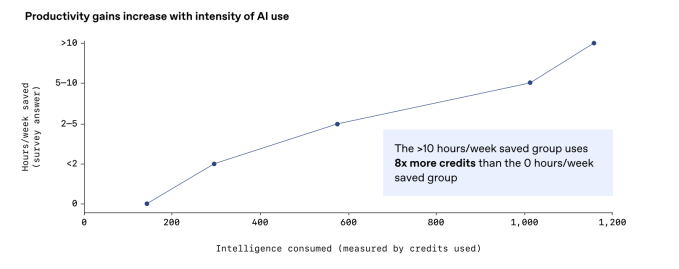
These integrations have led to notable time savings, according to OpenAI. Participants reported saving 40 to 60 minutes per day with OpenAI’s enterprise products, although this does not include time spent learning the systems, prompting, or correcting AI output.
The report found that enterprise workers are increasingly leveraging AI tools to expand their own capabilities. Three-quarters of those surveyed say AI enables them to perform tasks, including technical tasks, that they couldn't do before. OpenAI reported a 36% increase in coding-related messages outside of engineering, IT, and research teams.
While OpenAI emphasizes that its technology is democratizing access to skills, it's important to note that more widespread coding could lead to more security vulnerabilities and other flaws. When asked about this, Lightcap pointed to OpenAI’s recent release of its agentic security researcher Aardvark, which is in private beta, as a potential way to detect bugs, vulnerabilities, and exploits.
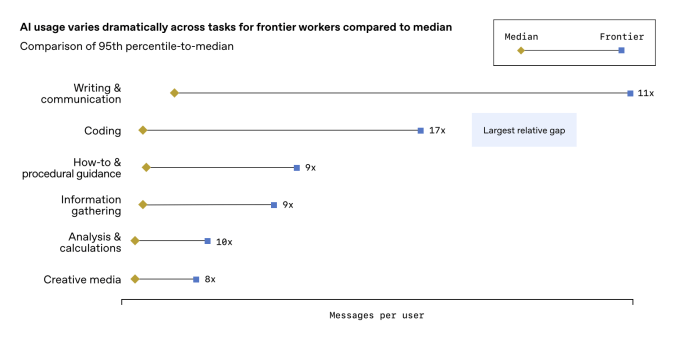
OpenAI’s report also found that even the most active ChatGPT Enterprise users aren’t utilizing the most advanced tools available, such as data analysis, reasoning, or search. During the briefing, Lightcap speculated that this is because fully adopting AI systems requires a mindset shift and deeper integration with enterprise data and processes. Adoption of advanced features will take time, he said, as companies retool workflows to better understand what's possible.
Lightcap and Chatterji also emphasized a report finding that showed a “growing divide in AI adoption,” with some “frontier” workers using more tools more often to save more time than the “laggards.”
“There are firms that still very much see these systems as a piece of software, something I can buy and give to my teams and that’s kind of the end of it,” Lightcap said. “And then there are companies that are really starting to embrace it, almost more like an operating system. It’s basically a re-platforming of a lot of the company’s operations.”
OpenAI’s leadership, which certainly feels the pressure of the firm’s $1.4 trillion in infrastructure commitments, framed this as an opportunity for laggards to catch up. For workers training AI systems to replicate their work, “catching up” might feel more like a countdown.

Posting Komentar untuk "OpenAI's Enterprise Win Amid Internal 'Code Red' Over Google Threat"
Posting Komentar