
Pushing the Frontiers of Quantum-Ready 2D Materials
Quantum technologies, ranging from ultrasensitive sensors to next-generation information processors, rely heavily on the ability of quantum bits, or qubits, to maintain their delicate quantum states for a sufficient duration. This stability is measured by the spin coherence time, which determines how long a qubit can retain its quantum information before it is disrupted by external factors.
One of the main challenges in maintaining this stability is the "noisy" environment that qubits often encounter. This noise can come from various sources, such as nuclear isotopes or other interferences that disturb the qubit's state. To overcome this challenge, researchers are exploring new materials that can provide quieter environments for qubits.
Two-Dimensional (2D) Materials and Their Potential
Two-dimensional (2D) materials—atomically thin sheets—offer promising solutions for creating quiet environments for qubits. Their reduced thickness naturally lowers the number of isotopes that interact with the qubit, making them ideal candidates for hosting quantum systems.
A recent study published in npj 2D Materials and Applications details a groundbreaking computational strategy developed by researchers at the University of Chicago Pritzker School of Molecular Engineering (UChicago PME). This high-throughput approach provides a data-driven method for identifying ideal 2D materials and substrates for qubit applications.
New Computational Strategy for 2D Materials
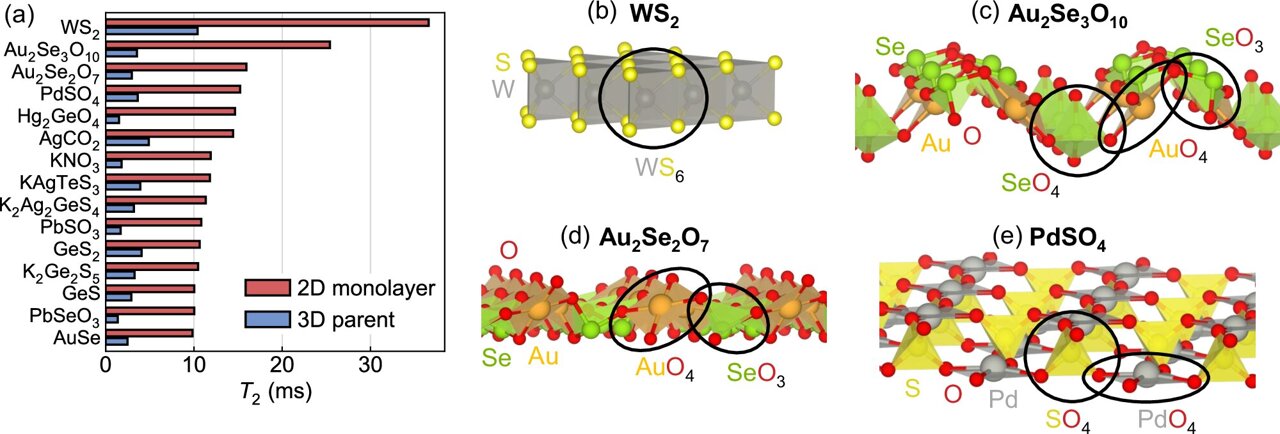
The research team, led by Michael Toriyama, a postdoctoral researcher in UChicago PME's Galli Group, created an automated framework using the "cluster correlation expansion" method. This technique simulates how isotopes interact with a qubit, allowing the team to calculate spin coherence times for over one thousand monolayers. They identified 189 materials that could potentially support coherence times longer than those of diamond, a commonly used host for spin qubits.
Some of the most promising materials include WS₂ and several Au-oxyselenides, which show predicted coherence times in the tens of milliseconds—exceptional values for solid-state systems. These compounds share two key features: they contain very few nuclei with strong magnetic moments and many of their atoms occur naturally in spin-free isotopes.
The Role of Substrate Selection
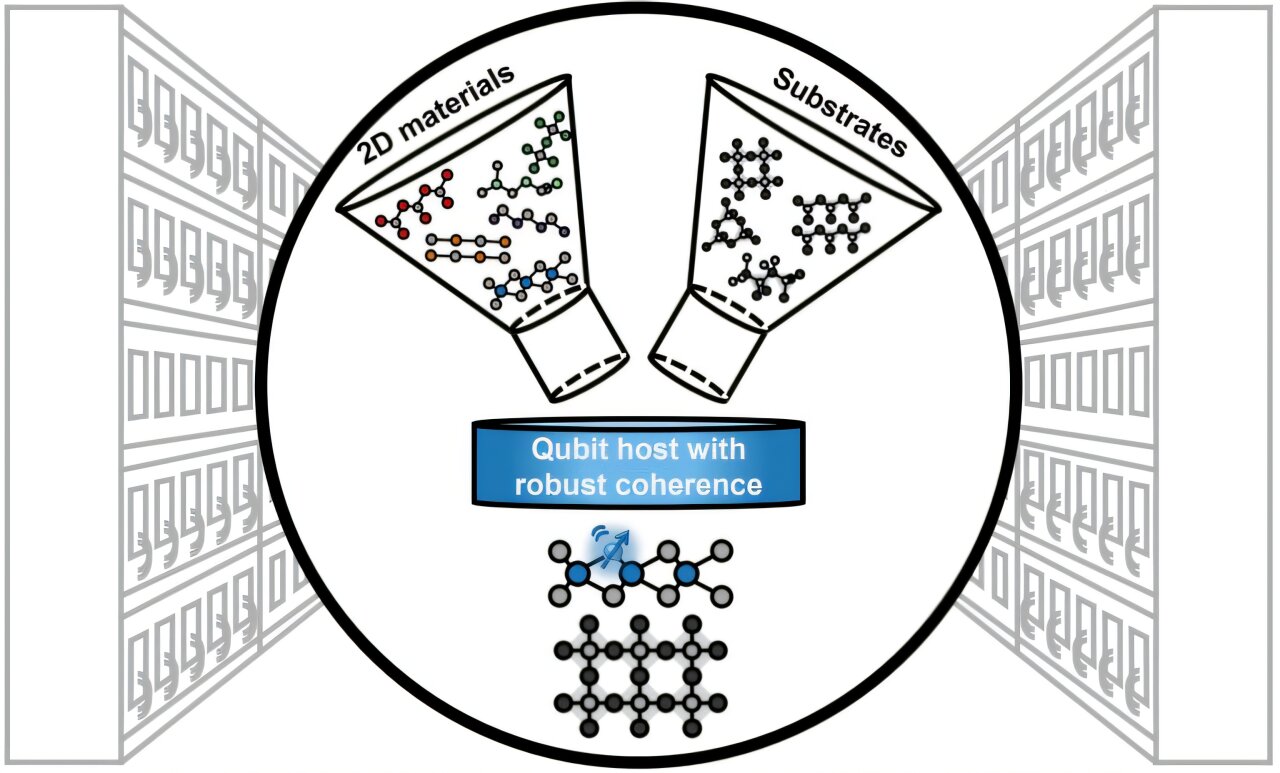
However, qubits do not exist in isolation. They are placed on substrates, and the choice of substrate plays a critical role in maintaining coherence. The team evaluated more than 1,500 combinations of 2D materials and substrates, revealing that substrates can significantly impact coherence unless carefully selected.
Materials like ceria and calcium oxide, which have low nuclear-spin noise, help preserve the long spin coherence time of the 2D host. This finding offers clear guidelines for designing high-performance 2D spin-qubit devices by selecting both a quiet host material and a quiet substrate.
Analytical Models and Future Directions
To enable large-scale screening and accelerate future discoveries, the authors also developed analytical models that capture the essential physics behind decoherence in 2D materials and heterostructures. These models, inspired by previous work from Tohoku University Assoc. Prof. Shun Kanai on 3D materials, allow fast estimates of coherence times without expensive simulations.
Using these models, the team expanded their search to nearly 5,000 additional 2D materials from public databases, identifying over 500 new candidates with long predicted coherence times.
Implications for Quantum Technologies
The broader implications of this work are significant. It reveals that the space of potentially useful 2D quantum materials is far richer than previously thought. By combining high-throughput simulations, data-driven modeling, and physical insight, the study offers a blueprint for systematically discovering next-generation qubit hosts in 2D systems.
Moreover, the research hints at an exciting direction: using artificial intelligence-inspired generative models similar to ChatGPT to design entirely new 2D materials optimized for quantum coherence.
As quantum technologies move from the laboratory to practical devices, data-driven strategies like this will become essential. They transform what was once trial-and-error exploration into a rational search across a vast design space, bringing the goal of robust, scalable, quantum-enabled devices closer to reality.

Posting Komentar untuk "Pushing the Frontiers of Quantum-Ready 2D Materials"
Posting Komentar