
Scientists reassess Cleveland's legendary sea monster
The Evolutionary Story of Dunkleosteus terrelli
Dunkleosteus terrelli, often referred to as the sea monster of Cleveland, has long been a symbol of prehistoric power and mystery. This 14-foot armored fish, known for its bone blades instead of teeth, has captivated the imagination of school children and museum visitors alike. Its skull, displayed in awe, has been painted by artists as a deep-sea terror unlike any other creature before or since.
But what if this iconic figure was not as strange as we thought? Recent research led by Dr. Russell Engelman from Case Western Reserve University suggests that Dunkleosteus may have been more ordinary than extraordinary. This new understanding changes how we view this ancient predator and its place in evolutionary history.
Myth vs. Reality: The "Alien" Fish That Wasn't
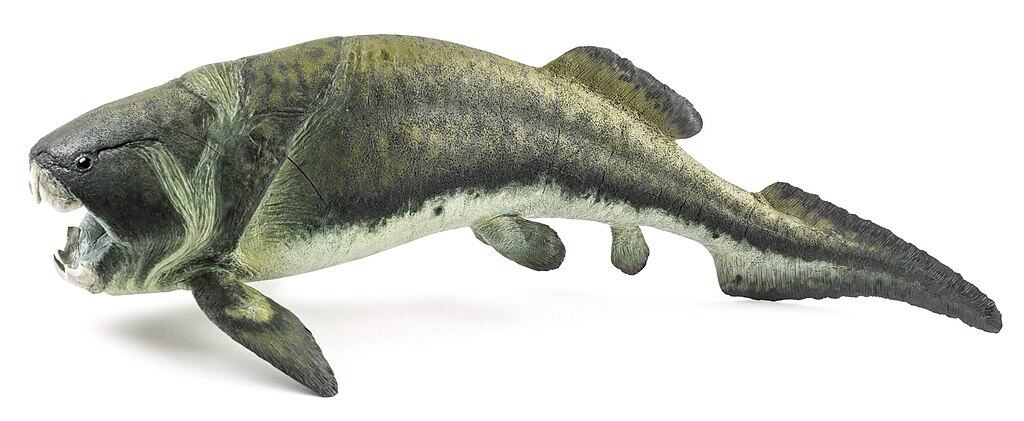
The reputation of Dunkleosteus as an alien-like creature stems largely from the nature of its fossils. Often found flattened, with internal anatomy rarely preserved, early scientists struggled to interpret its structure accurately. As Engelman explains, the lack of data led to assumptions about its anatomy that were later proven incorrect.
Trying to reassemble a crushed 1930s car from blueprints for a motorcycle is a fitting analogy for the challenges faced by early researchers. The result was a creature that seemed bizarre and out of place in the evolutionary timeline.
However, with modern tools and comparative data from other armored fishes around the world—especially superbly preserved fossils in Australia—scientists can now see which parts of Dunkleosteus are truly unique and which are standard for early jawed vertebrates.
One such example is its jaw structure. Engelman notes that the lower jaw of Dunkleosteus followed the same evolutionary pathway as our own. It started as a single undifferentiated cartilage and gradually became ossified into several distinct bones. This process mirrors the development of jaws in mammals, including humans.
Even the shark-like facial muscle identified in Dunkleosteus appears to have deeper evolutionary roots. While it resembles modern sharks and rays, a broader survey suggests a similar muscle may have been present in most early fishes and was simply lost or modified in the lineage leading to modern bony fishes.
Not Toothless... After All?
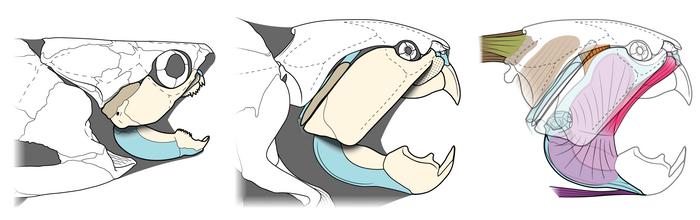
One of the most distinctive features of Dunkleosteus is its lack of true teeth. Instead, it had enormous, sharpened bone blades perfect for slicing through other armored fish. This feature has often been framed as "primitive," implying that Dunkleosteus lived before real teeth evolved.
However, Engelman cautions against this misconception. He explains that the lack of teeth in Dunkleosteus is not due to it being ancient, but rather because it belongs to a group of fish that have teeth but have lost them in certain lineages.
Moreover, its bone blades are not as unique as they seem. The system of growth and wear in Dunkleosteus is similar (but less extreme) to that seen in modern chameleons and an extinct group of reptiles called rhynchosaurs. This connection highlights the evolutionary logic behind these structures.
Whenever certain armored fish specialized in eating other large fish, bone blades independently developed as a tool for cutting digestible chunks out of very large animals. This shows that nature tends to reinvent the same tools when facing similar ecological challenges.
Still an Apex Predator?
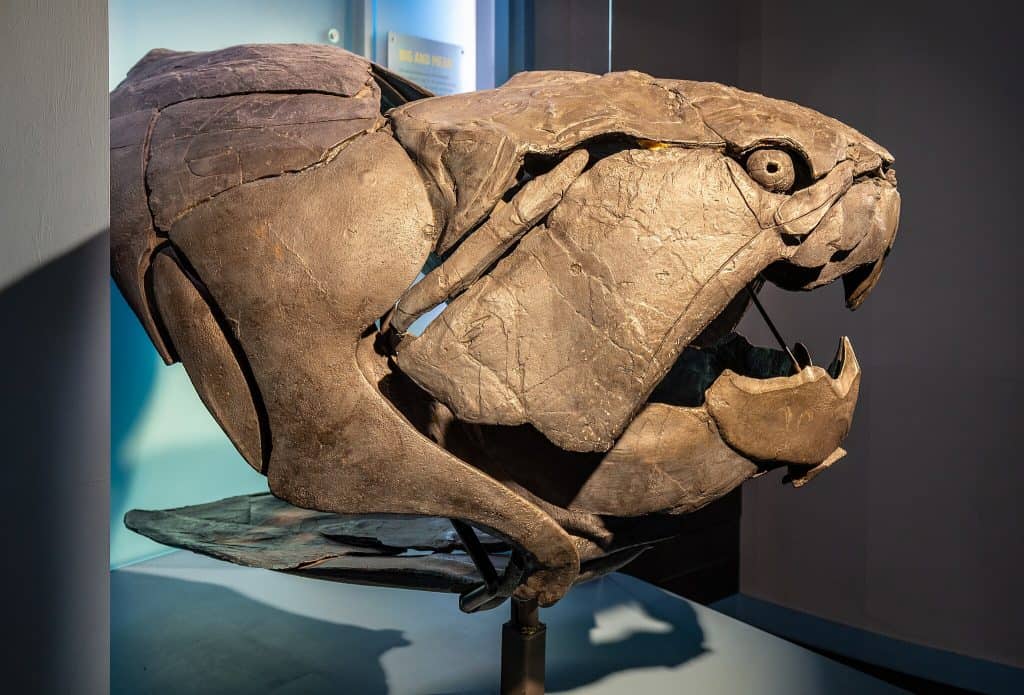
Even with a more grounded anatomy, Dunkleosteus remains an apex predator. However, scientists now have a clearer picture of how it fed, moved, and grew. One longstanding misconception was its size. For decades, popular books and museum signage cited enormous estimates, claiming it could reach lengths of 30 feet or more.
Engelman discovered that these claims were based on flawed reconstructions. He explains that the proportions seen in most reconstructions made it impossible for the fish to be that large. Oversized depictions became self-reinforcing, with reconstructions of Dunkleosteus that are 5–6+ meters long implying animals that are more than twice the size of the largest known fossils.
In reality, most individuals likely topped out around 14–20 feet long. While still massive, this is significantly smaller than the skyscraper-sized monster often depicted in popular media.
A New Reputation for Cleveland’s Beloved Sea Monster
So, what image should the public carry forward? Engelman hopes readers will understand Dunkleosteus as both extraordinary and familiar—a sleek, heavily armored pursuit predator shaped by the same evolutionary rules that guided countless other fish lineages.
With its anatomy freshly interpreted—from cartilage-rich skull to shark-like muscles to bone-blade jaws—we can finally imagine a creature that isn’t a mythic aberration, but a powerful, well-adapted product of its time.
It was fast. It was formidable. It was the apex predator of the Devonian seas.
But it was also part of a larger evolutionary story, one that includes sharks, early vertebrates, reptiles, mammals, and yes, even us.
If anything, that makes Dunkleosteus more remarkable, not less.

Posting Komentar untuk "Scientists reassess Cleveland's legendary sea monster"
Posting Komentar