
Scientists Uncover Cosmic 'Scar' from Solar Encounter with Two Intruder Stars
A Cosmic Encounter That Shaped Our Solar System
Astronomers have uncovered a fascinating event in the history of our solar system: around 4.4 million years ago, the sun had a close encounter with two extremely hot and massive stars. This discovery was made possible by examining a "scar" left in the swirling clouds of gas and dust that lie just beyond our solar system. The research not only reveals more about the immediate celestial environment of the solar system but also offers insights into how these cosmic interactions may have influenced the development of life on Earth.
To understand this event, the team of astronomers analyzed the movements of the "local interstellar clouds," which span approximately 30 light-years. These clouds are part of the region where the sun currently resides, along with the two intruder stars now located 400 light-years from Earth in the front and rear "legs" of the constellation Canis Major (the Great Dog). However, tracking this interaction is complex because the sun itself is moving at an incredible speed of 58,000 miles per hour (93,000 km/h), roughly 75 times faster than the speed of sound on Earth.
"It's kind of a jigsaw puzzle where all the different pieces are moving," said Michael Shull, team leader from the University of Colorado Boulder. "The sun is moving. Stars are racing away from us. The clouds are drifting away."
Beyond the local interstellar clouds, which contain wispy clumps of hydrogen and helium atoms, the solar system is situated within a region of the Milky Way known as the "local hot bubble." This area is relatively free of matter and plays a crucial role in shaping the conditions of our cosmic neighborhood.
Understanding these regions could be key to comprehending how life on Earth was able to thrive. "The fact that the sun is inside this set of clouds that can shield us from ionizing radiation may be an important piece of what makes Earth habitable today," Shull explained.
To investigate the influence of these cosmic interactions, Shull and his colleagues focused on two stars in Canis Major: Epsilon Canis Majoris (Adhara) and Beta Canis Majoris (Mirzam). The team found that these two stars likely passed close to the sun around 4.4 million years ago, coming as close as 30 light-years away. While this distance is vast in human terms—equivalent to about 175 trillion miles (281 trillion km)—it is considered a close passage in cosmic terms.
Such an encounter would have made these stars highly visible from Earth. "If you think back 4.4 million years, these two stars would have been anywhere from four to six times brighter than Sirius is today, far and away the brightest stars in the sky," Shull said.
These stars are significantly larger and hotter than the sun, with temperatures reaching up to 45,000 degrees Fahrenheit (25,000 degrees Celsius). When they passed through our cosmic neighborhood, they emitted powerful ultraviolet radiation that caused ionization in the local interstellar clouds. This process stripped electrons from hydrogen and helium atoms, leaving them positively charged and creating the "scar" that the researchers detected.
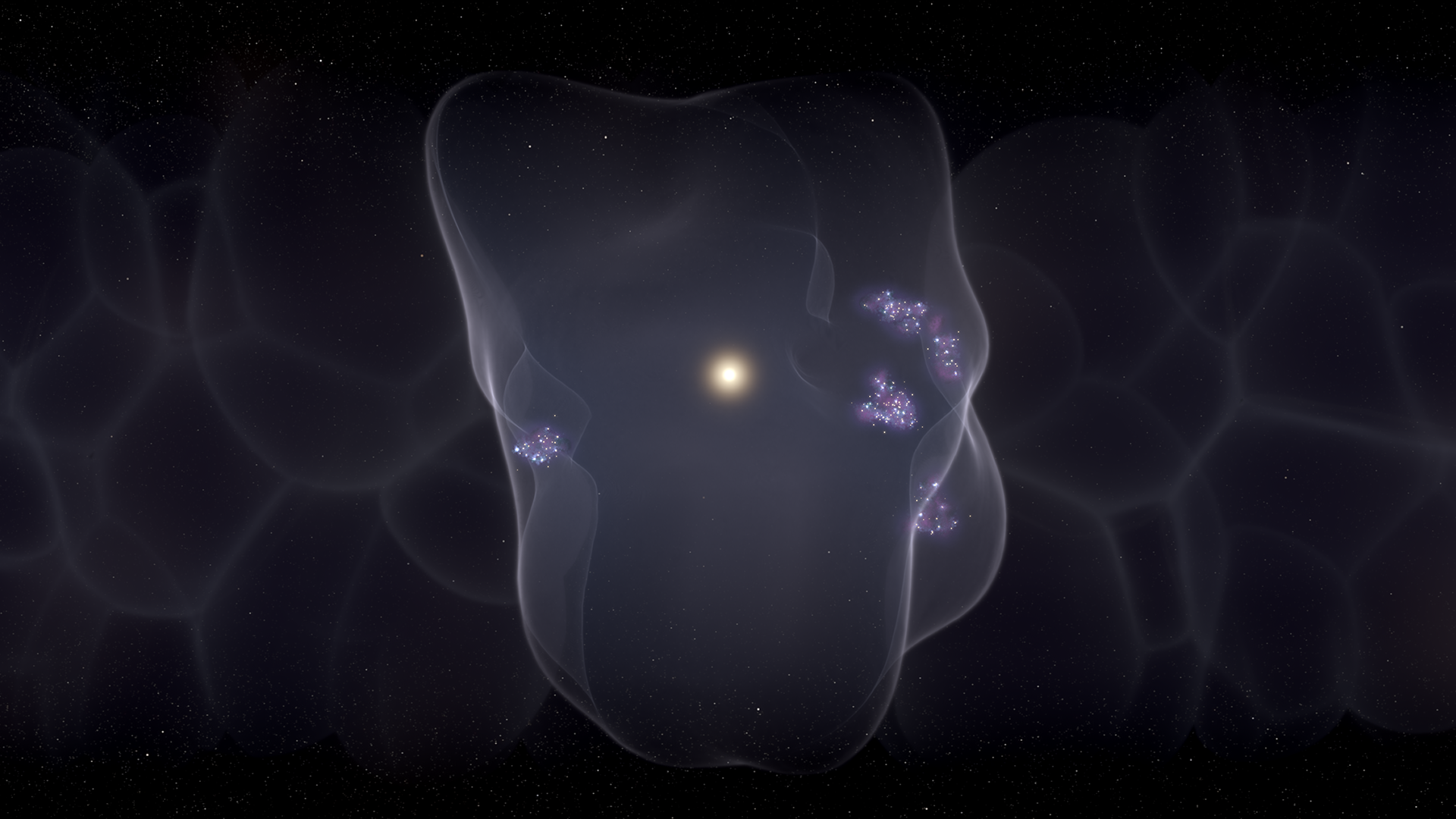
The team’s findings help explain a long-standing mystery about the local interstellar clouds. Previously, astronomers observed that 20% of the hydrogen atoms and 40% of the helium atoms in these clouds were ionized—an unusually high level, especially for helium. The team theorizes that this ionization was assisted by other sources of ultraviolet radiation, including three white dwarf stars and the local hot bubble itself.
The local hot bubble is believed to have formed due to the explosive deaths of between 10 and 20 stars. These supernovas heated the surrounding gas, causing the region to emit ionizing radiation in the form of X-rays and ultraviolet light, which further affected the nearby interstellar clouds.
Over time, the ionization of these clouds will fade as hydrogen and helium atoms regain their neutral charge by capturing loose electrons. This process could take millions of years.
Epsilon and Beta Canis Majoris are also nearing the end of their lives. While the sun, which is 4.6 billion years old, will live for another 5 billion years before becoming a white dwarf, these massive stars burn through their fuel much more quickly. It is likely that both Epsilon and Beta Canis Majoris will go supernova in the next few million years.
Although these stars are too far away to pose a threat to Earth, their explosive deaths could create a spectacular display for any lifeforms still present on our planet. "A supernova blowing up that close will light up the sky," Shull said. "It'll be very, very bright but far enough away that it won’t be lethal."
The team's research was published in the Astrophysical Journal at the end of November.

Posting Komentar untuk "Scientists Uncover Cosmic 'Scar' from Solar Encounter with Two Intruder Stars"
Posting Komentar