
Strange Supernova SN 2021ukt Shifts from IIn to Ib Type
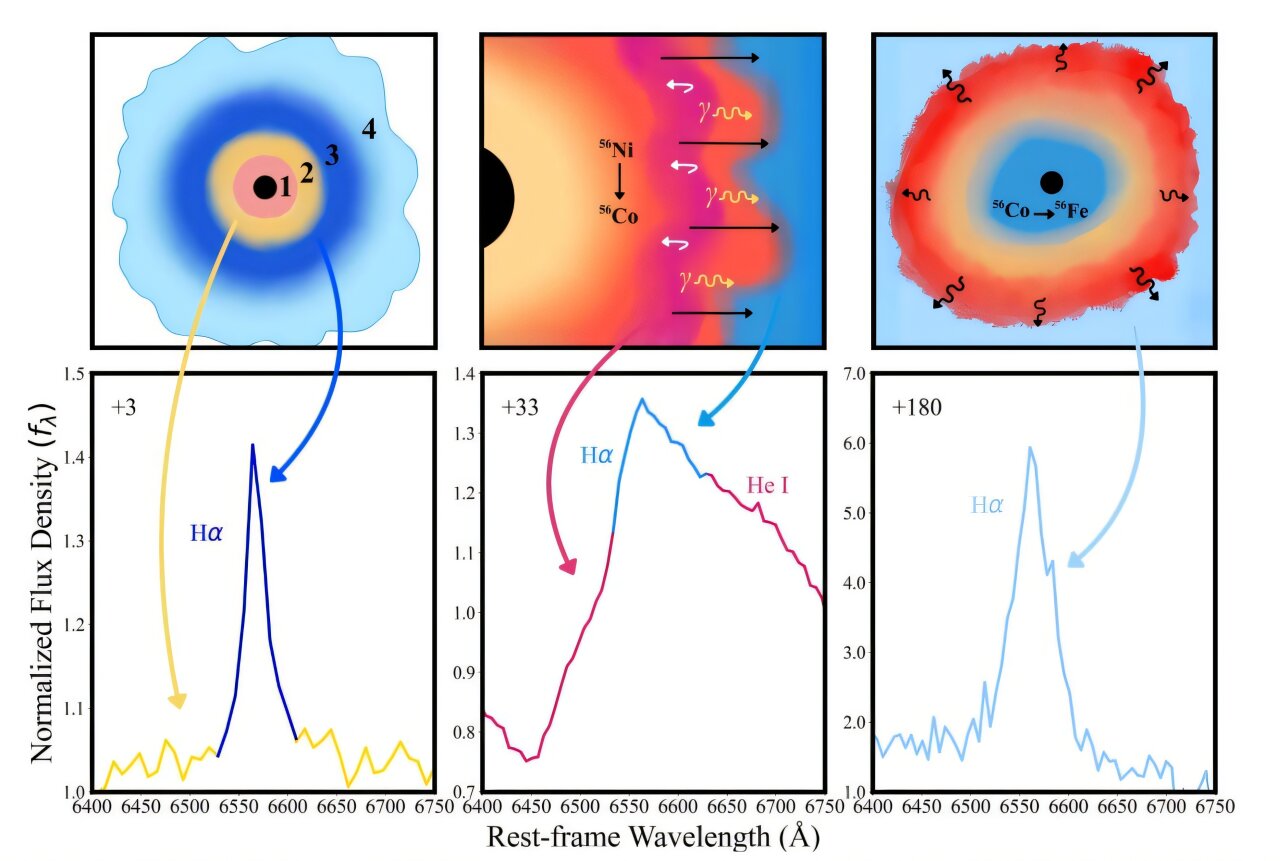
Understanding the Unique Nature of SN 2021ukt
Astronomers from the University of California, Berkeley and other institutions have conducted a detailed study of a unique supernova known as SN 2021ukt. This particular event has shown a rare transition from Type IIn to Type Ib, offering new insights into the life cycles of stars. The findings from this research were shared on the arXiv pre-print server and provide a deeper understanding of this celestial phenomenon.
The Role of Supernovae in Astronomy
Supernovae are among the most energetic events in the universe, marking the explosive end of certain types of stars. These events are crucial for scientists because they help reveal information about the evolution of stars and galaxies. In general, supernovae are categorized based on their atomic spectra: Type I, which lacks hydrogen lines, and Type II, which includes hydrogen spectral features.
Type IIn supernovae are a specific group that shows narrow emission lines, typically due to interactions between the ejected material from the explosion and dense circumstellar media (CSM) formed by the star before its demise.
Discovery and Observations of SN 2021ukt
SN 2021ukt, also referred to as ZTF21abpxquj, was first observed on July 31, 2021, by the Zwicky Transient Facility (ZTF). It was located in a galaxy called UGC 505, at a redshift of 0.0128. A team of researchers led by Neil R. Pichay from UC Berkeley used optical spectroscopy and photometry to analyze this supernova. They utilized ground-based telescopes such as the University of Hawai'i 2.2-m telescope and the Las Cumbres Observatory (LCO).
First Known Transition Between Supernova Types
One of the key findings of the study is the detection of persistent hydrogen-alpha emission, along with early-time light curves that show a plateau lasting approximately 25 days. These observations suggest ongoing interaction with extended, hydrogen-rich material that may have been stripped from the progenitor star before its explosion.
The evolution of SN 2021ukt from a CSM-dominated phase to an ejecta-dominated phase indicates a rare transition from its original classification as a Type IIn to either a Type Ib or possibly a Type IIb. This makes SN 2021ukt the first known supernova to undergo such a transition.
Insights into the Progenitor Star
The study also provided important details about the mass of the progenitor star of SN 2021ukt. It was determined that the star had a zero-age main-sequence (ZAMS) mass of around 12 solar masses. Additionally, the amount of radioactive nickel synthesized in the supernova ejecta was found to be less than 0.04 solar masses. The hydrogen-rich envelope surrounding the star was estimated to be smaller than 0.05 solar masses.
"The progenitor of SN 2021ukt is unique," the authors noted. "Based on our analysis, it likely resembled an SN IIn with a lower ZAMS mass. The hydrogen-rich envelope that was stripped from the progenitor remained close enough to interact with the ejecta, resulting in relatively narrow emission lines."
Conclusion
The research on SN 2021ukt highlights the complexity and diversity of supernovae, providing astronomers with a valuable case study of a rare transitional event. As more data becomes available, future studies may further clarify the nature of this unique supernova and its implications for stellar evolution.

Posting Komentar untuk "Strange Supernova SN 2021ukt Shifts from IIn to Ib Type"
Posting Komentar