
Tracking US Insect Populations with Weather Radar
The Hidden World of Insects in the Air
Although millions upon millions of living creatures fly, feed, and reproduce in the air, this habitat has remained largely unexplored. Insects are facing increasing pressure globally due to environmental changes and human activities. However, assessing the large-scale impacts of these pressures has been difficult because traditional insect monitoring typically focuses on a limited number of species and collects data at local levels.
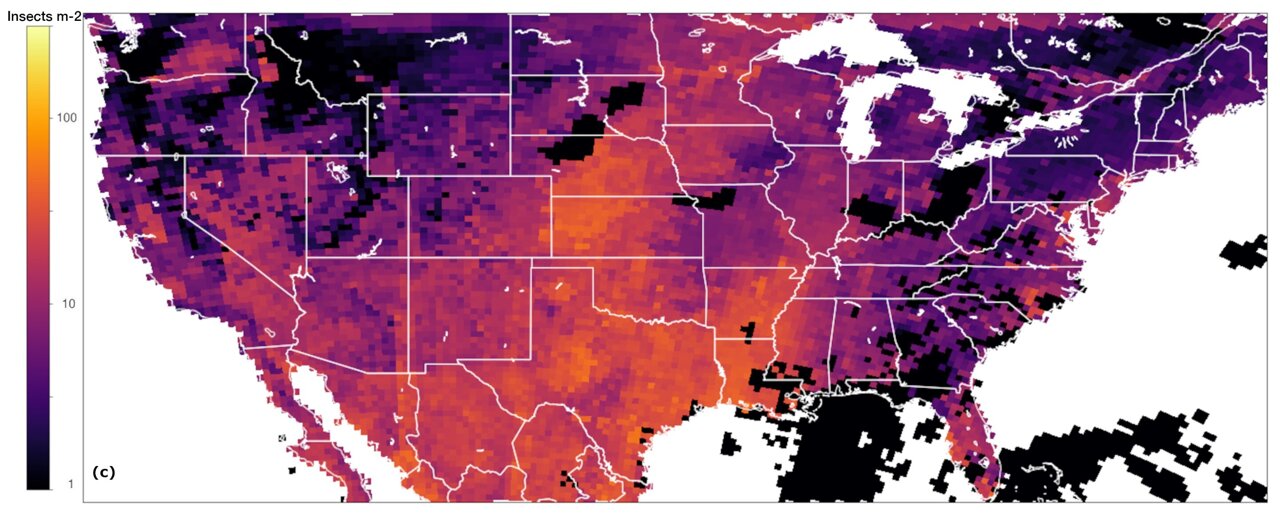
A new data source is changing this landscape: weather radar. Many countries have extensive weather radar networks that can serve as an automated, cost-effective, and large-scale method for monitoring insects in the airspace. These systems observe clouds and precipitation, but they also detect any other flying organisms in the atmosphere.
In the United States, NOAA provides weather radar data freely. Researchers such as Elske Tielens from the Swiss Research Institute WSL, Jeff Kelly from the University of Oklahoma (OU), and Phil Stepanian—formerly at OU and now at Lincoln Lab MIT—used this data to create the first global estimate of the number of insects above the U.S. mainland.
On an average summer day, approximately 100 trillion (10^14) insects, totaling millions of tons of biomass, fly over the U.S. Their findings were published in the journal Global Change Biology.
Seasonal Shifts and Temperature Trends
This study presents the first continental time series of insect abundance over a decade (2012 to 2021). While overall insect numbers remained relatively stable during this period, there were significant regional variations. About half of the radars observed an increase in insect density, while the other half noted a decline. These fluctuations were strongly linked to winter temperatures: regions with warmer winters saw greater declines in insect populations. For many insects, their life cycles—whether hatching, development, or parasite infestation—are heavily influenced by temperature.
Radar monitoring has made it possible to visualize continental patterns of flying insects for the first time, thanks to NOAA’s radar archive. However, it is not a complete solution. "It is likely that the most severe decline in insect populations already occurred between the 1970s and 1990s, before our archived data," says Tielens.
Additionally, weather radars cannot distinguish individual insect species. The stable trend across the U.S. might mask the fact that some species sensitive to environmental changes are disappearing, while common ones are increasing. "Therefore, it is essential to combine radar data with other sources like local surveys and citizen science," explains Tielens.
Despite these limitations, weather radars can provide crucial baseline data on insect populations, which can help build future time series. In the Global South, there are far fewer surveys of insect fauna compared to Europe and North America. By analyzing older radar data with new computational models, historical changes in insect populations may also be uncovered, according to the authors.
Future Implications and Research Directions
The use of weather radar offers a promising approach for studying insect populations on a large scale. It allows scientists to track trends across entire continents, something that was previously impossible with traditional methods. This data can inform conservation efforts and help understand the broader ecological impacts of climate change.
However, researchers emphasize the need for complementary data sources. Local surveys, citizen science initiatives, and direct observations can provide more detailed insights into specific species and their behaviors. Combining these methods with radar data will give a more comprehensive picture of insect population dynamics.
As technology advances, the potential for using weather radar to monitor biodiversity continues to grow. With further research and collaboration, this tool could play a vital role in protecting the often-overlooked world of airborne insects.
More information: Elske K. Tielens et al, Systematic Continental Scale Monitoring by Weather Surveillance Radar Shows Fewer Insects Above Warming Landscapes in the United States, Global Change Biology (2025). DOI: 10.1111/gcb.70587 Provided by Swiss Federal Institute for Forest, Snow and Landscape Research

Posting Komentar untuk "Tracking US Insect Populations with Weather Radar"
Posting Komentar